

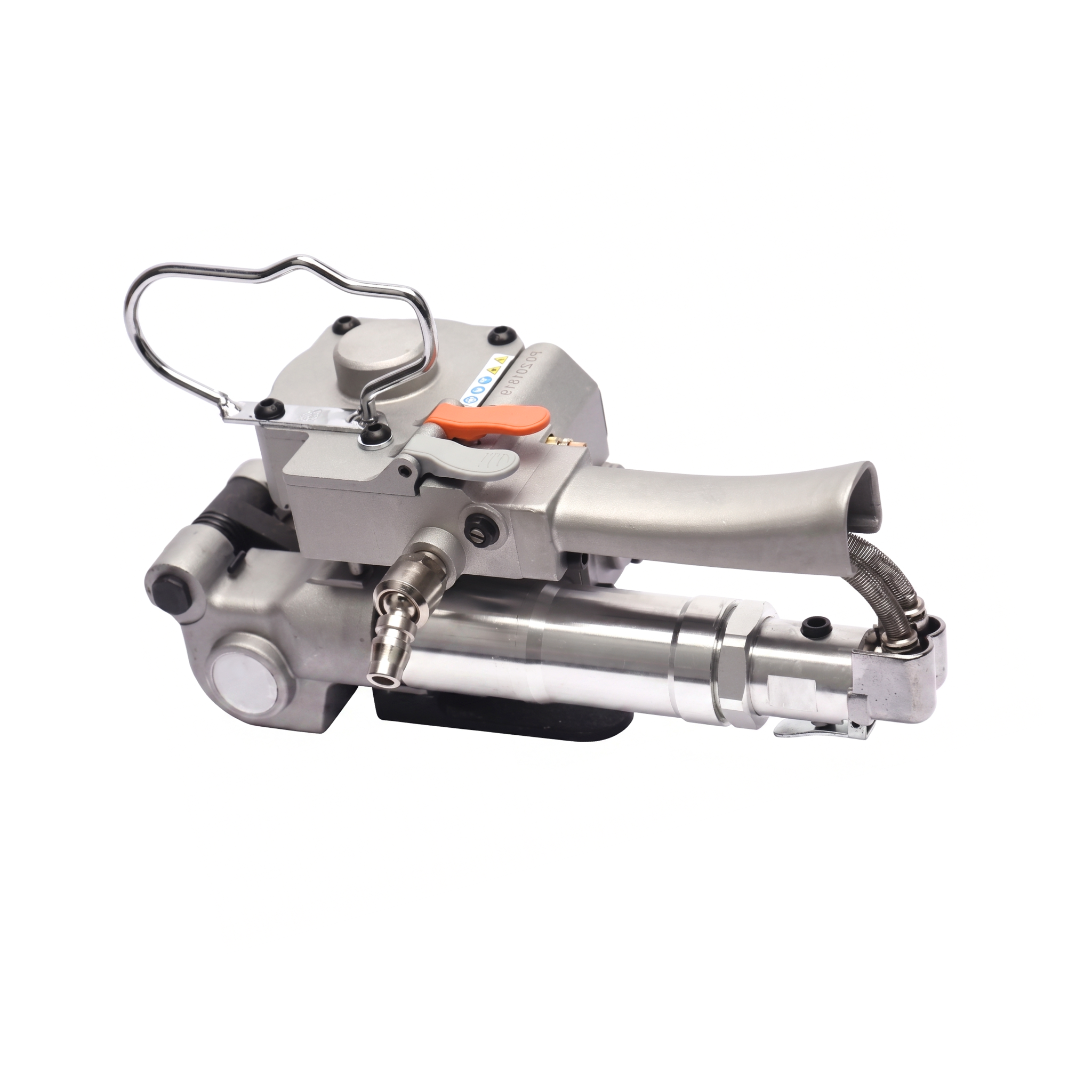
This guide covers the operation of the pneumatic strapping tool for polypropylene (PP) and polyester (PET) strapping: connecting to the compressed air line, adjusting tension and welding time according to the material, passing the strap around the bundle, automatic tensioning-welding-cutting cycle, and verifying the joint. Follow these steps for continuous strapping, without metal seals and without pauses for battery recharging.
Product Specifications
The Maxtens pneumatic strapping tool combines compressed air drive, thermal friction welding, and 3500 N of tension, in two versions depending on the strap width. The table shows the two available variants:
| Specification | 13 - 19 mm Version | 19 - 25 mm Version |
|---|---|---|
| SKU | 762144 | 762145 |
| Compatible strap width | 13 - 19 mm (1/2 - 3/4 in) | 19 - 25 mm (3/4 - 1 in) |
| Strap type | Polypropylene (PP) and polyester (PET) | Polypropylene (PP) and polyester (PET) |
| Maximum tension | 3500 N | 3500 N |
| Closing type | Thermal friction welding, no seals | Thermal friction welding, no seals |
| Operations | Tension, weld, and cut in one cycle | Tension, weld, and cut in one cycle |
| Power supply | Compressed air, 360° swivel inlet | Compressed air, 360° swivel inlet |
| Design | Separator-free, alloy base | Separator-free, alloy base |
| Brand | MAXTENS | MAXTENS |
Step-by-step Usage Guide
The procedure covers the complete cycle from connecting to the air line to the verified joint. The strapping tool integrates tensioning, welding, and cutting in a single action, but the result depends on two preparations: stable air and calibrated settings for the material.
Connect the strapping tool to the compressed air line
Attach the hose to the 360° swivel air inlet, which prevents the hose from kinking when moving the tool over the bundle. Use clean, dry air at the pressure indicated by the manufacturer on the equipment plate, and purge condensation from the line at the beginning of the shift: unstable pressure is the main cause of actual tensions below the configured setting.
Adjust tension and welding time according to the material
Configure the tool for the strap you are going to use: PP or PET, within the width range of your version (13-19 mm or 19-25 mm). The two materials require different adjustments: PET, being harder, requires more welding time and allows for higher tensions. If you alternate materials during the day, note the optimal values for each.
Calibrate with two or three test bundles at the beginning of the shift and each time you change material or strap supplier. The 3500 N is the equipment's maximum, not the universal value: loads that can be marked (boxes, bags) require less tension and corner protectors on the edges, while blocks, ceramics, and wood work close to the maximum.
Pass the strap around the bundle and join the ends
Unroll the strap from the coil (ideally on a dispenser cart), wrap it around the bundle, and ensure the two layers overlap and are aligned on the face where you will operate, with about 15 cm of margin to enter the tool. For loads with sharp edges, place corner protectors before tensioning.
Insert both layers and activate the automatic cycle
Place the two overlapping layers inside the strapping tool, between the rollers, and activate the operation buttons: the equipment tensions to the configured value, welds by thermal friction, fusing the two layers, and cuts the excess, all in a cycle of seconds. Keep the tool firm and supported throughout the entire cycle: moving it during welding produces weak joints.
Remove the strapping tool and verify the joint
Open and remove the tool and inspect the weld: melted area with regular friction marks, no gaps or separation between layers. Gently pull the closed strap: a correct joint will not separate. If it opens, increase the welding time and test on another strap before continuing the line.
Complementary Products
The pneumatic strapping tool operates without seals or buckles: its consumables are compatible plastic straps, plus accessories that protect the load and mobile backup equipment:
Polypropylene (PP) strapping is the consumable for light to medium loads; Polyester (PET) strapping is suitable for heavy palletizing that takes advantage of the 3500 N. The plastic corner protector protects edges and distributes tension in boxes and bags. The battery-powered strapping tool is the sister equipment for strapping away from the air line: on the dock, in the yard, or when loading a truck.
Maintenance and Care
For a pneumatic tool, its lifespan depends on air quality and head cleanliness. Here are the basic guidelines:
- Clean and dry air: ensure the line's maintenance unit (filter and regulator) is in good condition; moisture and particles in the air wear out internal cylinder seals and reduce actual working pressure.
- Daily head cleaning: at the end of the day, use a dry brush to remove melted strap residue and dust from the rollers and welding area; accumulated debris reduces joint quality.
- Regular roller inspection: with intensive use, inspect the tension roller wear every 2-3 months; a worn roller delivers uneven tensions and is a consumable part for scheduled replacement.
- Service for consistent failures: if joints are weak despite correct adjustments and stable air, stop the equipment and contact technical service; forcing a defective head exacerbates the damage.
- Storage and hose: store the strapping tool on a flat surface or hung from its support, disconnected from the line, and do not transport it by pulling the hose: pulling damages the swivel coupling.
Do not use straps other than PP or PET, or outside your version's width range (13-19 mm or 19-25 mm): friction welding is dimensioned for these thermoplastics and widths; other materials will not melt and can damage the head. Also, do not operate with unstable air pressure or an unpurged line: the actual tension falls below the configured setting, and the seal will be weak even if the cycle appears normal.
Frequently Asked Questions
Pneumatic or battery-powered: which is right for my operation?
The pneumatic tool is ideal for fixed workstations with an air line: it works continuously as long as there is pressure, without recharging pauses or loss of capacity with intensive use, perfect for continuous palletizing lines. The battery-powered strapping tool is advantageous where hoses cannot reach: docks, yards, and itinerant strapping. In large plants, it is common to have both: pneumatic for inline operations and battery-powered for mobile use.
What air pressure does it need to work properly?
The pressure indicated by the manufacturer on the equipment plate, supplied by an industrial line with a filter and regulator. More important than the specific value is stability: pressure drops mid-shift (small compressor, long and thin hoses, leaks in couplings) result in actual tension below the configured setting and irregular welds without the operator noticing.
Does the friction weld joint hold up as well as a metal seal?
With professional-quality PP and PET strapping and a properly calibrated tool, a thermal friction joint can withstand tensions equivalent to those of a well-closed metal seal. The operational difference is economic: welding eliminates the recurring consumption of seals and their storage, which in high-volume continuous strapping represents significant savings per pallet, in addition to a faster cycle per bundle.
