

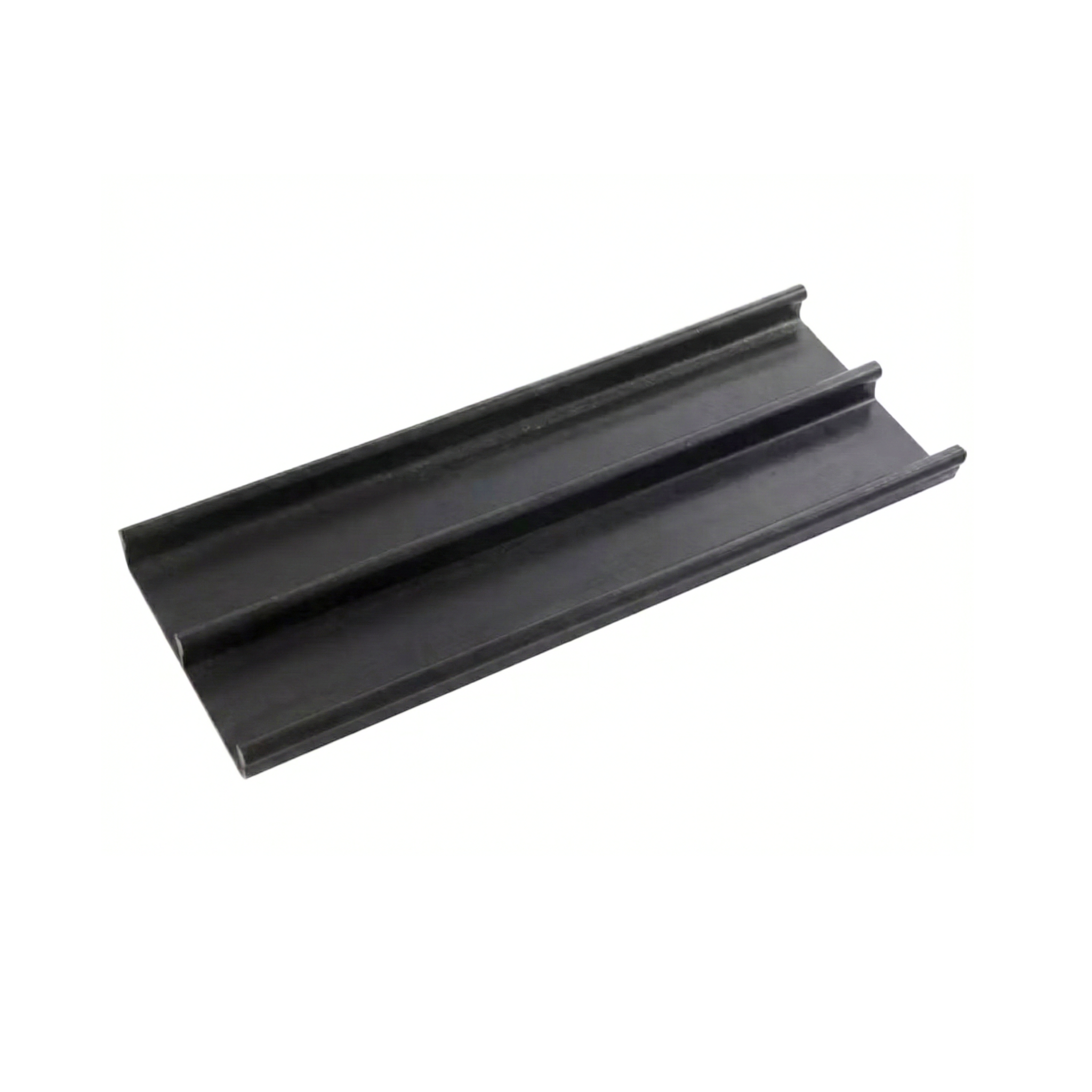
This guide covers the installation of the Poly Lock: marking the fastening line, preparing the base profile, pouring the concrete or anchoring to the wall, deploying the geomembrane up to the profile, welding to the profile and sealing the top joint. Follow these steps to anchor the geomembrane to concrete at the edges of a pond, wall or structure without perforating the sheet.
Product specifications
The Poly Lock is a polyethylene profile with a T-shaped or trapezoidal section designed to be embedded in concrete during pouring or anchored to hardened concrete. The protruding flange receives the geomembrane, which is mechanically trapped between the profile and a counter-flange fastened with a screw. The seal is watertight and resists both hydrostatic pressure and differential movements between the membrane and the concrete.
| Specification | Poly Lock |
|---|---|
| Material | Polyethylene (PE) |
| Fastening type | Mechanical with screw |
| Application | Geomembrane – concrete seal |
| Compatibility | HDPE geomembrane and similar |
| Service life | Permanent (non-biodegradable) |
Step by step
The Poly Lock supports two installation modes: embedded during the pouring of fresh concrete or mechanically anchored to hardened concrete. Embedded installation is more watertight and professional, but requires planning with the civil works. Anchoring to dry concrete is feasible when the wall is already built.
Mark the fastening line
Use chalk to trace the horizontal line along which the Poly Lock profile will run. It is usually placed 10 to 15 cm (4 to 6 in) above the maximum expected liquid level. This level is what defines how far the geomembrane rises before transitioning to the concrete.
Prepare the base profile
If you are going to embed the profile in fresh concrete, fasten the Poly Lock to the inner formwork of the wall before pouring, with small nails or double-sided tape. Make sure the flange faces the geomembrane side. If you are going to anchor to hardened concrete, mark and drill fastening points every 30 cm (12 in).
Pour the concrete or anchor to the wall
In embedded installation, pour the concrete into the wall and let it set; when the formwork is removed, the profile is integrated into the wall with the flange protruding. In anchored installation, fasten the profile with stainless steel screws and expansion plugs to the previously drilled points, with a butyl mastic joint between the profile and the concrete.
Deploy the geomembrane up to the profile
Raise the edge of the geomembrane until it fully covers the flange of the Poly Lock, leaving a 5 cm (2 in) margin above. The geomembrane must lie flat over the flange, with no folds or wrinkles, in full contact with the surface of the profile.
Weld the geomembrane to the profile
Use an extrusion welding machine with HDPE welding rod to fuse the edge of the geomembrane against the flange of the Poly Lock. Material compatibility (both polyethylene) ensures molecular fusion. Inspect the bead to detect points without penetration.
Seal the top joint
Apply polyurethane mastic on the top edge, where the edge of the geomembrane meets the concrete above the profile. That band prevents surface water from getting in behind the Poly Lock and compromising the fastening over time.
Whenever the civil works allow it, plan for embedded installation rather than anchoring to hardened concrete. The embedded method requires no additional screws, plugs or mastics: the profile is integrated into the wall itself and the fastening is permanent. The difference in appearance and durability is significant, especially in audited hydraulic works.
Do not fasten the geomembrane to the concrete with screws directly, without a Poly Lock. Each screw perforates the geomembrane and becomes a leak point, no matter how many washers and mastic you add. The Poly Lock exists precisely so that the mechanical fastening never goes through the waterproof sheet: the screws hold the profile to the concrete, and the geomembrane is sealed against the profile by welding.
Complementary products
The Poly Lock does not work in isolation: it requires a geomembrane, extrusion welding and a compatible rod. These three complementary items are what you will need in any hydraulic work with a geomembrane – concrete transition.
The HDPE polyethylene geomembrane is the waterproofing sheet that the Poly Lock fastens to the concrete: both materials are compatible for extrusion welding. The extrusion welding machine is the indispensable tool to fuse the bead between the geomembrane and profile; without it the mechanical seal is not watertight. The HDPE welding rod is the consumable that melts during the operation; calculate the quantity per linear metre according to the machine manufacturer's specification.
Maintenance and care
A correctly installed Poly Lock is permanent and requires no maintenance. Periodic inspection focuses on verifying that the seal shows no signs of failure:
- Annual visual inspection: check the profile and the welding bead looking for cracks, detachment or the presence of moisture behind the Poly Lock. Any visible leak must be addressed before it progresses.
- No subsequent mechanical aggression: the profile protrudes from the concrete and can be struck by equipment during maintenance of the works. Flag it or protect it with a metal stop whenever possible.
- Touch-up of the top sealant: the polyurethane mastic on the top edge degrades before the rest of the system. Touch it up every 5 to 7 years to keep the barrier complete.
- Storage of uninstalled profiles: in a covered place, on a flat surface, with no heavy objects on top that would deform the flange.
Frequently asked questions
Can I use Poly Lock to fasten PVC geomembrane or only HDPE?
The polyethylene Poly Lock is compatible with HDPE and LLDPE geomembranes: both are polyethylenes and weld to each other by molecular fusion. For PVC or EPDM the fastening is not by welding but by mechanical compression with a counter-flange and rubber gasket; specific versions exist for those cases. Before buying, check material compatibility with the virtual assistant.
Is it essential to install the Poly Lock in waterproofing works with a geomembrane?
Yes, in any transition between a geomembrane and a concrete structure. It is the critical point of the whole works: if the transition fails, it does not matter that the geomembrane is perfect, there is a leak. In audited projects (landfills, industrial ponds, treatment plants) the audit requires the Poly Lock system or a certified equivalent.
Embedded in fresh concrete or anchored to the hardened wall, which to choose?
Embedded whenever the civil works allow it: more watertight, with no screws to create potential leak points and at an equal or lower material cost. Anchoring to hardened concrete is reserved for existing works where the wall is already built, or for repairs. The embedded method is planned ahead of time: you have to coordinate with the formwork crew and the timing of the pour.
