

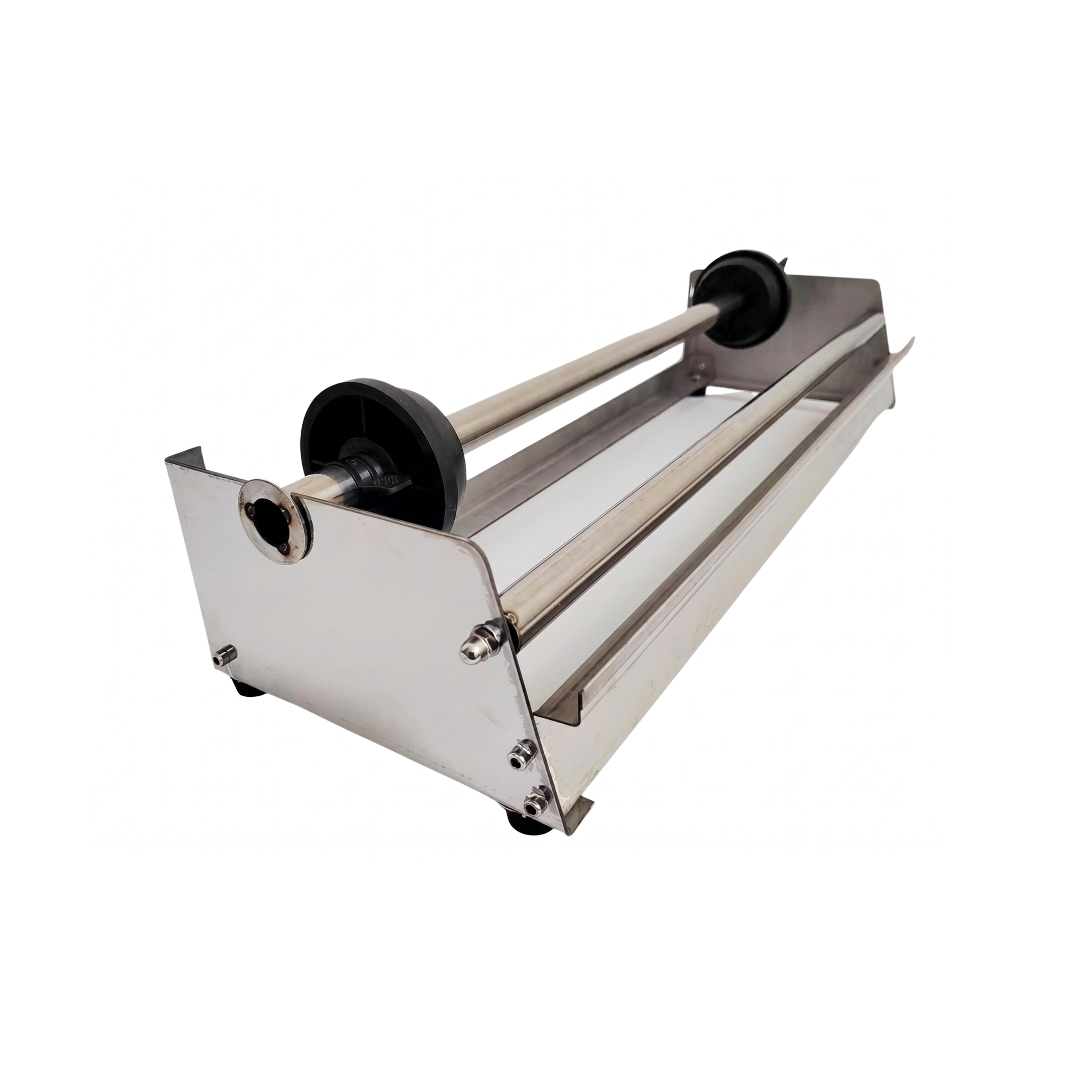
This guide covers the setup of the tabletop dispenser for stretch film or netting: choice of mounting (workbench or wall), loading the roll onto the roller, adjusting the positioning rings, and dispensing technique for wrapping boxes, parcels, and small packages. Follow these steps to transform your packing station into an agile, consumption-controlled setup.
Product Specifications
The dispenser is made of stainless steel by Fortemo, with a smooth-turning roller and adjustable positioning rings. The product has a single variant, so the instructions in this guide apply fully to your unit. Here are the technical data:
| Specification | Value |
|---|---|
| SKU | 439563 |
| Material | Stainless steel |
| Compatible roll width | Up to 500 mm (20 in), film or netting |
| Compatible core | 76 mm (3 in) standard · 50 mm with optional adapter |
| Maximum roll diameter | 175 mm |
| Roller | 22 mm diameter × 625 mm length |
| Dimensions | 620 × 200 × 125 mm |
| Net weight | 2.15 - 2.60 kg |
| Mounting | Tabletop or wall-mounted |
| Brand | Fortemo |
Step-by-Step Usage Guide
The setup is done only once; after that, daily operation is reduced to pulling, wrapping, and cutting. The steps cover everything from choosing the mounting method to having the film end ready for the next parcel:
Choose your mounting: on the table or wall-mounted
On the workbench, the dispenser is mobile and can be repositioned according to the task. Wall-mounted frees up table space and keeps the roll at a constant working height, the usual configuration in tight picking stations. For wall mounting, use anchors suitable for your wall: the assembly with a full roll can exceed 4 kg (8.8 lbs) in use.
Load the roll onto the roller
Insert the film or netting roll (up to 500 mm wide and 175 mm diameter) onto the roller, with the cling side of the film facing the package as it unwinds. Standard 76 mm cores fit directly; for rolls with 50 mm cores, use the optional adapter—never let the loose roll wobble on the spindle.
Adjust the positioning rings
Center the roll on the roller and move the adjustable rings until they hold it laterally without impeding its rotation. Properly adjusted, the roll turns smoothly, and the film dispenses flat; if too loose, the roll shifts when pulled at an angle, and the film edge comes out creased.
If your station processes parcels all day, mount the dispenser on the wall right at the edge of the table, with the roller parallel to the work surface: the operator pulls the film straight towards themselves, without twisting their torso, and the roll doesn't take up packing space. This is the ergonomic setup that provides the most efficiency in picking.
Dispense and wrap with tension from your hands
Pull the film with both hands and rotate the box or parcel on the table while the low-resistance roller dispenses the material evenly, without jerking. You control the tension by pulling: the film should stretch slightly and stick due to its cling, with a half-overlap between passes, just like in palletizing.
Cut and prepare the end
Press the end of the film against a previous layer to activate the cling and cut with scissors, a packing knife, or the optional film cutter. Leave the end of the roll resting on the roller or with a folded tab: finding the start for the next parcel should take no more than a second.
Complementary Products
The tabletop dispenser is the foundation of the packing station; these products are the rolls it dispenses and the sister tool for when the load grows:
The Transparent Manual Stretch Film is the standard 45 cm roll that this dispenser uses daily. The Manual Stretch Netting is the ventilated alternative for products that need to breathe. The Telescopic Dispenser takes over when what needs to be wrapped is no longer a box on the table but a full tall pallet.
Maintenance and Care
The stainless steel and simple mechanics of the dispenser require minimal but consistent maintenance:
- Roller cleaning: Wipe the roller and its axle with a dry cloth every week; accumulated dust at the ends is the primary cause of stiff rotation and jerking during dispensing.
- Ring and fastening inspection: Check that the positioning rings maintain their tightness and, for wall mounting, that the anchors remain firm; repeated pulling of the film can loosen screws over months.
- Free rotation before each shift: Spin the empty roller by hand; if it feels rough or slows down, clean the ends of the axle before loading the roll, never force it with the roll mounted.
Do not force out-of-range rolls: more than 500 mm wide or 175 mm in diameter will rub against the structure, causing jerky dispensing, and a 50 mm core mounted without its adapter will wobble on the roller and misalign the film. Verify your roll format before buying in bulk.
Frequently Asked Questions
Is it suitable for food films with a dispensing box?
It's not necessary: food-grade films (PE and PVC) come with their own dispensing box and cutter, designed for countertop use. This dispenser is designed for rolls of logistic stretch film and netting, which do not come with a dispenser and are handled by tension and cling.
Can I mount other rolls besides stretch film or netting?
Any roll with a 76 mm (or 50 mm with an adapter) core within the specified measurements will turn on the roller, but the dispenser is designed for materials that are dispensed by continuous pulling, such as stretch film and netting. For adhesive tape, kraft paper, or other materials requiring cutting per service, there are specific dispensers with blades and brakes.
What is the difference compared to a two-handle manual dispenser?
The workstation. The tabletop dispenser fixes the roll at the station, and you move the box or parcel; this format is for shipping boxes and small packages in continuous flow. The two-handle manual dispenser (or telescopic dispenser) holds the roll in your hands, and you walk around the load; this format is for pallets. Many operations use both, one per station.
