

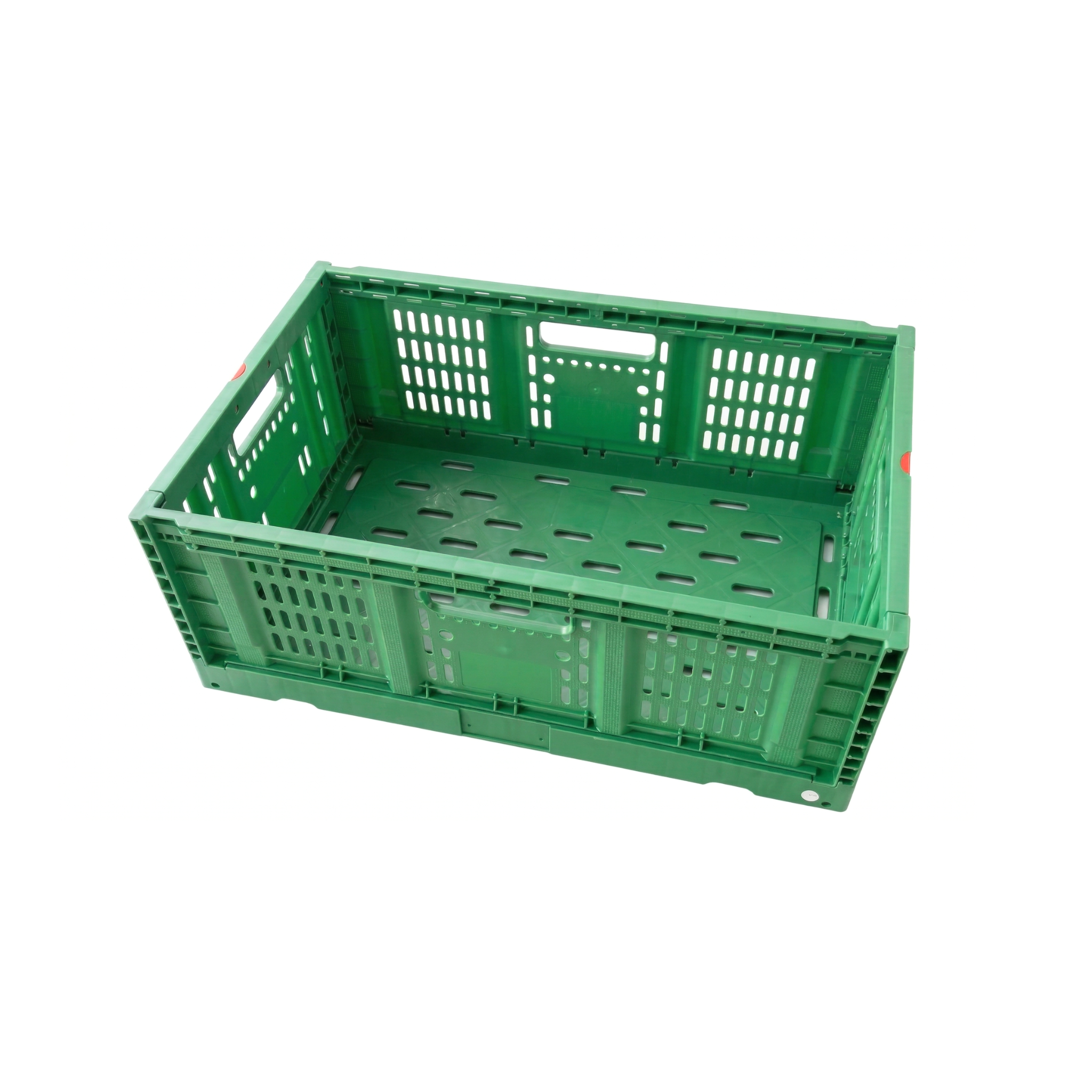
If you harvest fresh fruits, vegetables or produce for direct transport to a packing house or distribution center, run a supermarket or wholesale market where fresh produce turns over with a constant ventilation requirement, manage reverse logistics of containers between farm and processing plant, or store in a cold room with airflow between levels, the CARGOBO folding ventilated plastic crate with slotted walls and folding to 25% of its volume is the tool calibrated for those scenarios. This guide explains how to assemble the crate correctly, how to harvest delicate fruit without damaging it, how to stack during transport, how to leverage folding to multiply the return truck's capacity, and how to disinfect between seasons to maintain food safety.
The folding ventilated crate is the specific format for fresh produce with a ventilation requirement. For solid to mass bulk (cereals, fertilizers, gravel, table sugar) in larger volume, the choice is open-top flat-bottom big bags. For packaged non-perishable dry goods or cardboard boxes with conventional palletizing, 3-runner plastic pallets offer a robust platform without the ventilated geometry that is functional here.
Product specifications
The folding ventilated crate is offered as a single variant calibrated for agricultural harvest, fresh fruit logistics and supermarket turnover. The following table sets out the complete technical specifications:
| Specification | Value |
|---|---|
| SKU | 412356 |
| Material | Injection-molded HDPE with UV treatment |
| Color | Green |
| Geometry | Slotted walls on all four sides, base with drainage perforations |
| Unfolded dimensions | 60 × 40 × 23 cm (24 × 16 × 9 in) |
| Folded volume | ~25% of assembled volume |
| Folding mechanism | Side hinges with manual locking |
| Stackable when loaded | Yes (top-bottom interlock between identical crates) |
| Pressure washing | Compatible with pressurized water, neutral soap and common disinfectants |
| Suitable for | Fruits, vegetables, produce, aromatic herbs, cut flowers |
The 25% folding factor is the economic logic of this crate: 4 folded crates take up the space of 1 assembled crate on the return truck. For an operation with 1000 crates per week between farm and packing house, that means the return truck carries 4000 containers instead of 1000, dividing the return logistics cost to a quarter. The difference between reasonable profitability and poor profitability in fresh fruit reverse logistics depends directly on this multiplier.
Step by step to use it
The following procedure covers the complete cycle: assembly, harvest, stacking during transport, cold-room storage, folding for return and disinfection between cycles.
Assembling the crate
Take the folded crate by the base, raise the two long walls to vertical position and secure them with the hinge lock (a typical click confirms correct closing). Then raise the two short walls and lock them against the long ones with the side lock. Check that all four walls are vertical and firm —a poorly assembled crate with incomplete locking gives way under the load during harvest and ruins the contained product—. For operations with field staff, train harvesters to assemble and disassemble the crate correctly: careless assembly is the origin of 80% of early hinge breakages.
Harvesting and loading the product
Distribute the fruit or vegetable without piling above the top edge of the walls —overloading forces stacking onto the fruit of the upper level, crushing the one below—. For delicate products (mango, avocado, export tomato, papaya), avoid impacts during loading by placing the fruit one by one instead of dumping it from the harvester's hat. For fruit with a petiole or peduncle (mango, orange, lemon), orient the peduncle DOWNWARD against the bottom of the crate, not upward; the sharp peduncles puncture the fruit of the upper level when the next crate is stacked. This disciplined orientation distinguishes a professional harvest from an operation with recurring transport damage.
Stacking during transport and storage
Stack the loaded crates by fitting the top rim of the lower crate with the base of the upper crate. The crate's geometry distributes the weight to the walls, not to the fruit inside, allowing safe stacking of several levels depending on the weight of the product and the firmness of the fruit. For delicate fruit (strawberry, raspberry, blackberry), reduce stacking to 4-5 levels maximum and reinforce the closure with an intermediate lid or an inverted empty crate every few levels. For robust vegetables and fruits (potato, onion, citrus), stable stacking up to 8-10 levels is feasible in a cold room on a pallet with perimeter securing using manual stretch film to prevent shifting on curves.
In a cold room, ventilated crates work correctly only if the room's airflow can pass through the slotted walls —stacking that is too compact against the room walls or against other stacks cancels circulation and makes ventilation merely cosmetic—. The professional rule is to leave aisles of at least 10 cm between stacks and between stack and wall so that cold air enters from above and descends through the crates to the floor. For fruit with high respiration heat (apple, pear, ripe mango), cross-flow between crates is what keeps the temperature uniform across the whole stack; without it, the central crates heat the product in the center while the outer ones cool, generating uneven ripening and losses.
Folding for logistics return
After unloading the product, empty the crate completely and clean off visible residues. Release the lock of the short walls, fold the short walls inward, release the lock of the long walls and fold the long ones inward as well. The crate ends up folded to 25% of its assembled volume, with a flat profile suitable for efficient stacking in the return truck. Stack the folded crates vertically without exceeding the height of the truck and secure them with strapping or film to prevent shifting during the trip. The full folding operation takes less than 30 seconds per crate for trained staff, which allows mass folding between shifts at the packing house without penalizing the main operation.
Washing and disinfection between cycles
After returning to the farm or origin, the crates are pressure-washed with water and neutral detergent, paying special attention to the hinges, the bottom corners and the wall slots —areas where vegetable juices, small pieces of fruit and organic residues accumulate, which ferment, attract fruit flies and breed bacteria—. Disinfect by immersing in a 200 ppm chlorine solution for 5-10 minutes or by applying an approved product from the fruit-and-vegetable sector according to the project protocol. Rinse with clean water and let dry in the sun before the next cycle. For export production with GlobalGAP, GFSI or similar auditing, the disinfection procedure between cycles is mandatory and must be recorded per batch.
Do not use crates assembled with partial locking or hinges that do not engage completely. A crate with poorly locked walls opens during harvest or transport and ruins the contained production —mango knocked against the truck floor, strawberry crushed by the collapse of the side wall—. Nor should you force the folding or the assembly: if the lock does not engage with the operator's natural pressure, there is residue blocking the mechanism or the hinge is misaligned by a previous knock. Resolve the problem before continuing to use the crate —clean the hinge, align the wall carefully, or remove the crate from service if the hinge is structurally damaged—. The practice of "forcing the hinge with a hammer" is the origin of irreversible breaks that take the crate out of service within a few cycles.
Complementary products
To complement the folding ventilated crate in harvest, fresh fruit logistics and cold-room turnover, the following products cover the most common adjacent needs:
The 3-runner plastic pallet is the natural palletizing base when the crates are stacked for truck transport to the packing house or distribution center. The transparent manual stretch film wraps the stack of crates on the pallet around its perimeter, preventing shifting during curves and braking and maintaining the integrity of the pallet load throughout the trip. The open-top flat-bottom big bag is the alternative choice when the harvest is of solid bulk (potato, onion in bulk, grains) in larger volume where the ventilated crate is too small. The IBC container is the complement for liquids in the agricultural operation (irrigation water, agrochemicals, liquid fertilizers) on the same farm.
Maintenance and care
Inspect each crate before use for broken or cracked side hinges (discard the crate if it compromises the locking of the walls), walls with deep cracks that compromise structural integrity during harvest, base with drainage perforations obstructed by dried residues (open them with a fine punch), and top edges with deformations that hinder interlocking when stacking. The hinges are the component most exposed to wear from continuous use: lubricate with food-grade silicone grease every few cycles to smooth folding and reduce operator effort.
For prolonged storage between seasons, keep the crates folded, clean and dry, in a covered area away from direct sunlight. Although the material has UV treatment, continuous Caribbean radiation over months progressively weakens the HDPE and especially the hinges where the thickness is smaller. Keep a record of the fleet by unit or by batch with the number of accumulated cycles, in order to schedule gradual replacement before mass breakages compromise the harvest flow in high season.
Frequently asked questions (FAQ)
How many stacking levels does it withstand when loaded?
It depends on the weight of the product and the firmness of the fruit. For robust fruits (citrus, potato, onion, apple), stacking 8-10 levels is feasible during transport and cold-room storage with no risk of structural crushing or damage to the product at the bottom. For delicate fruit (strawberry, raspberry, blackberry, very ripe papaya, half-ripe mango), reduce to 4-5 levels maximum and consider using an intermediate lid or an inverted empty crate every 2-3 levels to distribute the weight. The practical rule: the total weight on the bottom crate should not exceed that of 8-10 identical crates with product, plus a margin for inertias during transport. On a pallet, the total stacked height should not exceed 1.6-1.8 m to keep a low center of gravity and stability during curves.
Can I use it in a cold room at freezing temperatures?
The crate's HDPE maintains structural integrity at commercial cold-room temperatures (0 to 4 °C, typical for fresh fruit). For deep freezing (-18 °C or lower), HDPE becomes more brittle and a knock that would not normally break the crate at room temperature can crack it —especially at the hinges—. For long-duration frozen product it is not the optimal choice; a rigid non-folding crate or a metal crate specific for freezing is preferable. For standard refrigeration of fresh fruit, vegetables and perishable product between 0 and 12 °C, the folding ventilated crate works perfectly, maintaining the cold airflow between crates that is the main conservation factor.
How many fold-assemble cycles does it last?
With professional handling —assembling and folding without forcing, washing between seasons, storage under cover between periods of non-use, periodic hinge lubrication— a Cargobo crate offers multiple harvest seasons with many fold-assemble cycles before retirement due to hinge wear. Without that care —crates assembled with hammer blows, stored in the open, with residues jamming the hinges— the service life drops to a fraction. The initial investment in training the harvest and packing-house staff in correct assembly-folding is negligible compared to the extended service life it provides across the entire crate fleet.
