

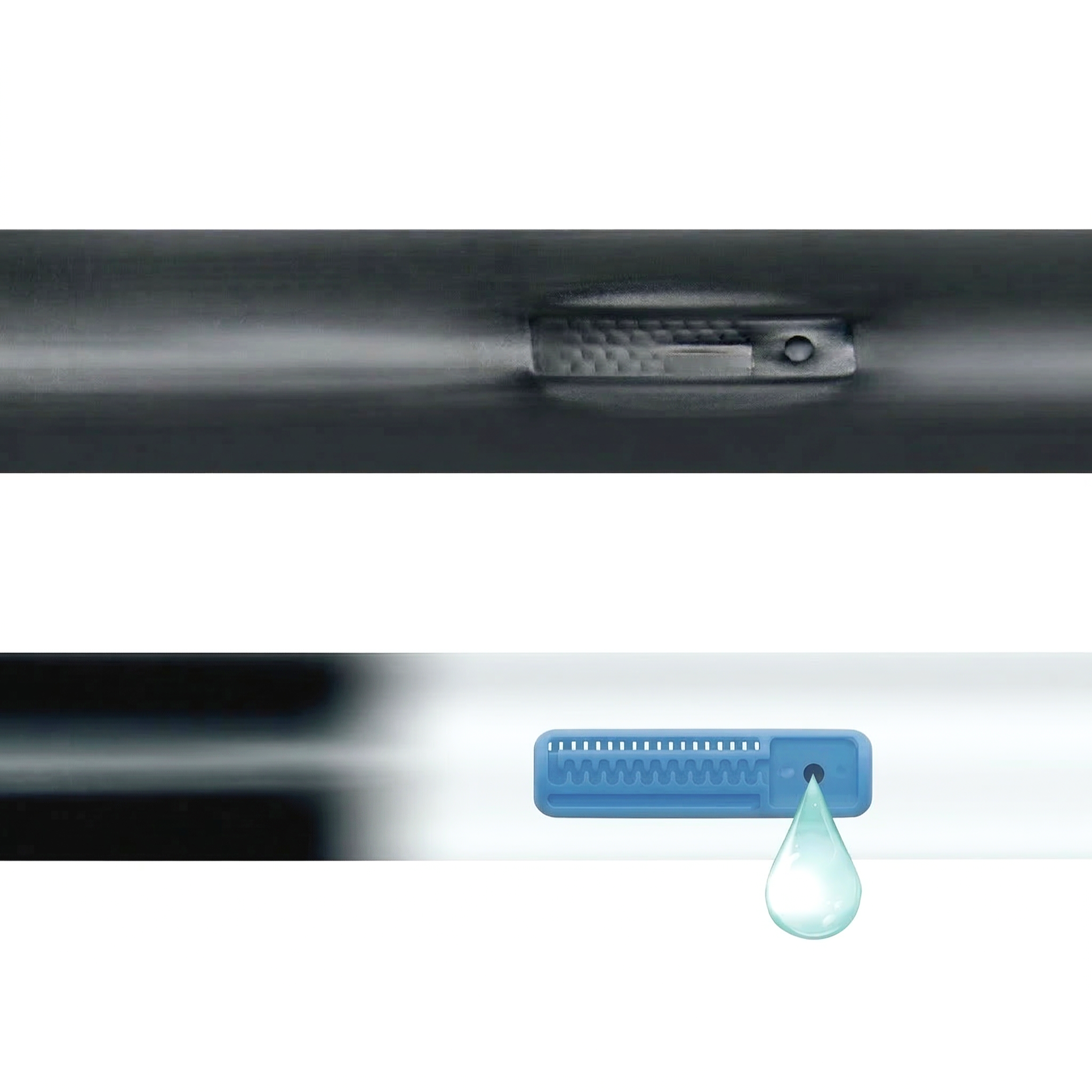
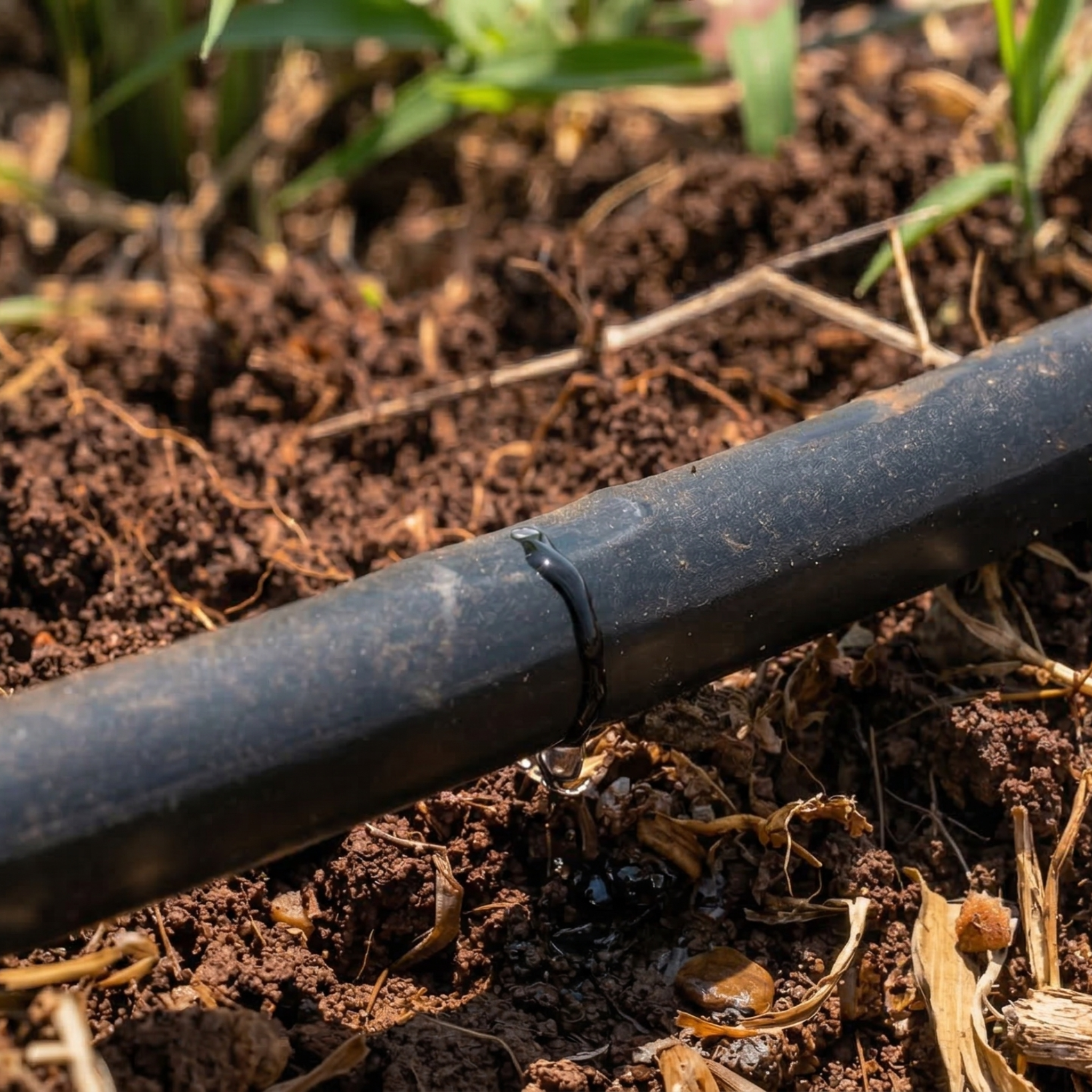
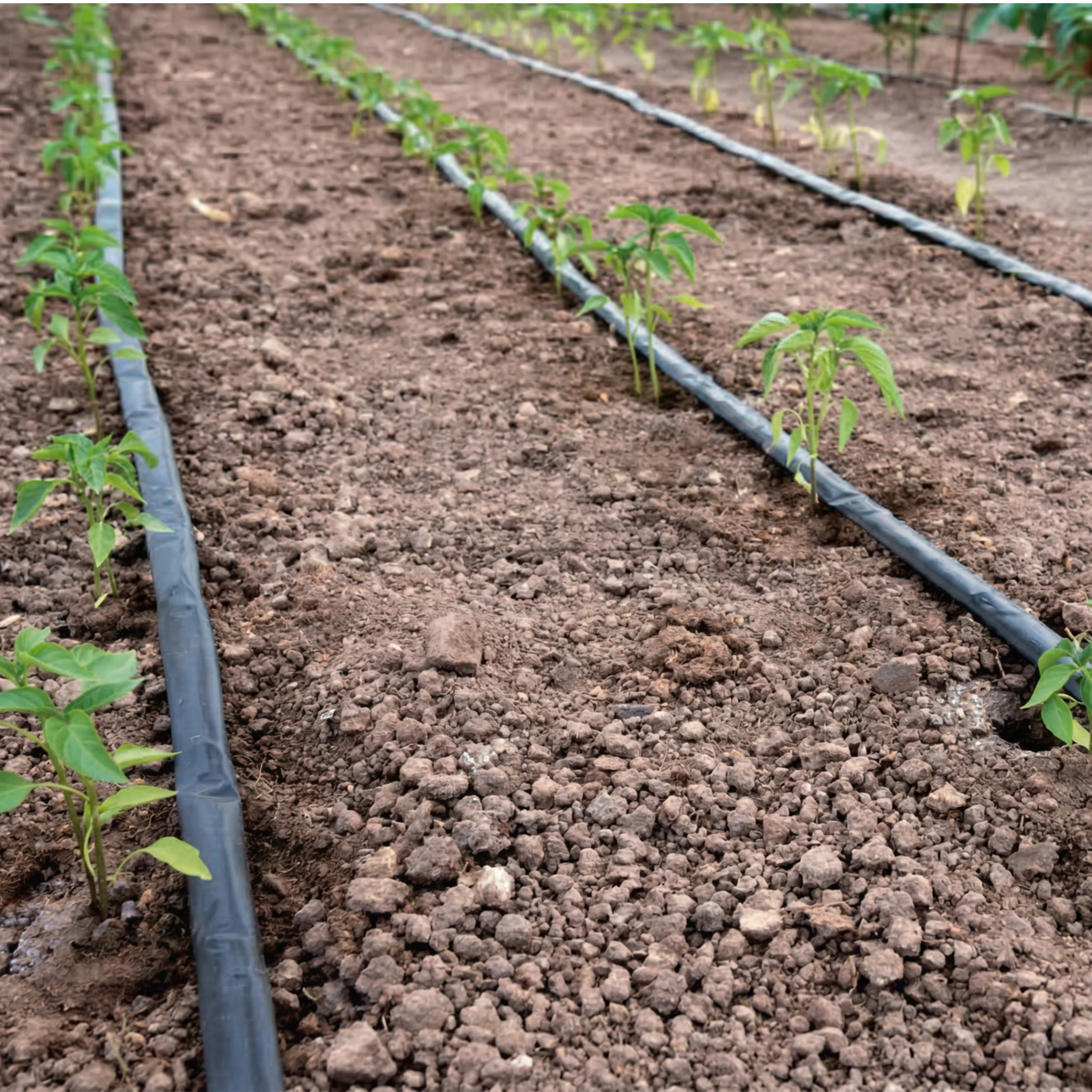


Watering row crops with maximum water efficiency, without losing water to evaporation or wetting non-productive areas, on relatively flat land and at a reasonable cost per meter, requires a flat LDPE drip tape with integrated 3D arc labyrinth emitters and controlled anti-clogging. This standard drip irrigation tape —also known as drip tape, flat drip line, or flat irrigation hose— is manufactured by Gardese from LDPE, 16 mm diameter and 0.3 mm thick (120 gauge), under ISO 9261, in two emitter spacings (20 and 30 cm) with a 1.6 L/h flow rate, in 500 m rolls, designed for vegetables, row fruit crops, export crops with drip irrigation, and professional intensive agriculture.
Key benefits
- 3D arc anti-clogging labyrinth: the internal design creates controlled turbulence that keeps fine particles in suspension and prevents sediment from settling inside the emitter, a critical condition for well or river water with the typical mineral load of the Caribbean.
- ISO 9261 compliance: manufacturing meets the international standard for flow uniformity, diameter, and spacing —an audited requirement for serious agronomic projects and export production.
- Built-in inlet filter on every emitter: the emitter's own filter protects against clogging from particles that bypass the head filter, adding an extra layer of protection to the system.
- Compatible with mechanized laying: sized for tractor unwinders with calibrated tensile strength, allowing long continuous runs in agronomic projects without breakage stoppages.
- 120 gauge (0.3 mm) for a full agricultural season: calibrated thickness that withstands months of cultivation under Caribbean radiation without becoming brittle before harvest —a lifespan engineered for seasonal agricultural use.
Typical applications and uses
- Row vegetables in greenhouses or open fields: tomato, bell pepper, cucumber, zucchini, eggplant.
- Berries such as strawberry, and leafy vegetables in intensive production.
- Export crops with controlled irrigation: pineapple, melon, watermelon, potato, tobacco, bell pepper, oil palm.
- Combined with mulching film for efficient fertigation and simultaneous weed control.
Quality and durability
An economical drip tape fails on two counts: the internal labyrinth design is simple, with no 3D turbulence (causing rapid clogging from any sediment), and manufacturing does not comply with ISO 9261 and has loose tolerances (causing heterogeneous flow between emitters and crop non-uniformity). Gardese uses a 3D arc labyrinth and the ISO 9261 standard, which separates a drip tape built for a serious agronomic project from a generic tape that fails mid-season.
The operating range is kept strictly between 0.3 and 1 bar (4.35 to 14.5 psi). Below 0.3 bar flow drops and the emitters farthest from the manifold stop emitting; above 1 bar the tape is overloaded, emitters may exceed nominal flow and the material grows brittle over time. Standard flat drip tape has no pressure compensation, so on long runs (over 100 m) or sloped terrain it pays to split into sectors with valves or use the pressure-compensating version to equalize flow end-to-end.
Minimum filtration of 130 microns (120 mesh) at the irrigation manifold — non-negotiable technical requirement. The tape has a 3D arc labyrinth and a built-in filter at each emitter, but these are sized for fine particles: sand, silt, biofilm and carbonates do pass through and clog the labyrinth. For well or river water it pays to combine a 120-mesh screen filter with a disc filter for organic-matter retention. For hard water, inspect and clean the filters often (weekly in peak season). Without proper filtration the warranty does not apply.
Yes. The tape is sized for mechanized laying with a tractor-mounted unwinder, the standard setup for large areas (several hectares). The rolls are produced in continuous lengths without intermediate joints, and the tensile strength is calibrated to avoid tearing during unrolling. For manual or small-scale laying it also works perfectly. Always unroll with the emitter side facing up and apply uniform tension to avoid twists that reduce local flow.
Three critical precautions. First: lay the tape on the leveled bed and then roll the mulch over it, not the other way around. Second: avoid water droplets forming between tape and film under sun, since they produce a magnifying-glass effect that melts and pierces the mulch. Third: keep active control over rodents and pests that chew tape buried under film (darkness draws rodents). For condensed water under the film that could scorch, check the first week and install pins or anchors along the line to keep it in soil contact.
Still have questions?
Ask us and we will gladly help you with whatever you need.
| Diameter | 16 mm (5/8 in) |
|---|---|
| Wall thickness | 0.3 mm (120 gauge) |
| Distance between drippers | 20 cm (8 in) |
| Flow per dripper (@ 1 bar) | 1.6 L/h (0.42 gph) |
| Roll length | 500 m (1640 ft) |
| Recommended working pressure | 1 bar (14.5 psi) |
| Operating pressure range | 0.3 bar - 1 bar (4.35 psi - 14.5 psi) |
| Material | High-quality polyethylene (UV resistant) |
| Dripper type | Turbulent flow labyrinth (anti-clogging) |
| Required filtration | 120 mesh (130 micron) |
| Number of drippers per roll | 2500 drippers |
| Total roll flow rate | 4000 L/h (1056.7 gal/h) |
| Maximum lateral length (on flat ground) | 72 m (236.2 ft) |
| Production standard | ISO 9261:2004 |
| Roll: Width | 56.0 cm (22.05 in) |
|---|---|
| Roll: Height | 56.0 cm (22.05 in) |
| Roll: Depth | 35.0 cm (13.78 in) |
| Roll: Weight | 22.8 kg |
Payment & Security
