

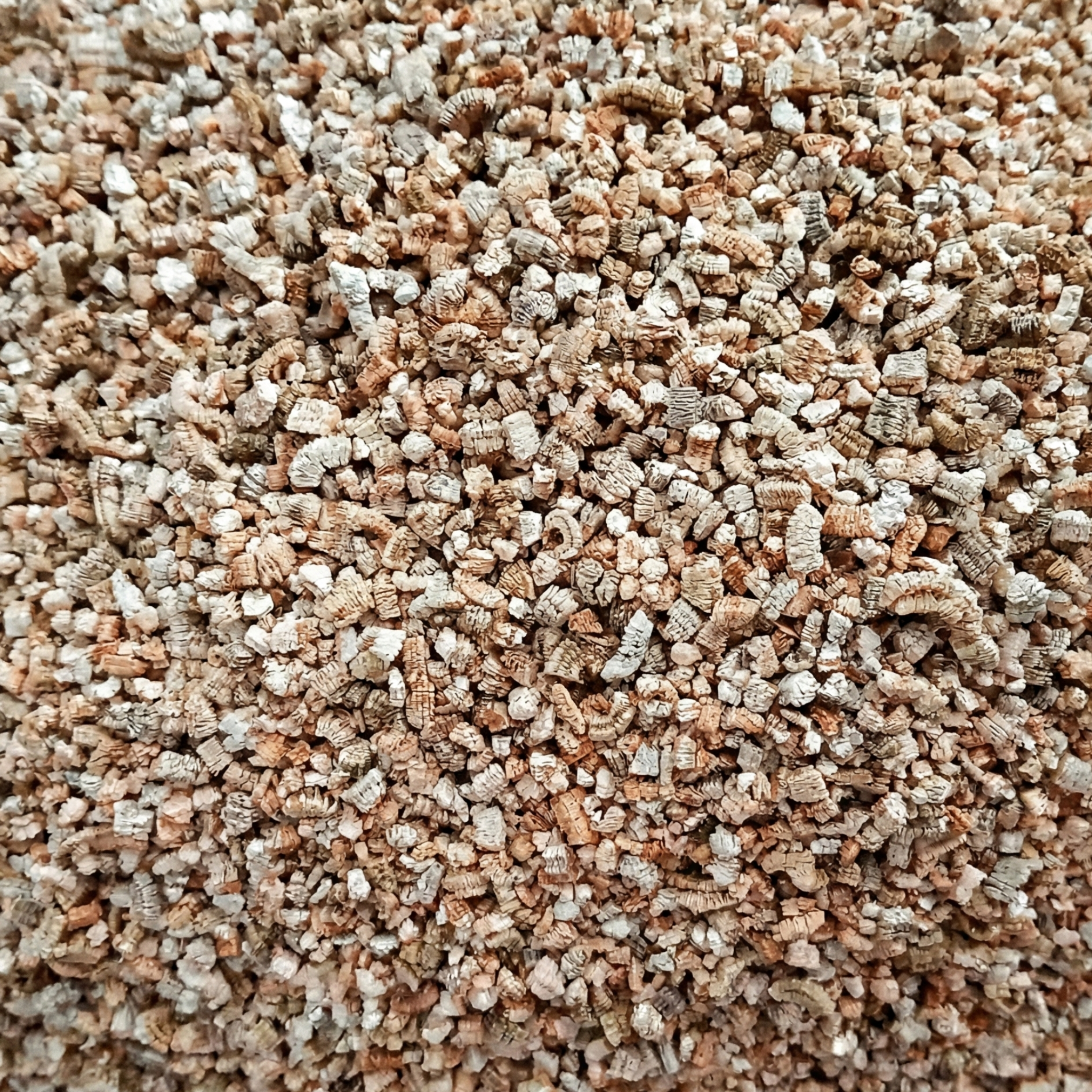


Maintaining constant humidity in professional seedbeds, retaining nutrients in delicate substrates, or ensuring uniform germination in plant production requires an expanded mineral calibrated for controlled water retention. This expanded vermiculite—also called expanded mica or expanded laminar silicate—is supplied by Gardese in 100 L bags in two granulations (Fine 1-3 mm and Medium 3-6 mm), designed for seedbeds, propagation, hydroponic mixes, nurseries, and urban gardens where water retention is a priority.
Main benefits
- Moisture and nutrient retention: the laminar structure absorbs water and nutrients and releases them slowly, keeping the substrate hydrated between waterings without waterlogging.
- Balanced aeration: provides porosity without the extreme drainage speed of perlite, an ideal condition in seedbeds where humidity must be constant but oxygen needs to be available.
- Neutral pH and chemically inert: does not alter the pH of the substrate or interfere with organic or synthetic fertilizers, making it compatible with any professional mix.
- Sterility and cleanliness: sterile inorganic mineral, free of pathogens, pests, and weed seeds, a critical condition in commercial plant production.
- Gardese controlled sourcing: modern expanded vermiculite, without the historical contaminations that affected old batches of industrial origin.
Applications and typical uses
- Seedbeds and professional germination: the Fine version retains uniform moisture around the seed during the critical period.
- Cutting propagation: facilitates rooting by maintaining constant humidity in the cut area without rotting the tissue.
- Mixes for succulents and bonsai: combined with perlite and coir for a balance of retention and drainage.
- Hydroponic substrate cultivation: inert medium that retains the nutrient solution between irrigation cycles.
Quality and durability
An economical vermiculite fails in two areas: the granulometric calibration is inconsistent and the origin can be questionable (vermiculite from some historical mines brought serious contaminations). Gardese works with modern vermiculite of certified origin and uniform calibration, which separates a safe and predictable material from a generic bag of uncertain origin.
What is vermiculite used for and when should you choose it over other substrates?
What's the real difference compared to perlite — when to choose one over the other?
Is vermiculite reusable after a crop cycle?
Is it safe — were there historical issues with asbestos in old vermiculite?
Still have questions?
Ask us and we will gladly help you with whatever you need.
| Dimensions and format | |
|---|---|
| Volume | 100 L (26.4 gal) |
| Physicochemical properties | |
| Cation exchange capacity (CEC) | High (100 - 150 meq/100 g) |
| Electrical conductivity (EC) | Very low (< 0.5 dS/m) |
| Particle size | 1 - 3 mm (0.04 - 0.12 in) |
| pH level | 7.0 - 8.0 |
| Presentation and packaging | |
| Packaging | Bag |
| Sack: Width | 65.0 cm (25.59 in) |
|---|---|
| Sack: Height | 17.0 cm (6.69 in) |
| Sack: Depth | 110.0 cm (43.31 in) |
| Sack: Weight | 12.0 kg |
Official GARDESE warranty
What's covered
Confirmed defect: replacement or refund of the amount paid.
What's not covered
Pago & Seguridad

