
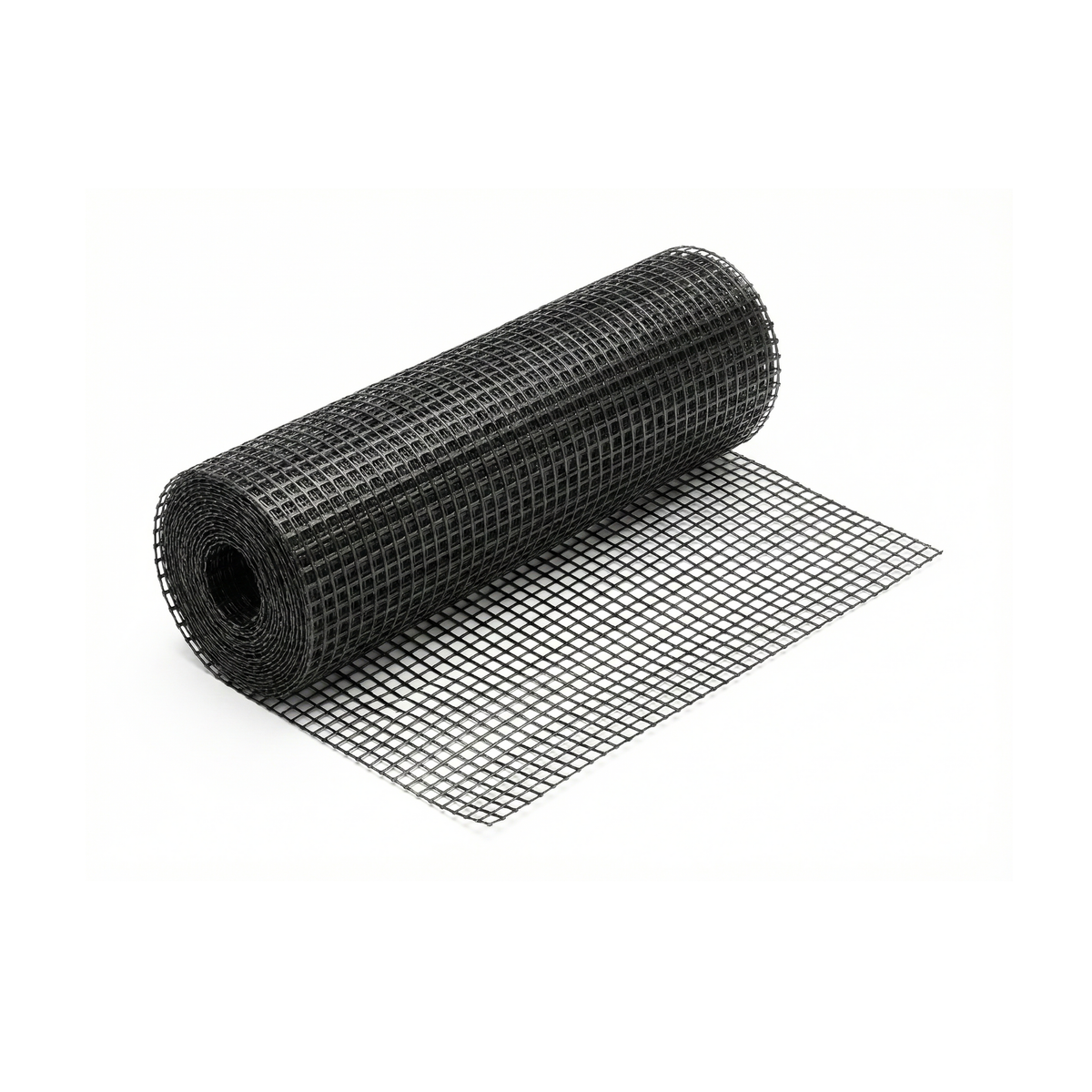
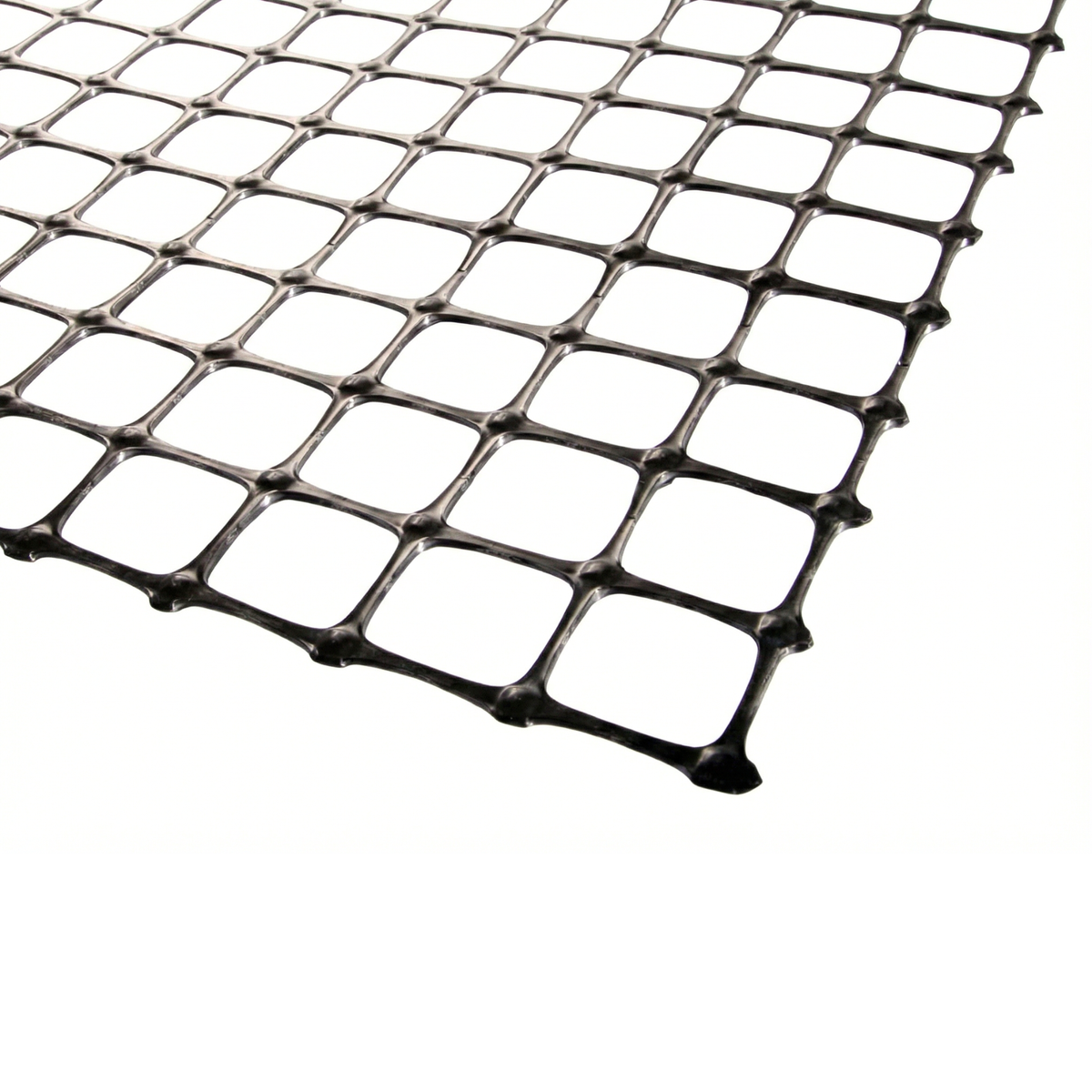
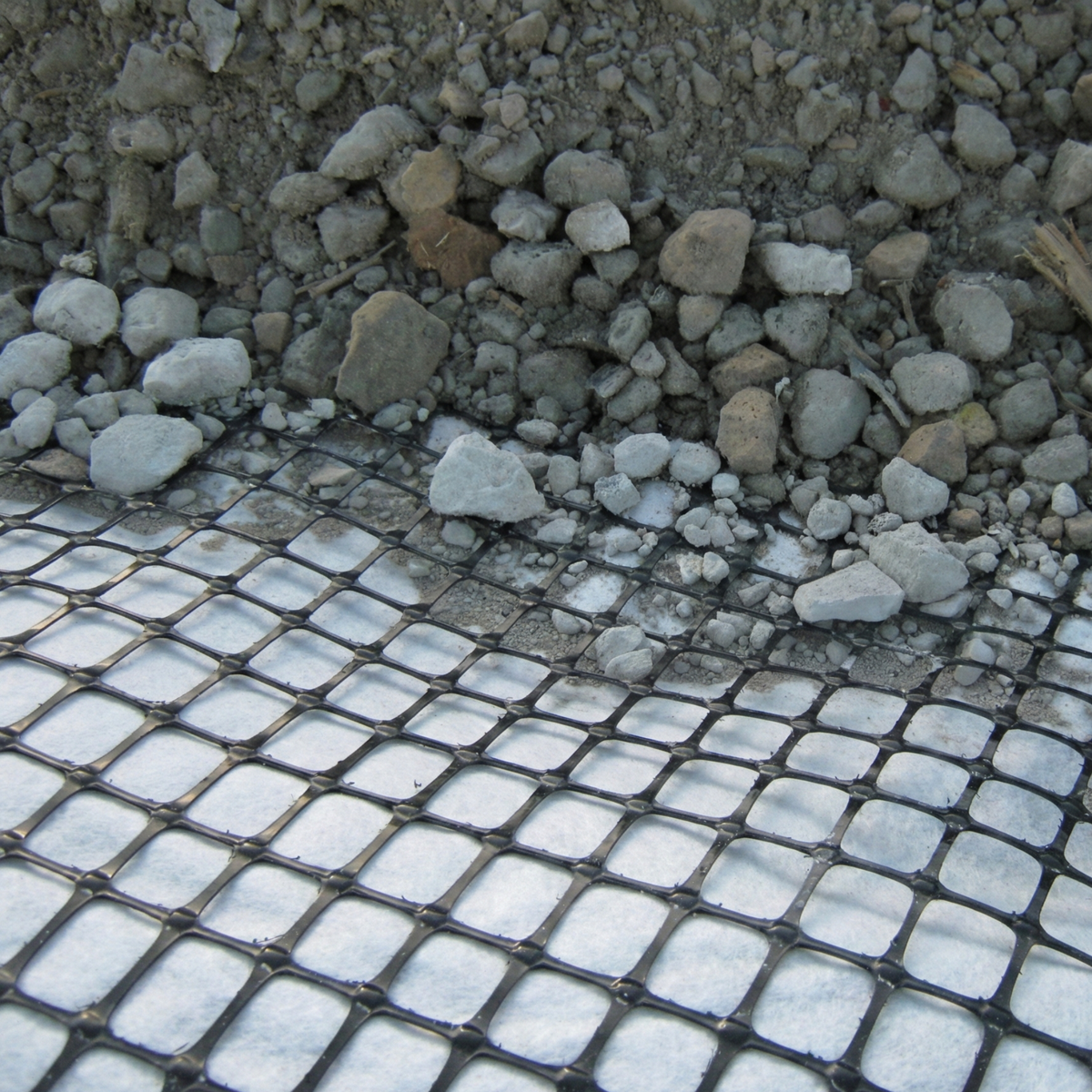
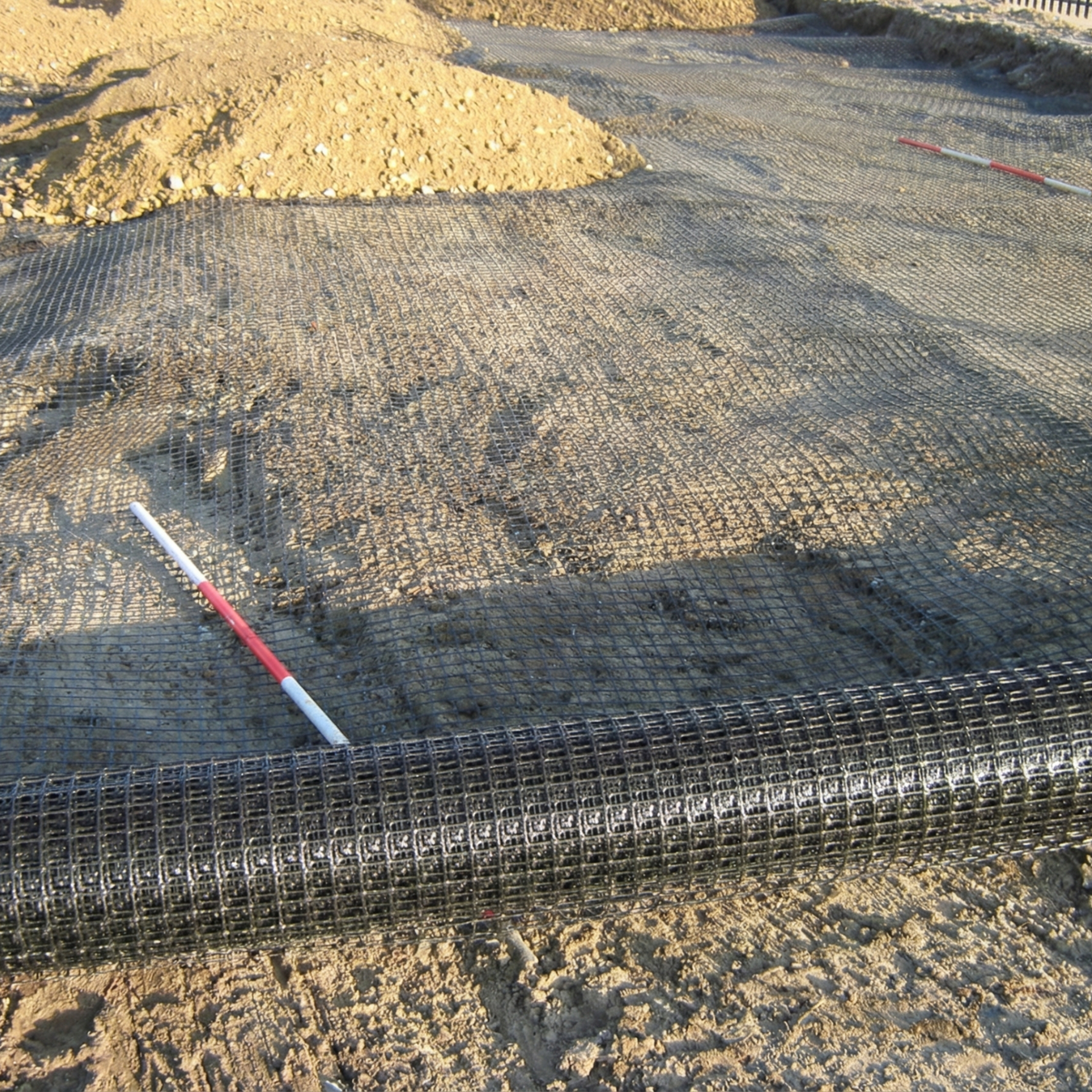



Reinforcing road bases on soft soils where gravel sinks and forms potholes in a few months, stabilizing commercial parking lots with vehicular loads dispersed in multiple directions, and reducing the thickness of expensive aggregate by saving excavation and backfill, requires extruded biaxial geogrid with tensile strength in two directions and calibrated apertures for aggregate interlock. This polypropylene (PP) biaxial geogrid—also called biaxial geogrid, biaxial geogrid or subgrade reinforcement mesh—is manufactured by MOLTEXO from extruded virgin PP and stretched in two directions, available in 20 and 40 kN/m strengths, in 6 m wide and 50 m long rolls, designed for road construction, industrial platforms, commercial parking lots, and temporary access roads during construction.
Key Benefits
- Bidirectional strength for dispersed loads: stretching in both longitudinal and transverse directions produces a mesh with tensile strength in both directions, ideal for distributing vehicular and pedestrian loads coming from multiple angles onto the pavement.
- Mechanical interlock with granular aggregates: rigid apertures confine crushed stone and gravel ("interlock"), creating a pseudo-rigid aggregate layer with significantly higher bearing capacity than unbound aggregate, a mechanism that distinguishes an effective geogrid from a decorative plastic grid.
- Savings on calibrated aggregate: allows for a reduction in base and subbase thickness, depending on soft soil conditions and required project strength, resulting in significant savings on excavation, backfill, and costs in large-scale projects.
- Chemically inert and durable PP: resists biological degradation, chemical attack from soil acids and alkalis, environmental humidity, and typical Caribbean temperatures, conditions for a service life of decades when buried.
- Rapid deployment without specialized machinery: manageable roll that is spread over the subgrade with basic equipment, a condition that significantly reduces construction times compared to alternatives with cementation or chemical soil stabilization.
Typical Applications and Uses
- Reinforcement of bases and subbases for paved roads, unpaved roads, and industrial roadways with continuous traffic.
- Stabilization of commercial parking lots, marshalling yards, industrial platforms, and heavy equipment parking areas.
- Shallow foundations on soft, swampy, or low bearing capacity soils in residential and commercial projects.
- Temporary access roads for construction sites, mining operations, and work areas with inadequate natural soil.
Quality and Durability
An economical biaxial geogrid fails in two ways: the PP is not virgin but low-quality recycled (which causes abrasion and breakage due to interaction with aggregates during spreading and compaction) and the two-directional stretching is deficient with weak nodes (which significantly reduces the actual strength compared to the declared strength). MOLTEXO works with extruded virgin PP and controlled bidirectional stretching, which distinguishes an auditable structural geogrid for construction from a generic plastic grid that appears to reinforce but provides no real bearing capacity.
Equivalences
Equivalent to these other-brand references:
- 20 kN/m (1.4 kip/ft) · Roll 6 m (19.7 ft) wide and 50 m (164 ft) long
- Tensar BX1100Tensar SS20NAUE Secugrid 20/20Maccaferri MacGrid EG20SPavco Wavin P-BX 2020LAKA Biaxial Geogrid (family)RBK Builds Geogrids (family)ECOSEA Geogrid (family)
- 40 kN/m (2.7 kip/ft) · Roll 6 m (19.7 ft) wide and 50 m (164 ft) long
- Tensar BX1200Tensar SS30NAUE Secugrid 40/40Maccaferri MacGrid EG40SLAKA Biaxial Geogrid (family)RBK Builds Geogrids (family)ECOSEA Geogrid (family)
Brands and references mentioned belong to their respective owners; cited only for comparison and compatibility.
What's the real difference between a biaxial and a uniaxial geogrid?
Can I lay asphalt or concrete directly on the geogrid?
How much aggregate can be saved by using this geogrid?
Is it resistant to water and soil chemicals over decades?
What kind of granular fill should be used over the geogrid?
Still have questions?
Ask us and we will gladly help you with whatever you need.
| Material and construction | |
|---|---|
| Material | Polypropylene |
| Dimensions and format | |
| Aperture dimension (MD/TD) | 36 / 38 mm (1.42 / 1.50 in) |
| Minimum rib thickness (MD/TD) | 1.3 / 1.0 mm (0.051 / 0.039 in) — ASTM D1777 |
| Strength and performance | |
| Strain at ultimate strength (MD/TD) | 13 / 13 % — ASTM D6637 |
| Junction efficiency (MD/TD) | 95 / 95 % — GRI GG2 |
| Aperture stability (MD) | 700 N·mm/° (6.19 lbf·in/°) — COE Method |
| Tensile strength @ 2% strain (MD/TD) | 7 / 7 kN/m (480 / 480 lb/ft) — ASTM D6637 |
| Tensile strength @ 5% strain (MD/TD) | 14 / 14 kN/m (959 / 959 lb/ft) — ASTM D6637 |
| Ultimate tensile strength (MD/TD) | 20 / 20 kN/m (1370 / 1370 lb/ft) — ASTM D6637 |
| Flexural stiffness (MD) | 1,090,000 mg·cm (15.1 oz·in) — ASTM D7748 |
| Durability and protection | |
| Minimum carbon black | 2 % — ASTM D4218 |
| UV protection | Yes (high) |
| Presentation and packaging | |
| Presentation | Roll 6 m (19.7 ft) wide × 50 m (164 ft) long |
| Standards and certifications | |
| Test methods | EN ISO 10319 (tensile strength) |
| Roll: Width | 26.0 cm (10.24 in) |
|---|---|
| Roll: Height | 26.0 cm (10.24 in) |
| Roll: Depth | 600.0 cm (236.22 in) |
| Roll: Weight | 72.0 kg |
Official MOLTEXO warranty
What's covered
Confirmed defect: replacement or refund of the amount paid.
What's not covered
Payment & Security

