
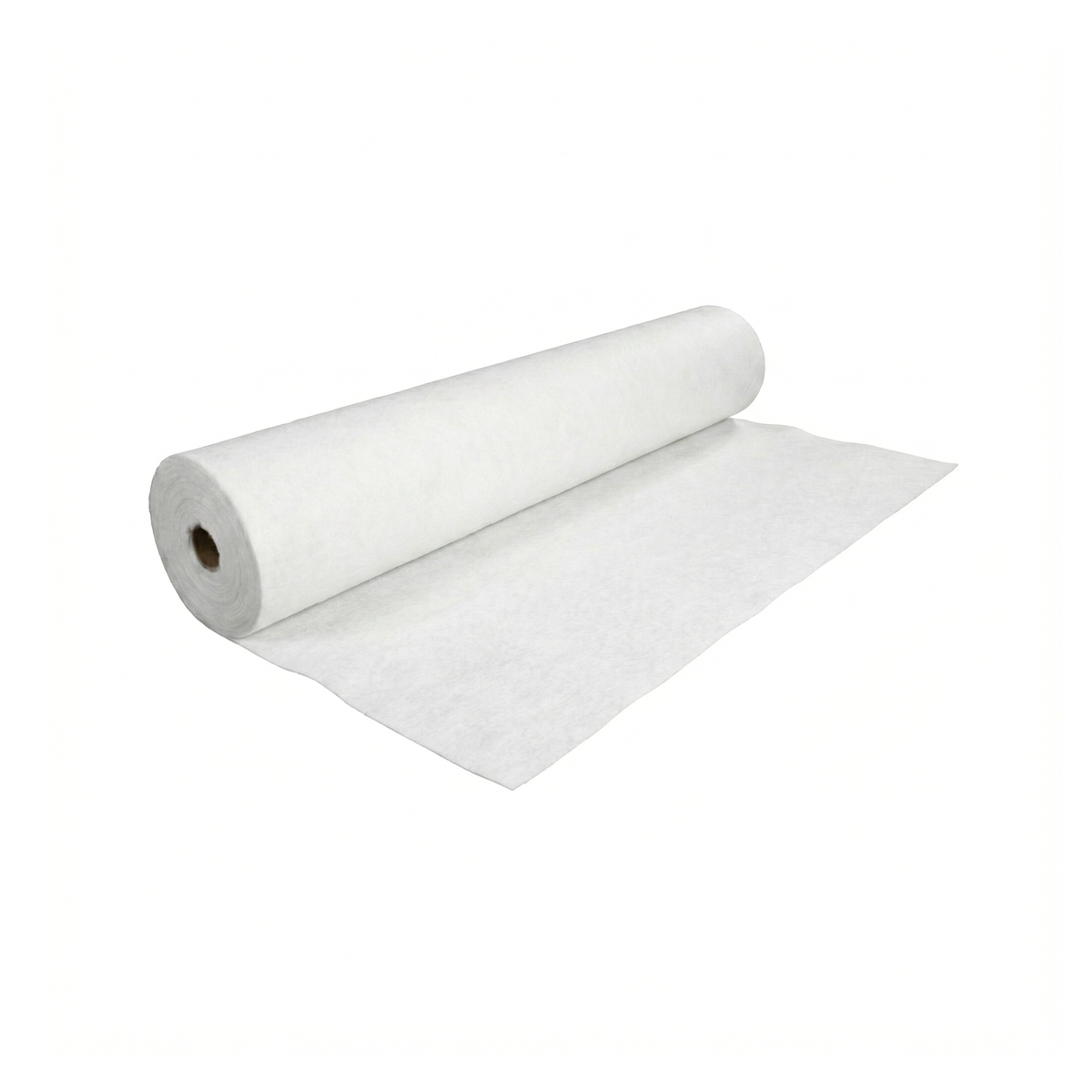
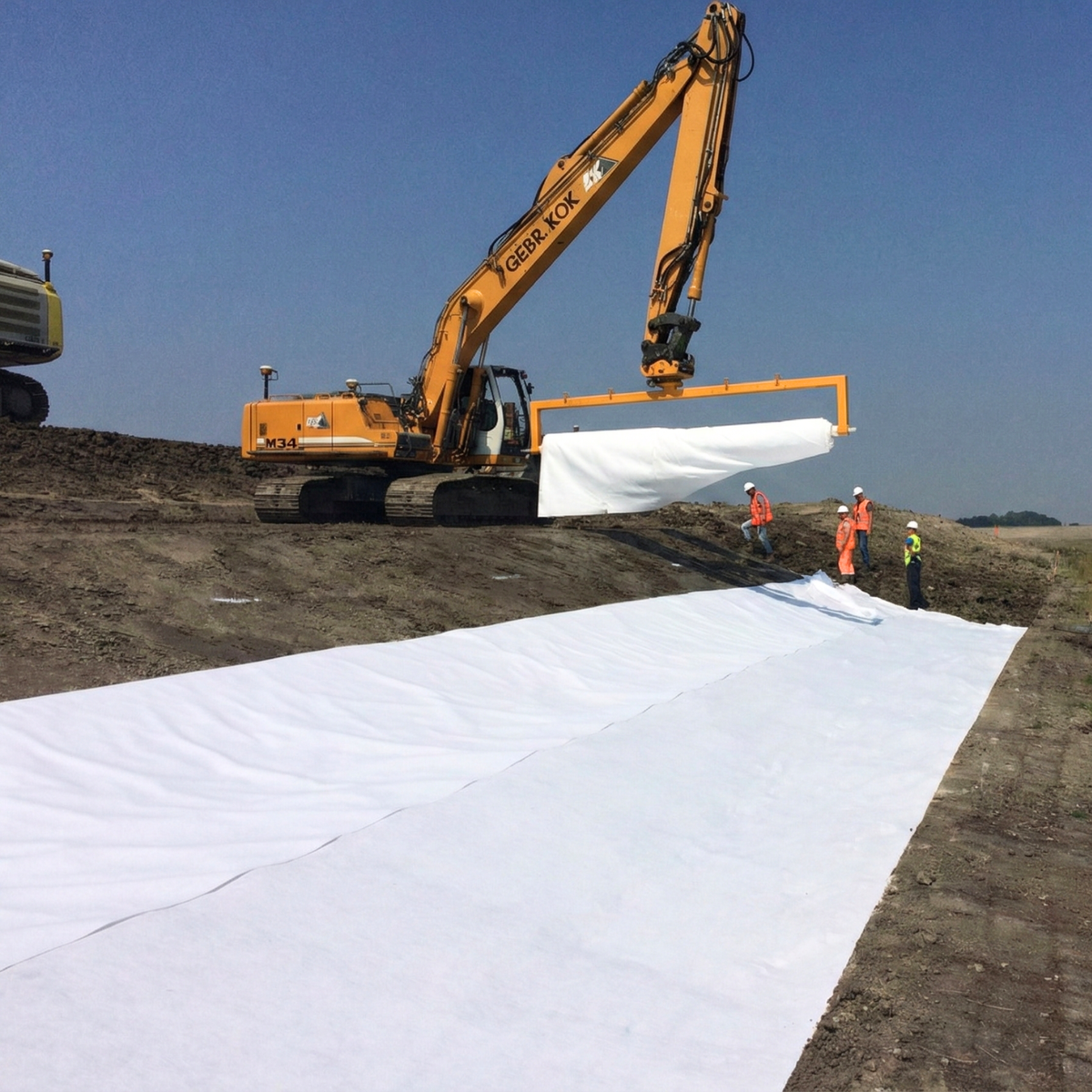
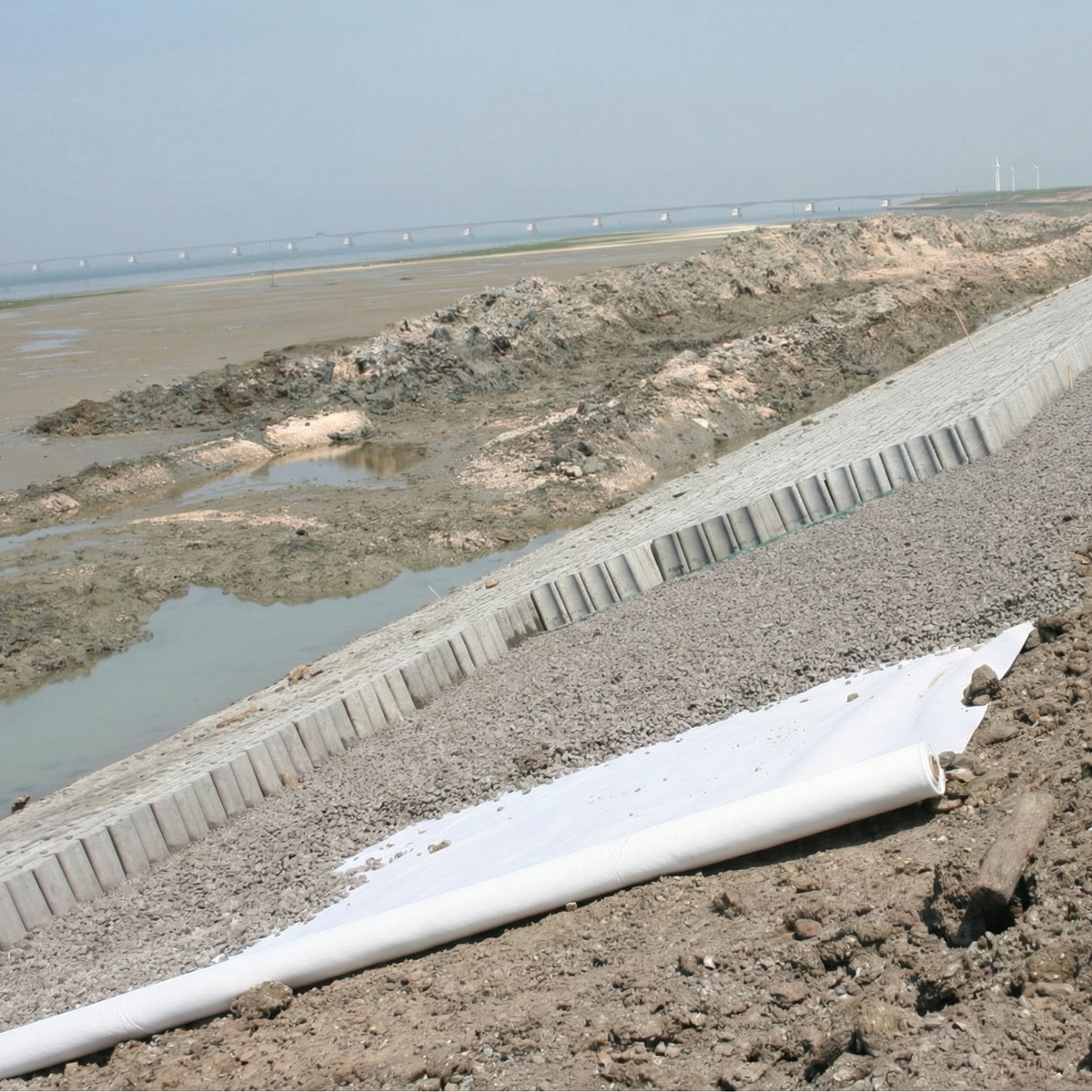


Separating fill layers and subsoil in road works so that expensive aggregate does not sink into soft soil, efficiently draining filter trenches with hydraulic efficiency, and protecting geomembranes against puncturing by sharp stones, all under continuous static loads for decades, requires a polyester non-woven geotextile with low creep and chemical resistance to acidic soils. This polyester (PET) non-woven geotextile—also called filter fabric, PET geotextile blanket, or needle-punched filter fabric—is manufactured by MOLTEXO using needle-punched PET, in three weights (100, 200, and 400 g/m²) in white, in rolls 5.95 m wide and 100 m long, designed for road works, drainage, professional landscaping, and geomembrane protection in hydraulic projects.
Key Benefits
- Effective layer separation: prevents fine or expensive aggregate (gravel, base) from mixing with soft natural subsoil, maintaining the load-bearing capacity of the structure and extending the pavement's service life beyond typical years without geotextile.
- High-permeability filtration: the needle-punched structure of randomly oriented fibers allows continuous water flow while retaining fine soil particles (silts, fine sands), a critical condition for filter trenches and French drainage systems without fine particle migration to the drainage medium.
- PET with low creep under continuous loads: polyester maintains mechanical properties for years under static loads, a superior condition to standard PP for audited hydraulic projects with a declared service life of decades.
- Chemical and biological resistance: withstands degradation by typical soil acids and alkalis, does not rot, is not attacked by fungi, nor by rodents, conditions that rule out other organic solutions.
- Three weights for project scale: 100 g/m² for landscaping and light drainage, 200 g/m² for standard civil works and low-traffic roads, 400 g/m² for geomembrane protection and demanding audited hydraulic works.
Applications and typical uses
- Underground drainage systems, filter trenches, and French drains in civil and residential works.
- Road construction, access roads, and parking lots as a separation layer between subbase and soft subsoil.
- Protection of impermeable geomembranes (HDPE, LLDPE) in dams, landfills, and reservoirs against puncturing by stones.
- Gardening and landscaping under decorative gravel layers, mineral mulching, artificial turf, and pathways.
Quality and durability
An economical PET geotextile fails in two ways: the actual weight is lower than declared (resulting in insufficient filtration and puncturing failure upon contact with sharp stones), and the PET is low-grade recycled (leading to high creep and loss of mechanical properties within a few years under continuous load). MOLTEXO uses virgin needle-punched PET with calibrated weight, which distinguishes an auditable hydraulic construction geotextile fabric from a generic felt that fails after a few seasons.
Equivalences
Equivalent to these other-brand references:
- 100 g/m² (3 oz/yd²) and white · Roll 5.95 m (19.5 ft) wide and 100 m (328 ft) long
- BIDIM RT 07Abmat™ Geo-Fabric 100 gsmWINIW Needle-Punched PET Geotextile 100 gsmBoshida PET Nonwoven Geotextile 100 gsmLianyi PET Nonwoven Geotextile 100 gsm
- 200 g/m² (6 oz/yd²) and white · Roll 5.95 m (19.5 ft) wide and 100 m (328 ft) long
- BIDIM OP 20BIDIM RT 14Maccaferri MacTex H40.2HongHuan FNG200FCSC Geotextile 200
- 400 g/m² (12 oz/yd²) and white · Roll 5.95 m (19.5 ft) wide and 100 m (328 ft) long
- BIDIM OP 40BIDIM RT 26Maccaferri MacTex H80.2Yingfan 400g PET Needle-Punched Geotextile
Brands and references mentioned belong to their respective owners; cited only for comparison and compatibility.
What's the real difference between non-woven and woven geotextile?
Can it be left exposed to Caribbean sun without protection?
How are the rolls joined together on site?
How permeable is it really to water, and why does it matter?
Still have questions?
Ask us and we will gladly help you with whatever you need.
| General | |
|---|---|
| Type | Nonwoven filament |
| Material and construction | |
| Material | Polyester |
| Dimensions and format | |
| Thickness | 0.8 mm (0.031 in) |
| Strength and performance | |
| Tensile strength | 6 kN/m (411 lb/ft) |
| Tear resistance | 0.15 kN (33.7 lb) |
| Elongation | 30–80% |
| Grab strength | 300 N |
| CBR puncture resistance | 0.9 kN (202.3 lb) |
| Hydraulics and filtration | |
| Equivalent opening | 0.05 - 0.3 mm (0.002 - 0.012 in) |
| Presentation and packaging | |
| Presentation | Roll 5.95 m (19.5 ft) wide × 100 m (328 ft) long |
| Standards and certifications | |
| Test methods | EN ISO 10319, 12236, 11058 and 12956 |
| Roll: Width | 25.0 cm (9.84 in) |
|---|---|
| Roll: Height | 25.0 cm (9.84 in) |
| Roll: Depth | 600.0 cm (236.22 in) |
| Roll: Weight | 59.5 kg |
Official MOLTEXO warranty
What's covered
Confirmed defect: replacement or refund of the amount paid.
What's not covered
Payment & Security

