

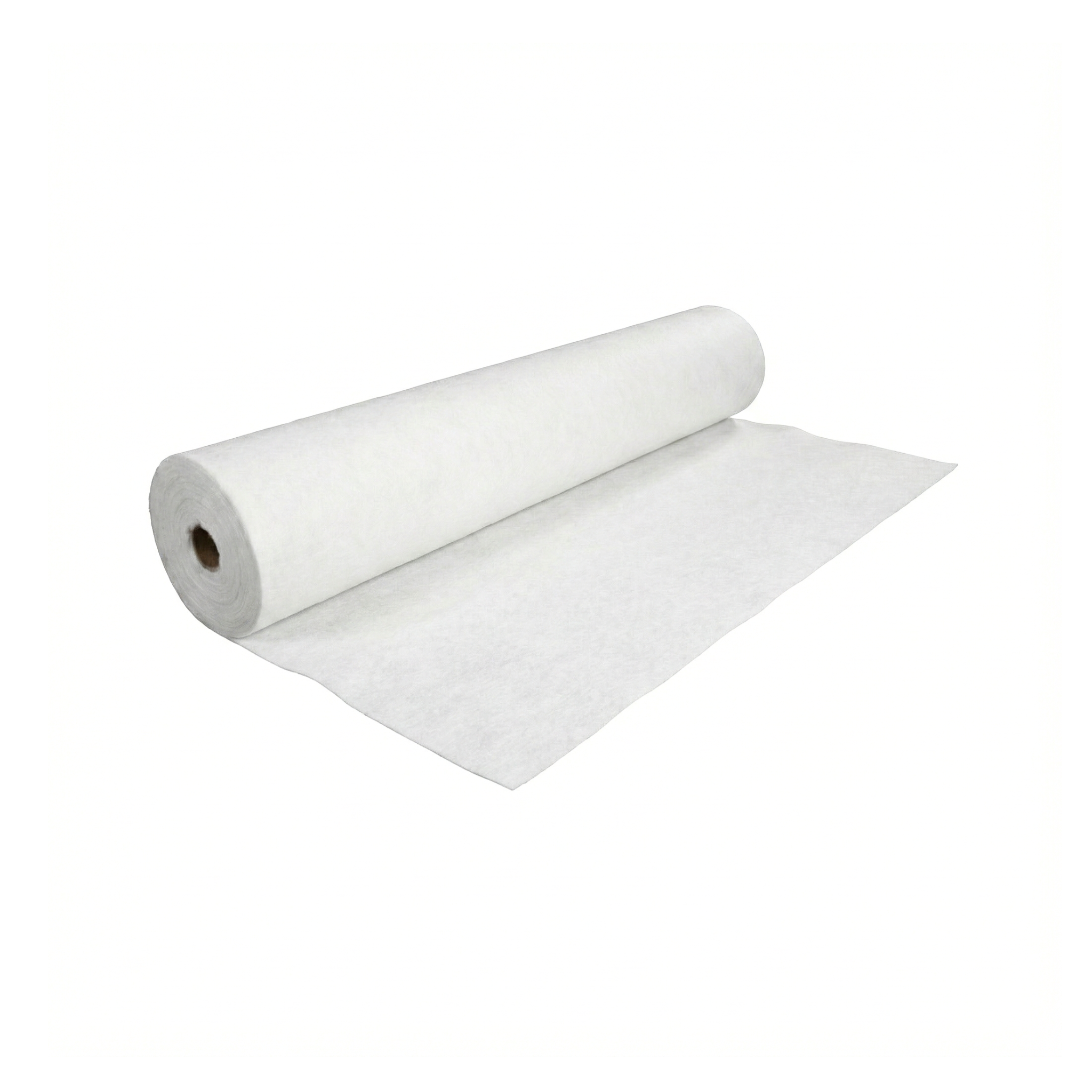
If you are assembling an underground drainage system, a filter trench with a French drain, a separation layer beneath decorative gravel, or you need to protect a dam or reservoir geomembrane against puncture from stones, the non-woven PET geotextile is the component that separates, filters and protects for decades without rotting. This guide explains how to choose the correct weight among 100, 200 and 400 g/m² depending on the application, how to roll out the sheet and how to secure the correct overlap at joints so the system works.
The non-woven PET geotextile is not a structural component —it does not provide significant tensile strength—. Its function is to filter water by retaining fines, separate layers of different materials and absorb small puncture stresses. If your project needs structural reinforcement (MSE walls, reinforcement of heavy road bases), the correct choice is the woven PET geotextile or geogrids, not this product. Read it in full before ordering quantities to confirm that the non-woven PET is the correct material for your case.
Product specifications
The non-woven polyester (PET) geotextile is offered in three weights, presented in a roll 5.95 m wide by 100 m long. Each weight is calibrated for a different scale of application. The following table sets out the complete technical specifications of the three available variants:
| Specification | 100 g/m² white | 200 g/m² black | 400 g/m² white |
|---|---|---|---|
| SKU | 764389 | 709840 | 909095 |
| Material | Needle-punched virgin PET | Needle-punched virgin PET | Needle-punched virgin PET |
| Type | Non-woven | Non-woven | Non-woven |
| Weight | 100 g/m² (3 oz/yd²) | 200 g/m² (6 oz/yd²) | 400 g/m² (12 oz/yd²) |
| Color | White | Black | White |
| Roll width | 5.95 m (19.5 ft) | 5.95 m (19.5 ft) | 5.95 m (19.5 ft) |
| Roll length | 100 m (328 ft) | 100 m (328 ft) | 100 m (328 ft) |
| Area per roll | 595 m² | 595 m² | 595 m² |
| Recommended application | Professional landscaping, agricultural drainage and light filter trenches | Standard civil works, road separation and low-to-medium traffic roads | Geomembrane protection and audited hydraulic works |
| Chemical resistance | Inert to acids and typical soils | Inert to acids and typical soils | Inert to acids and typical soils |
| Estimated service life | Decades when buried | Decades when buried | Decades when buried |
The installation steps are common to all three variants. Where the technique differs by weight, the step text states so explicitly. Before starting, confirm with your designer that the chosen weight matches the application: the 100 g/m² is insufficient for geomembrane protection, and the 400 g/m² is oversizing for landscaping.
The sister guides for the non-woven PP geotextile, the woven PET geotextile and the woven PP geotextile cover the other three variants of the family: the non-woven PP is the economical alternative for landscaping and agriculture, the woven PET is the structural version with low creep for MSE walls, and the woven PP covers road stabilization and structural weed control.
Step-by-step use
The following procedure covers the complete installation cycle of the non-woven PET geotextile on site. The instructions apply to all three weight variants, with specific notes where the technique differs.
Selecting the correct weight
Before ordering the material, confirm that the chosen weight matches the application. 100 g/m² is suitable for landscaping, mineral mulching, separation beneath decorative gravel and residential filter trenches. 200 g/m² is the civil works standard for separation between sub-base and subsoil, road French drains and low- or medium-traffic roads. 400 g/m² is reserved for geomembrane protection (HDPE in dams and landfills), audited hydraulic works and areas with loose angular stone that punctures lower weights. Mix weights on the same site only when it has been designed that way.
Surface preparation
Clear the surface of roots, vegetation and sharp-edged stones that could tear the geotextile when laying it or when covering it with the upper material. For a French drain, excavate the trench to the design depth and verify that the bottom has the minimum drainage slope (typically 1-2%). For separation beneath gravel, level the surface and compact it if the natural soil is very soft. For geomembrane protection, remove pointed stones from the supporting soil that could puncture the membrane and ensure the surface is reasonably smooth.
Rolling out the sheet
Unroll the sheet by hand or with light machinery —the 5.95 m wide roll allows this even for a single person in most weights—. Keep the fabric free of folds or wrinkles: a wrinkled non-woven geotextile loses filtration effectiveness in the affected area. For trenches, lay it in a “U” shape covering the bottom, the walls and leaving 50 cm of excess on each side to wrap the aggregate afterwards. For horizontal separation, lay it flat with the face upwards (in variants with a different manufacturing face) and check that the roll unrolls without pulls that distort the fabric.
Overlap at joints
When joining two rolls, overlap a minimum of 30 cm. On soft or saturated subsoils, increase the overlap to 50 cm to ensure the system maintains filtration continuity even if one of the two sheets shifts during covering. In geomembrane protection, the minimum overlap is 50 cm without exception: a loose joint can leave the membrane exposed to point puncture for decades. For a French drain with complete wrapping of the aggregate, the ends of the roll must rest over the bottom of the trench, not cut flush.
For a French drain in a trench, the geotextile is installed as a complete wrap of the aggregate. The correct procedure is to excavate the trench, lay the geotextile so it covers the bottom, the walls and protrudes at least 50 cm on each side, fill with draining aggregate (clean crushed stone 1-2 inches), fold the excess geotextile to close the “package” over the aggregate and cover with natural soil. This complete wrap protects the drain against migration of fines for years. A geotextile placed only at the bottom of the trench loses effectiveness within a few seasons because fines enter from the sides and clog the aggregate.
Covering with the upper layer
Cover the geotextile with the material specified in the design without unnecessary delay —exposure to the Caribbean sun degrades PET over time even with a UV additive—. For a French drain, fill with clean draining aggregate. For separation beneath decorative gravel, cover with the planned gravel layer, avoiding direct dumping of expensive aggregate from a height onto the geotextile. For geomembrane protection, install the membrane over the geotextile with the care appropriate to the specific system of each project. The general rule is not to leave the geotextile exposed to the sun for more than a few weeks.
Do not use a non-woven geotextile as a structural reinforcement element. Its tensile strength is very low (typically between 5 and 15 kN/m depending on weight), insufficient for MSE walls or road bases with heavy loads. If you install it where the project requires a woven geotextile or geogrid, the system will not perform as calculated and may collapse. The function of the non-woven is filtration, separation and protection against puncture; never tensile reinforcement.
Complementary products
To complement the non-woven PET geotextile in drainage, separation and geomembrane protection systems, the following products cover the most common adjacent needs:
The woven PET geotextile is the option when the project requires structural reinforcement in addition to separation: MSE walls, industrial platforms with heavy loads, reinforced slopes. The non-woven PP geotextile is the economical alternative for landscaping and agricultural drainage where the low creep of PET is not a critical factor. The biaxial PP geogrid is combined with the non-woven geotextile as a double-layer system (separation plus reinforcement) on soft subgrades for audited road works. The metal rods serve as temporary anchoring of the geotextile during rollout in windy or sloped areas, before covering with the upper layer.
Maintenance and care
The non-woven geotextile buried beneath a layer of aggregate or soil requires no maintenance during its service life of decades. What does require care is the storage and handling prior to installation: the rolls are stored horizontally on pallets or a smooth bed, covered against direct sunlight. PET is resistant to UV but not immune —a roll exposed to the Caribbean sun for several months loses surface properties and becomes brittle at the edges—. Inspect each roll before bringing it down to the site to identify permanent folds, cuts or edge damage that may have occurred during transport.
During handling on site, avoid dragging the rolls over stones or sharp metal edges that could tear the roll on its inner part. A 30 cm longitudinal cut in a 100 m roll is not visible until it is unrolled, at which point it is already too late to claim it from the supplier. If the functional system is critical (geomembrane protection, primary drainage), consider opening and visually checking each roll before laying, especially the thicker weights, which are the most expensive.
Frequently asked questions (FAQ)
Which weight should I choose among 100, 200 and 400 g/m²?
The criterion is the severity of the environment: type of upper load, presence of pointed stones, size of the aggregate in contact and expected service duration. 100 g/m² covers residential landscaping, mineral mulching and light agricultural drainage. 200 g/m² is the civil works standard for road separation beneath a granular layer, road French drains and low- or medium-traffic roads. 400 g/m² is reserved for geomembrane protection (HDPE in dams and landfills), audited hydraulic works and areas with loose angular stone. If you are between two options due to reasonable doubt, increase the weight: the extra cost of one step is usually lower than the cost of reinstalling the system when the lower one failed.
Why PET and not PP for my application?
PET has low creep under continuous loads, a critical condition for hydraulic works and audited projects with a declared service life of decades (dams, landfills, road separation beneath serious paved highways). PP is slightly less resistant to creep but lighter, more manageable and resistant to alkalis (useful in agro-industry with fertigation and basic soils). For landscaping, agricultural drainage, landscape design and light works, the non-woven PP geotextile performs at a lower cost. For hydraulic works, geomembrane protection and road projects with structural auditing, PET is the correct choice.
How many m² does a roll yield and how do I calculate how many I need?
A roll of 5.95 × 100 m equals 595 nominal m². To calculate the actual number of rolls, deduct the overlap: in standard works with a 30 cm overlap, the efficiency is 90 to 92%. For a surface of 1000 m², calculate between 1.85 and 2 rolls. For a French drain with complete wrapping of the aggregate, the geotextile consumption per linear meter of trench is approximately twice the basic perimeter of the trench (because it covers the bottom, the walls and closes at the top); calculate the meters of trench × (perimeter × 1.05 to include overlap) for a more precise estimate.
