

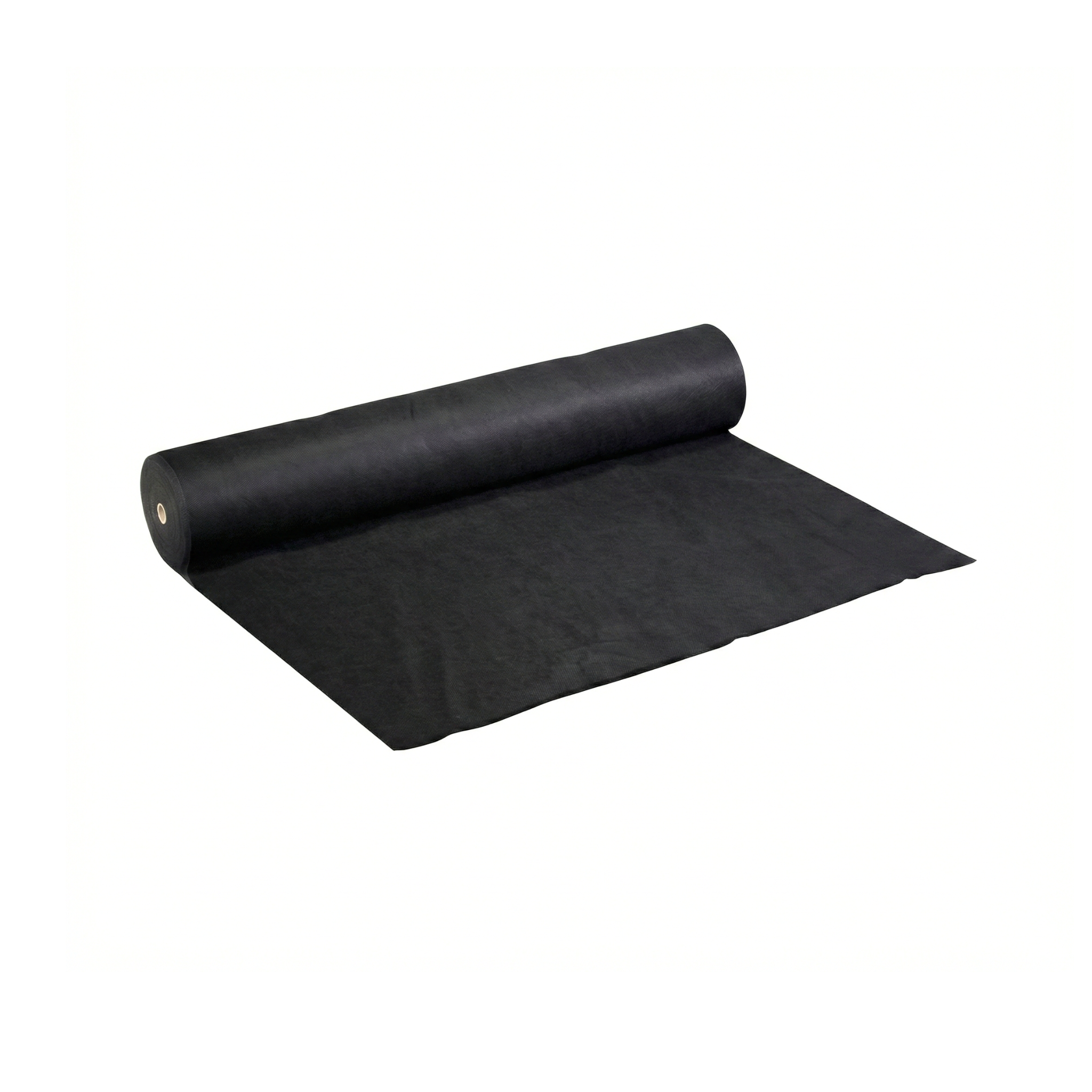
If you are working in professional gardening, landscaping, agricultural drainage, separation under decorative gravel or stabilization of farm tracks, PP nonwoven geotextile is the economical option of the family: same needle-punched structure as PET but with polypropylene as the base material —lighter, more manageable and more resistant to alkalis typical of fertilizers and basic soils—. This guide explains how to choose the correct weight among 100, 200 and 400 g/m² (all in black) according to the application and how to lay it out, overlap and cover it correctly.
As with PET nonwoven, PP nonwoven geotextile is NOT a structural component —its function is to filter, separate and absorb small punching stresses, not to provide tensile reinforcement—. If your project requires reinforcement (tracks with medium traffic, landscaping with loads, structural weed barrier, low walls), the correct choice is woven PP geotextile or geogrids, not this product. For hydraulic works with structural audit and service life declared in decades, consider the PET version for its lower creep under continuous load.
Product specifications
PP nonwoven geotextile is offered in three weights in black, presented in a roll 5.95 m wide by 100 m long. The following table contains the complete technical specifications of the three available variants:
| Specification | 100 g/m² | 200 g/m² | 400 g/m² |
|---|---|---|---|
| SKU | 534623 | 623451 | 654237 |
| Material | Needle-punched PP | Needle-punched PP | Needle-punched PP |
| Type | Nonwoven | Nonwoven | Nonwoven |
| Weight | 100 g/m² (3 oz/yd²) | 200 g/m² (6 oz/yd²) | 400 g/m² (12 oz/yd²) |
| Color | Black | Black | Black |
| Roll width | 5.95 m (19.5 ft) | 5.95 m (19.5 ft) | 5.95 m (19.5 ft) |
| Roll length | 100 m (328 ft) | 100 m (328 ft) | 100 m (328 ft) |
| Area per roll | 595 m² | 595 m² | 595 m² |
| Chemical resistance | Inert to acids and alkalis | Inert to acids and alkalis | Inert to acids and alkalis |
| Estimated service life | Decades buried | Decades buried | Decades buried |
The steps are common to the three variants. The main difference between weights is the puncture resistance and durability under loads: 100 g/m² for aesthetic-functional use without vehicle traffic, 200 g/m² for light traffic (garden carts, rotary tiller), 400 g/m² for effective geomembrane protection or separation layer under angular aggregate.
The sister guides for PET nonwoven geotextile, PET woven geotextile and PP woven geotextile cover the other three variants of the family and help confirm whether the PP nonwoven choice is the right one for your case.
Step by step to use it
The following procedure covers the complete installation cycle of PP nonwoven geotextile in gardening, drainage and light works. The instructions apply to the three weight variants, with specific notes where the technique differs.
Selection of the correct weight
Before ordering the material, confirm that the chosen weight corresponds to the application. 100 g/m² is suitable for residential gardening, mineral mulching, separation under decorative gravel with foot traffic and residential filter trenches without equipment passage. 200 g/m² is the standard for farm tracks, unpaved residential driveways, agricultural drainage with cart passage and separation under fine aggregate. 400 g/m² is reserved for geomembrane protection in agricultural reservoirs, separation under coarse angular aggregate and professional landscaping works with occasional concentrated loads.
Surface preparation
Clear the surface of roots, existing vegetation and pointed stones that could tear the geotextile. For gardening with decorative gravel, remove the entire topsoil layer and level it —a bed with potholes leaves “pockets” where the geotextile sinks and gravel accumulates irregularly—. For drainage trenches, excavate to the design depth with a drainage slope (1-2%). For reservoir geomembrane protection, remove pointed stones from the supporting soil. The quality of the bed preparation is directly proportional to the expected performance of the system.
Rolling out the roll
Unroll the roll manually —the 5.95 m wide roll allows it even for a single person in 100 and 200 g/m² weights; for 400 g/m² it is best to work in pairs—. Keep the fabric free of folds or wrinkles. For trenches, lay it out in a “U” shape covering the bottom, walls and leaving 50 cm of excess on each side to wrap the aggregate. For horizontal separation in gardening, lay it out flat over the leveled surface. If you are working in wind, temporarily fix it with metal garden staples every 1-2 meters to prevent the roll from curling up.
Overlap at joints
When joining two rolls, overlap a minimum of 30 cm. In gardening with decorative gravel where the overlap may be visible if it moves, use 40-50 cm to ensure the system maintains continuity even if the wind moves the geotextile before covering. For French drains, the ends of the roll must rest over the bottom of the trench, not cut flush. In reservoir geomembrane protection, increase the overlap to 50 cm without exception.
In gardening with decorative gravel, the 100 g/m² PP nonwoven geotextile remains visible at the edges and, although it is functional, it looks aesthetically poor compared to a professional finish. The landscaper's technique is to bury the edges of the geotextile 5-10 cm below the final level of the gravel: dig a small perimeter trench, fold the geotextile downward and cover with gravel. This gives the finished garden the look of “gravel without geotextile” while preserving the full separation function. For premium residences, the landscaper's extra time is worth it.
Covering with the top layer
Cover the geotextile with the intended material without unnecessary delay. Exposure to Caribbean sun degrades PP faster than PET; ideally cover it the same day of installation and within 3-5 days at most. For gardening with decorative gravel, dump the distributed gravel and rake gently to level without puncturing the geotextile with the rake. For French drains, fill with clean draining aggregate and fold the excess to close the wrap. For geomembrane protection, install the membrane over the geotextile with the care appropriate to the specific system.
Do not install PP nonwoven geotextile in areas with heavy vehicle traffic or concentrated loads (trucks, construction machinery, large static loads). PP nonwoven has low puncture resistance under concentrated load —even the 400 g/m² weight can break under the point weight of a tractor wheel on loose angular stone—. For vehicle traffic areas use biaxial PP geogrid or woven PP geotextile, not this product.
Complementary products
To complement PP nonwoven geotextile in gardening, agricultural drainage and light works, the following products cover the most common adjacent needs:
The PET nonwoven geotextile is the premium version of the same functional principle, indicated when low long-term creep is a factor (audited hydraulic works, separation under paved roads with declared service life). The woven PP geotextile is the choice when the project needs tensile reinforcement in addition to separation: farm tracks with heavier traffic, structural weed barrier, low walls. The metal garden staples are the natural tool for fixing the geotextile in gardening during layout and before covering with gravel. The biaxial PP geogrid is combined with the nonwoven geotextile in a double-layer system for soft subgrades with vehicle traffic.
Maintenance and care
PP nonwoven geotextile buried under a layer of gravel or soil requires no maintenance during its service life. Where it is worth checking periodically is in gardening with decorative gravel: over time, the gravel may shift due to wind, heavy rain or foot traffic and expose the edges of the geotextile. If this happens, redistribute the gravel or, if the exposed area is large, lift the gravel in that area, adjust the geotextile and cover again.
For storage prior to installation, keep the rolls in a horizontal position on flat pallets, covered against direct sunlight. PP is more sensitive to UV than PET; a roll exposed to the Caribbean sun for several months loses strength and becomes brittle. Inspect each roll before lowering it to the site to identify folds, cuts or edge damage. For small quantities (partial rolls) kept in stock between jobs, keep the original packaging as UV protection.
Frequently asked questions (FAQ)
Which weight should I choose among 100, 200 and 400 g/m²?
The criterion is the severity of the environment in your specific application. 100 g/m² covers residential gardening without vehicle traffic, mineral mulching and separation under decorative gravel. 200 g/m² is the standard for farm tracks with light traffic, unpaved residential driveways and agricultural drainage with cart passage. 400 g/m² is reserved for geomembrane protection in agricultural reservoirs, light civil works and separation under coarse angular aggregate. If you are between two options due to reasonable doubts, increase the weight: the extra cost is usually lower than reinstalling the system when the lower one failed.
PP or PET for my application?
PP is more economical, lighter (more manageable manually), more resistant to alkalis typical of fertilizers and basic soils, and ideal for agribusiness and gardening. PET has better long-term creep behavior, a critical condition in audited hydraulic works, dams and road separation under paved roads with structural audit. For residential gardening, landscaping, agricultural drainage and light works, PP is the correct choice. For hydraulic works with service life declared in decades, PET justifies the extra cost.
How many rolls do I need for my project?
A roll of 5.95 × 100 m equals 595 m² nominal. To calculate the real number, subtract the overlap: with a standard overlap of 30 cm the efficiency is 90-92%. For a surface of 500 m² calculate one roll (with 50-60 m² of surplus for adjustments). For French drains with complete wrapping of the aggregate, consumption is approximately double the basic perimeter of the trench per linear meter. In gardening with irregular shapes, reserve an additional 10-15% for cuts and adjustments —surplus geotextile in gardening almost always finds secondary uses (additional flower beds, large planters, patches), so having surplus is less costly than running short and having to order an extra roll for 50 m²—.
