
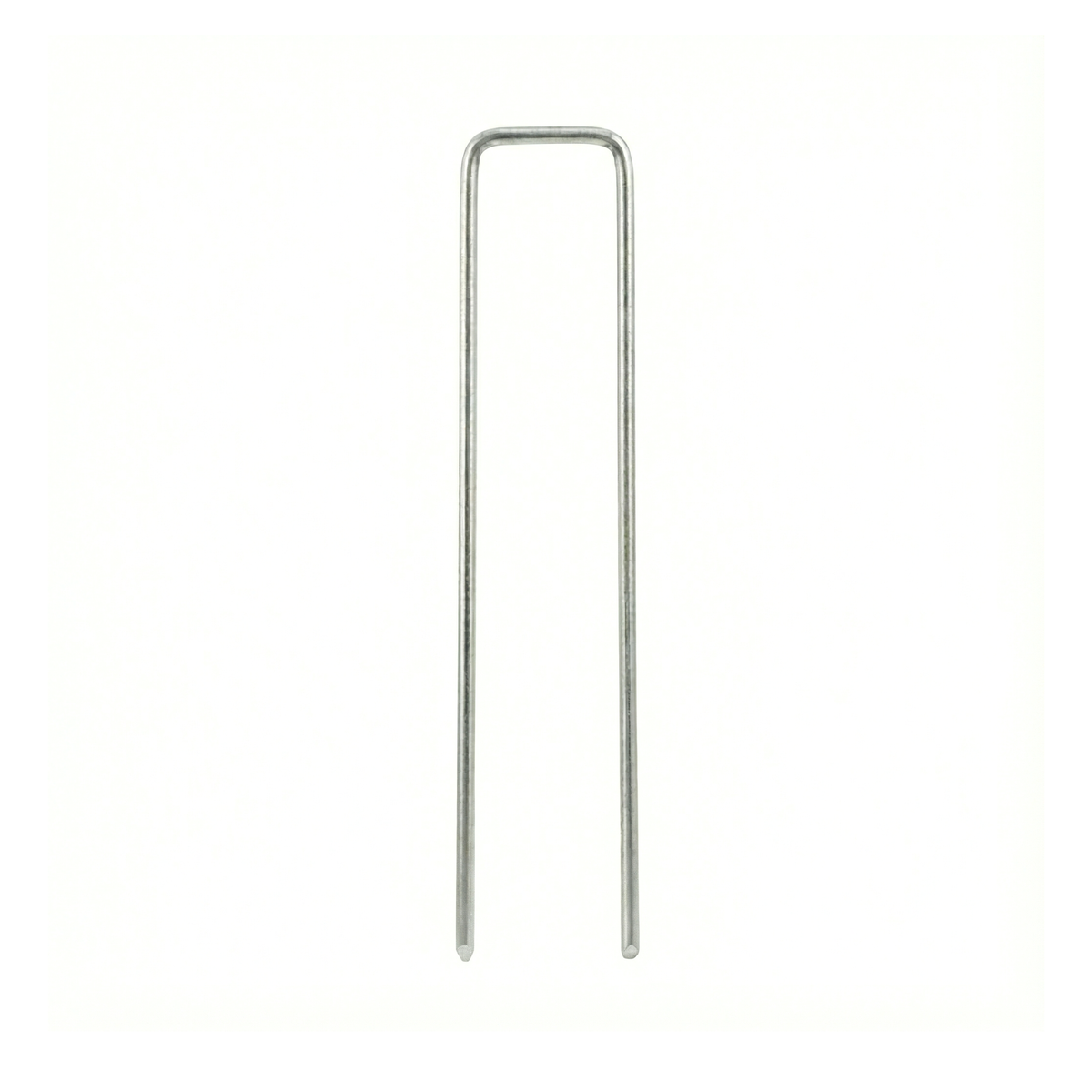
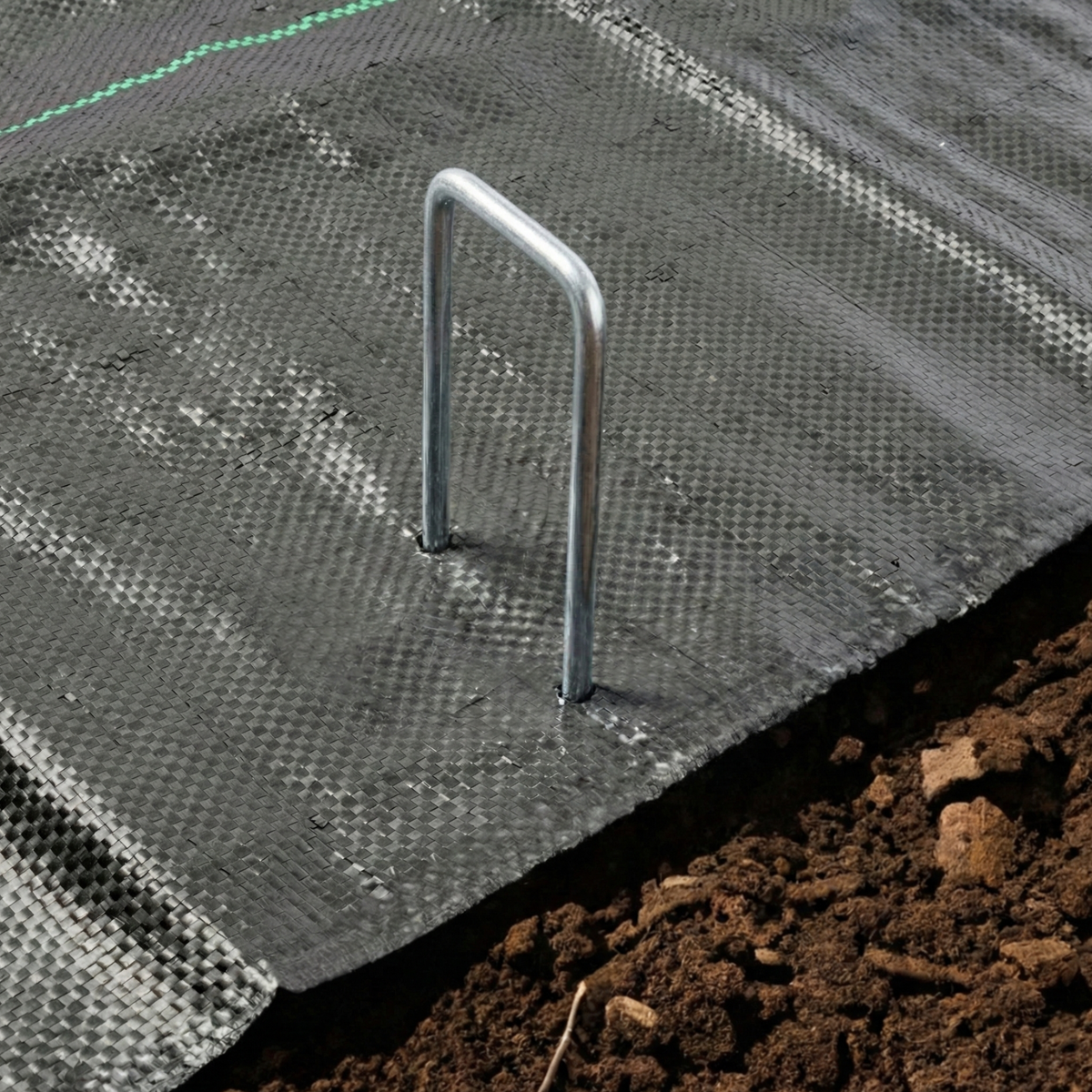
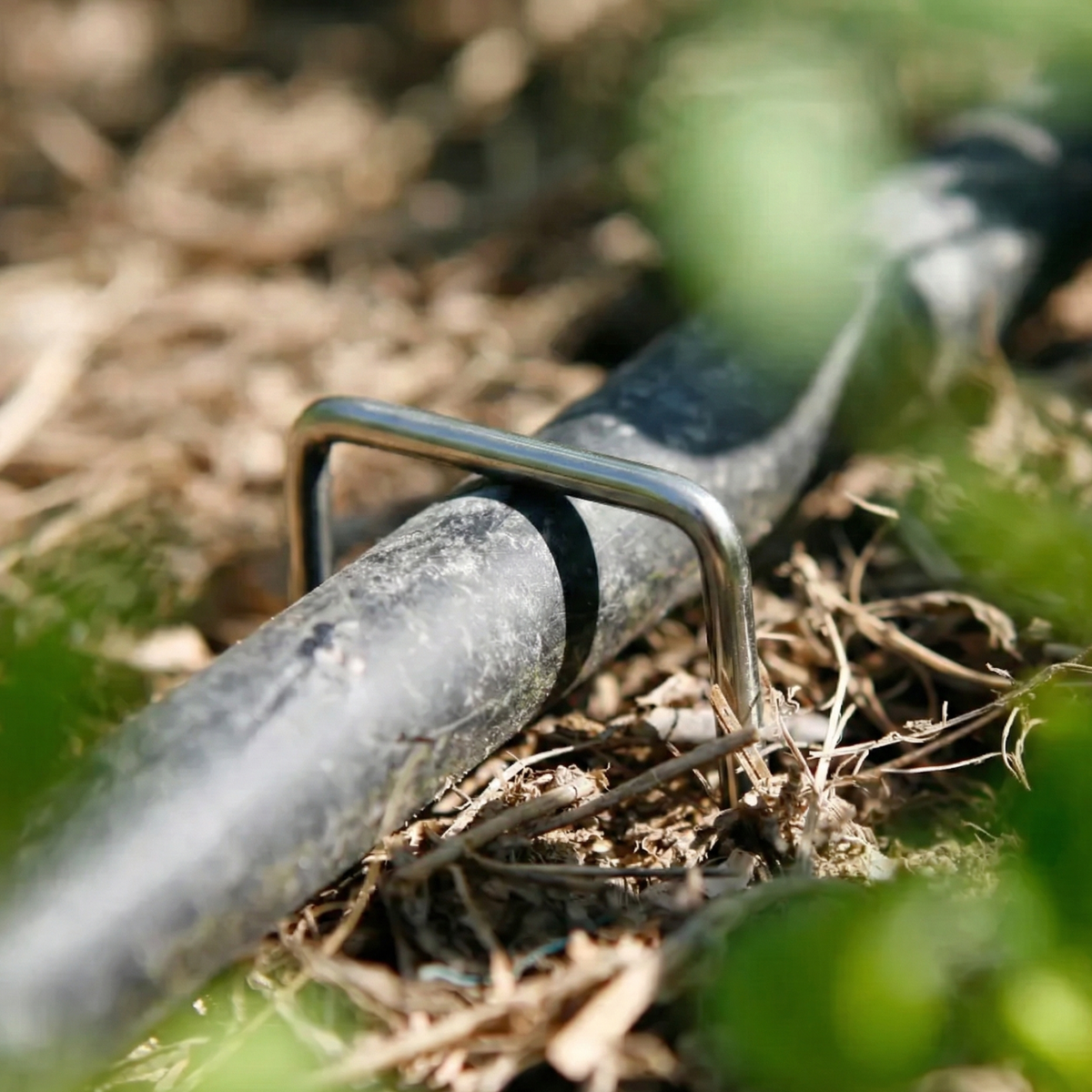
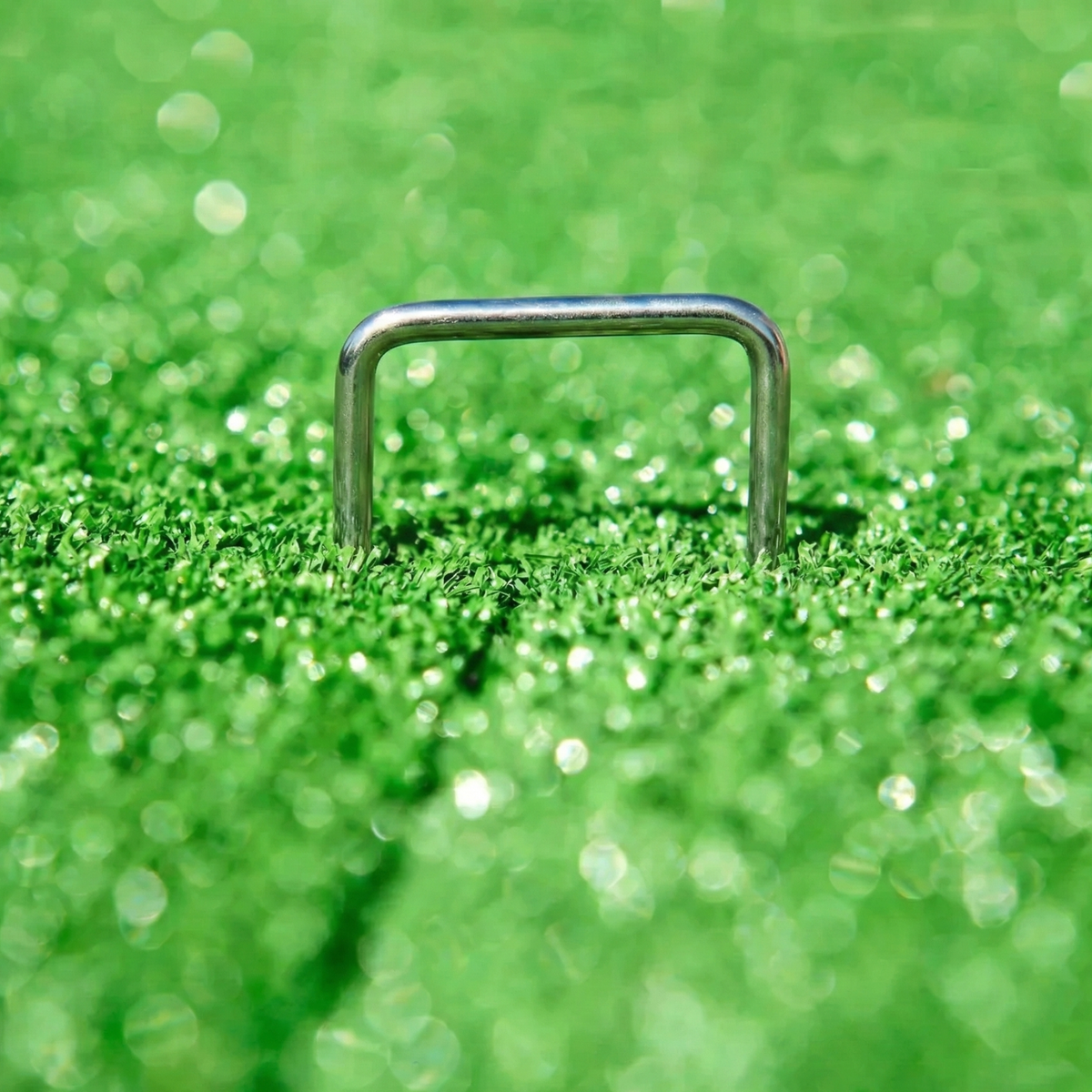


Anchoring residential and commercial synthetic turf to the ground with a firm hold that won't loosen with traffic or wind, securing weed barrier mesh in productive orchards where plastic staples fail due to lack of strength, and fastening drip irrigation hoses or polyethylene pipes in intensive agriculture, demands a metal U-shaped garden staple with beveled tips and robust construction. This metal garden staple—also called a landscape staple, sod staple, or U-shaped fixing stake—is manufactured by MOLTEXO from robust metal, with dimensions of 4×20 cm (width × height), in a box of 500 units, designed for professional landscaping, synthetic turf installation, intensive agriculture, and gardening projects with tensile loads.
Main Benefits
- U-shaped design with double anchoring point: the two arms of the staple provide two simultaneous penetration points into the ground, doubling the retention force and distributing the load over the fixed material, a critical condition compared to individual nails that concentrate all force at one point.
- Beveled tips for efficient penetration: the sharp bevel allows for insertion into compact, clayey, or calcareous soils typical of the Caribbean without the need for pre-drilling, a condition for increasing installation speed in extensive projects.
- Mechanical resistance to driving and traction: the robust metal withstands blows from a rubber mallet or construction tool during driving without permanently bending, and endures tensile loads from turf or mesh in joints that tend to lift.
- Discrete profile integrated into the landscape: once installed, the staple is almost invisible under the turf or mesh, a condition for maintaining a clean aesthetic of the garden or crop, a differential advantage compared to bulky anchors.
- Compatibility with MOLTEXO fixing stop: designed to combine with a plastic garden stop that prevents the staple from tearing fine meshes and distributes pressure on synthetic turf.
Typical Applications and Uses
- Installation of synthetic turf (artificial grass) in residential, commercial, parks, and sports areas.
- Securing weed barrier mesh and geotextiles in gardens, orchards, and landscaping projects.
- Fastening drip irrigation hoses and polyethylene pipes in crop rows.
- Anchoring bird protection meshes, crop nets, and sediment barriers in construction.
Quality and Durability
An economical garden staple fails in two ways: the metal is of thin gauge or inferior quality (which causes permanent bending at the first blow in compact soil and halves the project's effectiveness) and the tips are blunt instead of beveled (which requires excessive driving force and leaves staples semi-installed). MOLTEXO works with robust metal and beveled tips, which distinguishes a professional construction staple from a generic peg that bends without penetrating.
Equivalences
Equivalent to these other-brand references:
- 4 cm (1.6 in) wide and 20 cm (8 in) high · Box of 500 staples
- Hy-Tex Metal Fixing Pin U-shaped 200 x 38 x 200 mmHXT Plastics U-Shaped Ground Staple 20 cm
Brands and references mentioned belong to their respective owners; cited only for comparison and compatibility.
Are these staples suitable for installing artificial grass?
Can they be used in soils with lots of stones and gravel?
Do they rust from soil moisture in Caribbean climates?
Are they reusable after removal?
Still have questions?
Ask us and we will gladly help you with whatever you need.
| Material and construction | |
|---|---|
| Material | Galvanized stainless steel |
| Dimensions and format | |
| Width | 4 cm (1.57 in) |
| Height | 20 cm (7.87 in) |
| Thickness | 0.3 mm (0.01 in) |
| Presentation and packaging | |
| Presentation | Box of 500 staples |
| Box: Width | 36.0 cm (14.17 in) |
|---|---|
| Box: Height | 8.0 cm (3.15 in) |
| Box: Depth | 36.0 cm (14.17 in) |
| Box: Weight | 8.0 kg |
Official MOLTEXO warranty
What's covered
Confirmed defect: replacement or refund of the amount paid.
What's not covered
Payment & Security

