
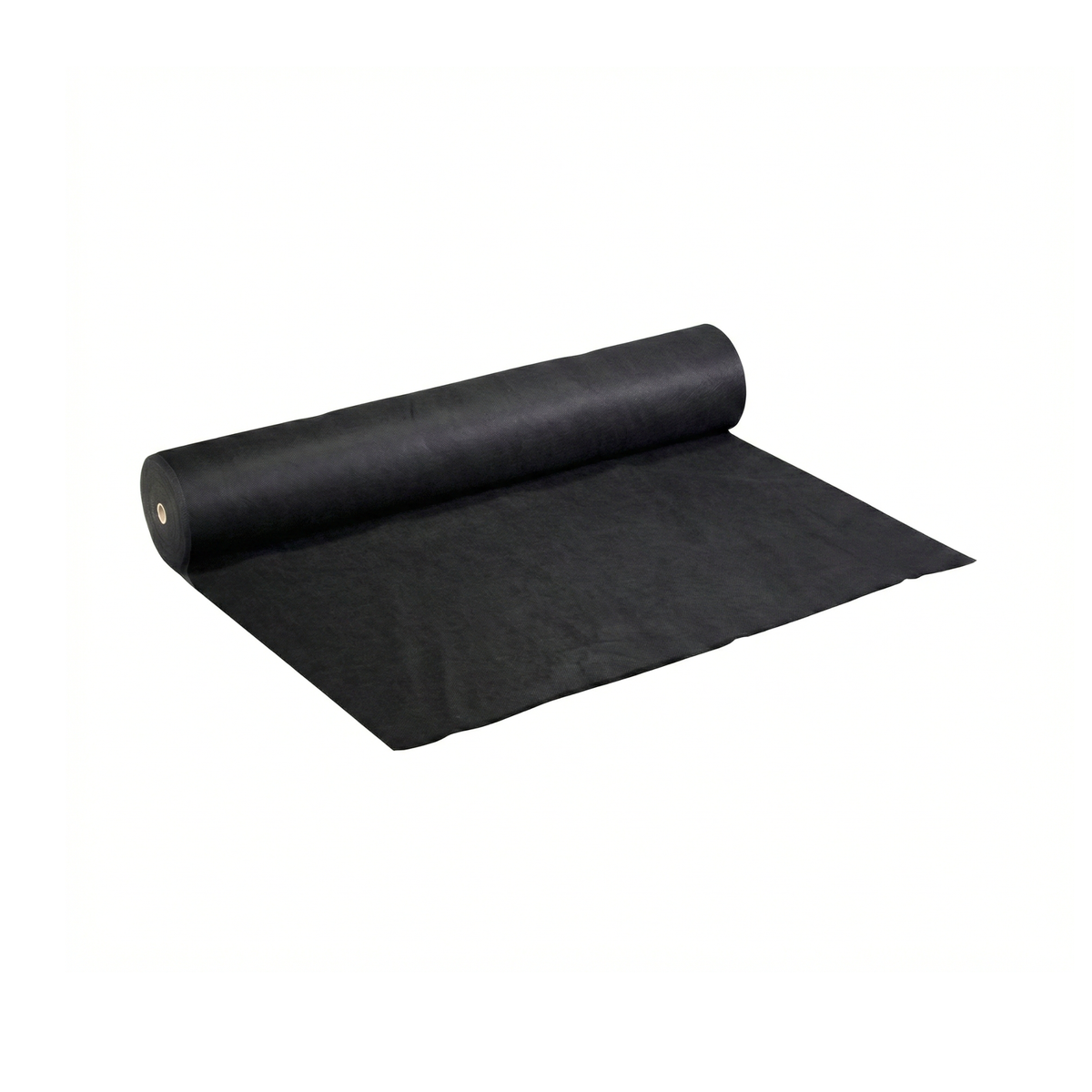
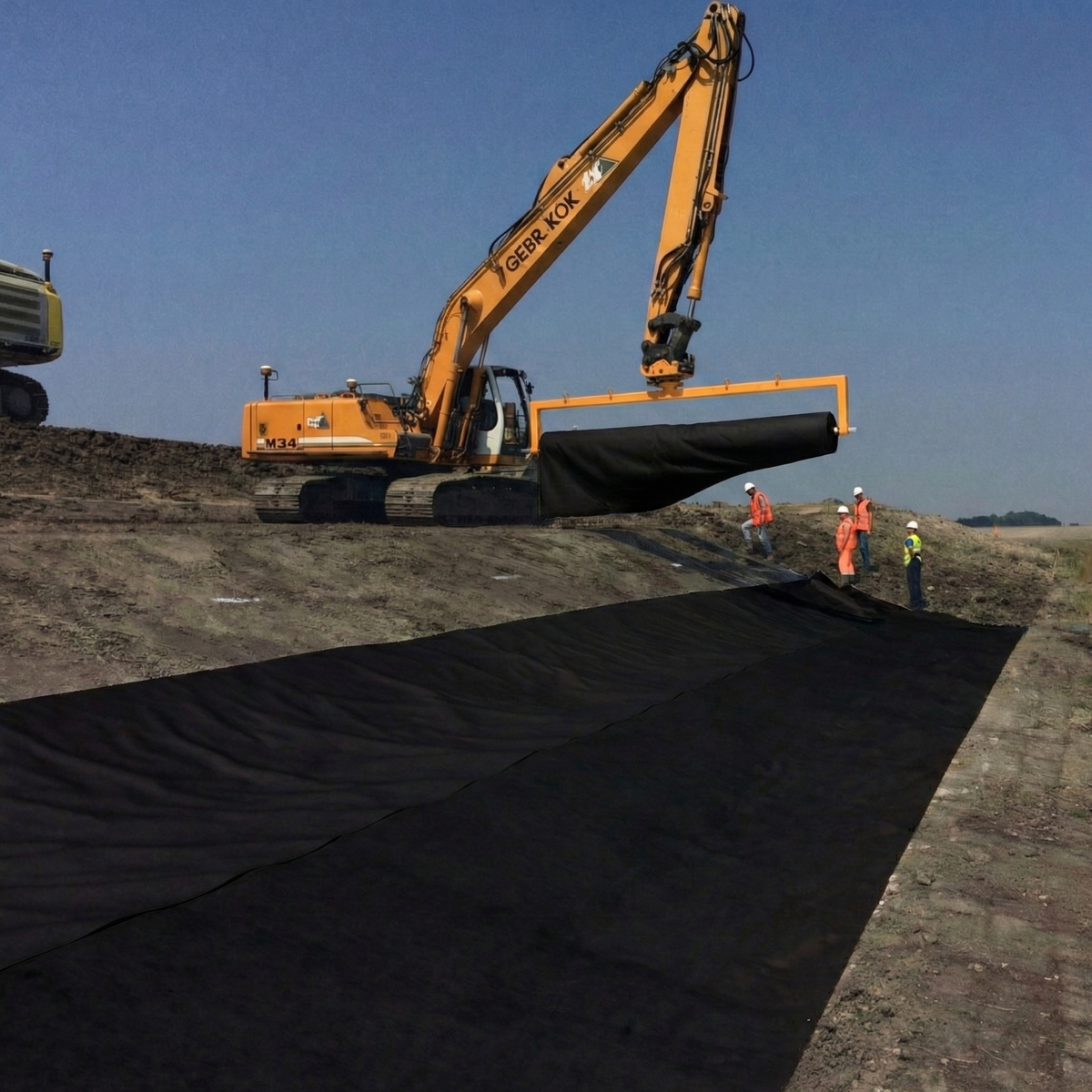
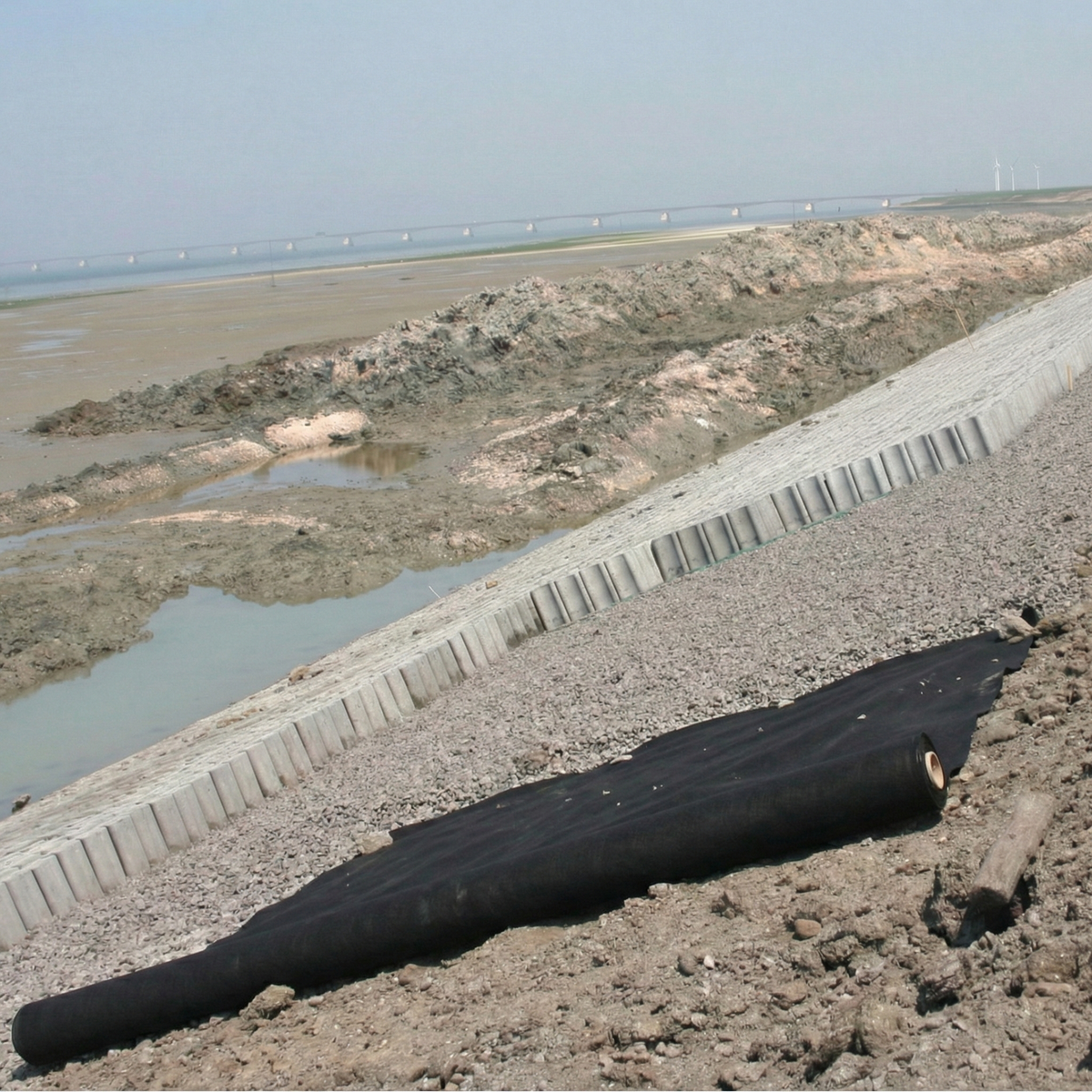


Separating layers in professional landscaping projects, agricultural drainage, and light civil engineering where economy is a priority with chemical resistance to fertilizers and soil alkalis, without the need for the low creep offered by PET in large-scale hydraulic works, requires nonwoven polypropylene geotextile with calibrated weight and consistent permeability. This nonwoven polypropylene (PP) geotextile—also called landscape fabric, PP geotextile felt, or landscape cloth—is manufactured by MOLTEXO using needle-punched PP, in three weights (100, 200, and 400 g/m²) in black, in rolls 5.95 m wide and 100 m long, designed for gardening and landscaping, agricultural drainage, light infrastructure, and residential projects with a good price-performance balance.
Key Benefits
- High permeability filtration: the needle-punched nonwoven structure allows free water flow while retaining fine soil particles, a condition for agricultural drainage, stormwater systems, and separation between soil and decorative gravel in landscaping.
- PP with superior chemical resistance to alkalis: polypropylene withstands exposure to alkaline fertilizers, lime, fresh cement, and basic soils better than PET, a useful condition for agribusiness with intensive fertigation.
- Lightweight for manual handling: lower weight per unit area compared to PET facilitates transport, manual deployment without heavy machinery, and handling in residential or small agricultural projects.
- Adaptability to irregular terrain: the flexible material conforms to curves, trenches, slopes, and irregular shapes, a differentiating condition compared to rigid geogrids and rigid woven geotextiles.
- Three weights for project scale: 100 g/m² for residential gardening and light agricultural drainage, 200 g/m² for farm entrances and light traffic paths, 400 g/m² for geomembrane protection and light civil engineering.
Typical Applications and Uses
- Gardening and landscaping: barrier between soil and decorative gravel, under stone paths, in large planters, and mineral mulching areas.
- Agricultural drainage: filter trenches in orchards, extensive crops, and excess water evacuation systems.
- Stabilization of farm roads, residential driveways, and unpaved paths with light traffic.
- Protection of geomembranes in agricultural reservoirs and small reservoirs with moderate hydrostatic loads.
Quality and Durability
An economical PP geotextile fails in two points: the fiber is low-grade with deficient needling (which causes defibration upon contact with stones and premature breakage) and the declared weight is not met (which reduces real performance). MOLTEXO works with calibrated needle-punched PP in three auditable weights, which separates a professional construction geotextile from a generic landscape fabric that breaks at the first pass of a rototiller or worker's footstep.
Equivalences
Equivalent to these other-brand references:
- 100 g/m² (3 oz/yd²) and black · Roll 5.95 m (19.5 ft) wide and 100 m (328 ft) long
- Pavco Wavin NT 1600Solmax GEOTEX 351Solmax GEOTEX 311Solmax MIRAFI 135NLAKA LK-Nonwoven (family)RBK Builds Nonwoven Geotextile (family)TESCO / Tex Delta Geotextile (family)
- 200 g/m² (6 oz/yd²) and black · Roll 5.95 m (19.5 ft) wide and 100 m (328 ft) long
- Pavco Wavin NT 2500Pavco Wavin NT 3000Solmax GEOTEX 701Solmax MIRAFI 180NUS Fabrics US 205NWBIDIM PP 10Maccaferri MacTex N 40.1Solmax MIRAFI 160NLAKA LK-Nonwoven (family)RBK Builds Nonwoven Geotextile (family)TESCO / Tex Delta Geotextile (family)
- 400 g/m² (12 oz/yd²) and black · Roll 5.95 m (19.5 ft) wide and 100 m (328 ft) long
- Pavco Wavin NT 6000Solmax GEOTEX 1201BIDIM PP 23Solmax MIRAFI 1120NMaccaferri MacTex N 80.1Maccaferri MacTex H 80.1Sika Sikaplan®-400 Geotextile CASolmax MIRAFI® P40LAKA LK-Nonwoven (family)RBK Builds Non-Woven Geotextile (family)TESCO / Tex Delta Geotextile (family)
Brands and references mentioned belong to their respective owners; cited only for comparison and compatibility.
What is this PP geotextile mainly used for compared to PET?
Is it useful for small home gardening projects, or only for civil works?
Is it complicated to cut and adapt to irregular terrain?
Does it really prevent weed growth under the gravel?
Still have questions?
Ask us and we will gladly help you with whatever you need.
| Material and construction | |
|---|---|
| Material | PP (filaments) |
| Mass per unit area | 100 g/m² (2.95 oz/yd²) |
| Dimensions and format | |
| Thickness | ≥1.0 mm (≥0.039 in) |
| Mass per unit area deviation | ±5% |
| Strength and performance | |
| Elongation at break (longitudinal and transverse) | 60% - 100% |
| CBR puncture strength | ≥ 1.1 kN (≥ 247.3 lb) |
| Tensile strength (longitudinal and transverse) | ≥ 7 kN/m (≥ 479.6 lb/ft) |
| Tear resistance (longitudinal and transverse) | ≥ 0.21 kN (≥ 47.2 lb) |
| Grab strength (vertical and horizontal) | ≥ 0.4 kN (≥ 89.9 lb) |
| Hydraulics and filtration | |
| Equivalent opening O95 | 0.07 - 0.3 mm (0.0028 - 0.0118 in) |
| Vertical permeability coefficient | 1.0 × (10⁰-10⁻²) cm/s (0.0328 × (10⁰-10⁻²) ft/s) |
| Durability and protection | |
| UV resistance retention | ≥80% |
| Presentation and packaging | |
| Presentation | Roll 5.95 m (19.5 ft) wide × 100 m (328 ft) long |
| Standards and certifications | |
| Test methods | EN ISO 10319, 12236, 11058 and 12956 |
| Roll: Width | 28.0 cm (11.02 in) |
|---|---|
| Roll: Height | 28.0 cm (11.02 in) |
| Roll: Depth | 595.0 cm (234.25 in) |
| Roll: Weight | 60.0 kg |
Official MOLTEXO warranty
What's covered
Confirmed defect: replacement or refund of the amount paid.
What's not covered
Payment & Security

