

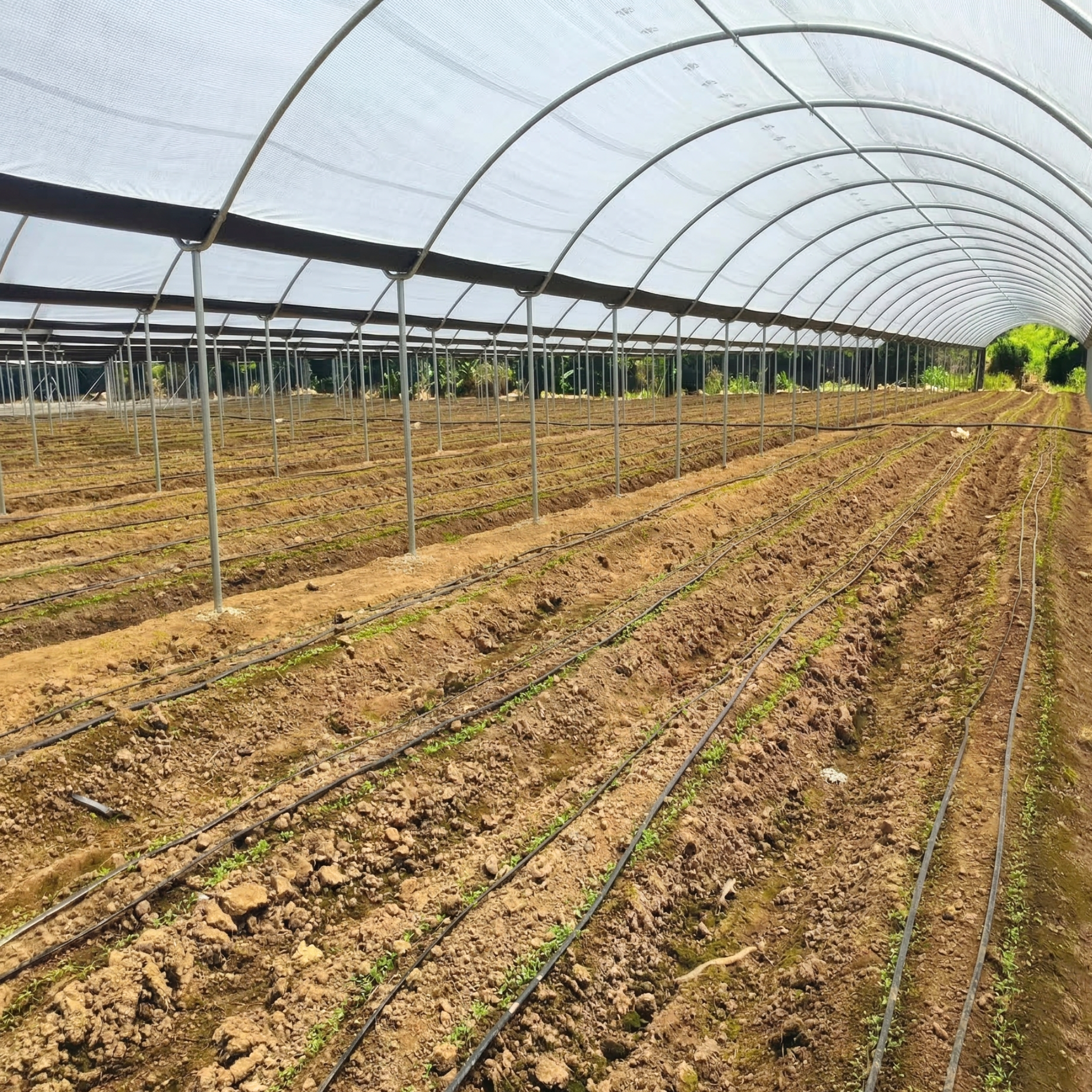
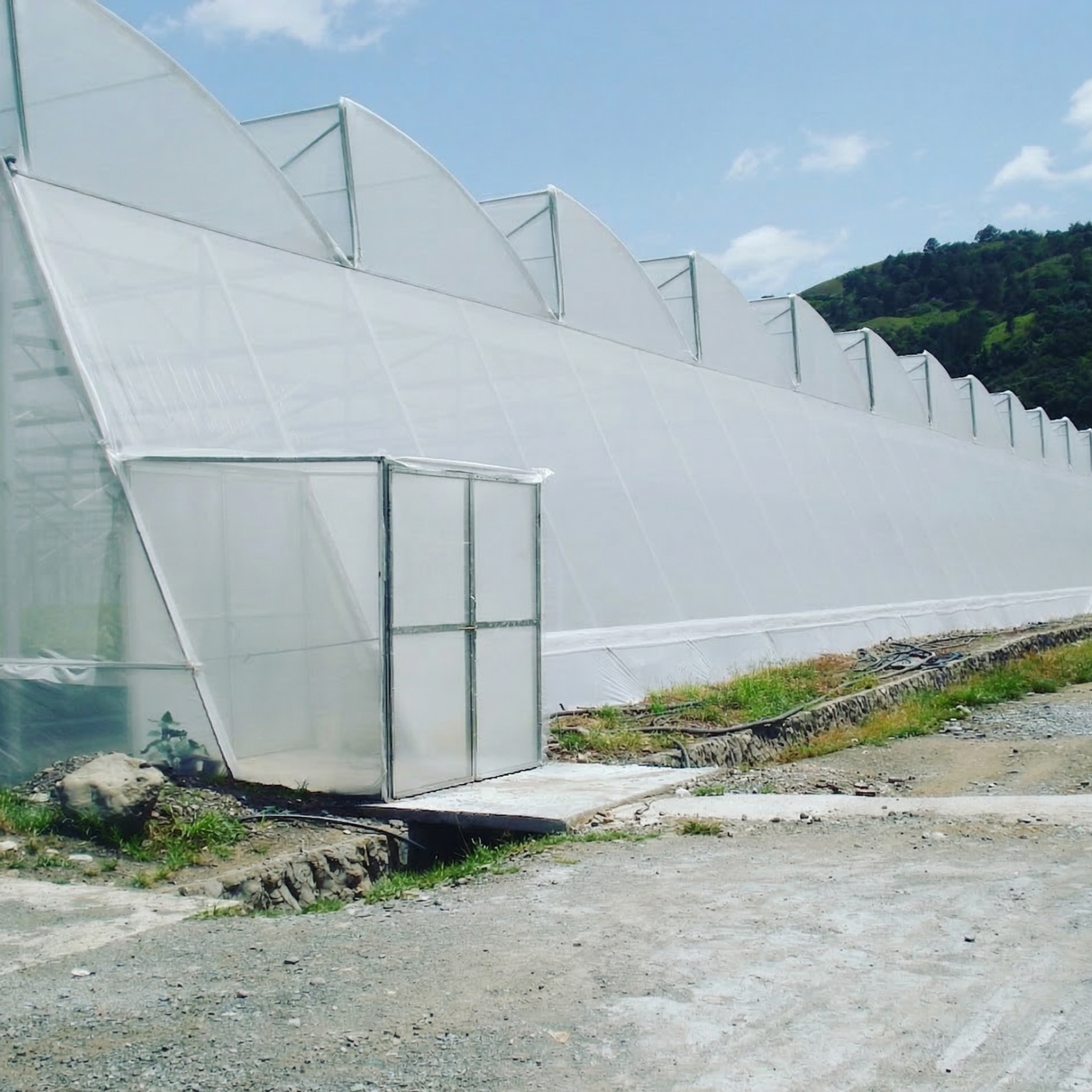
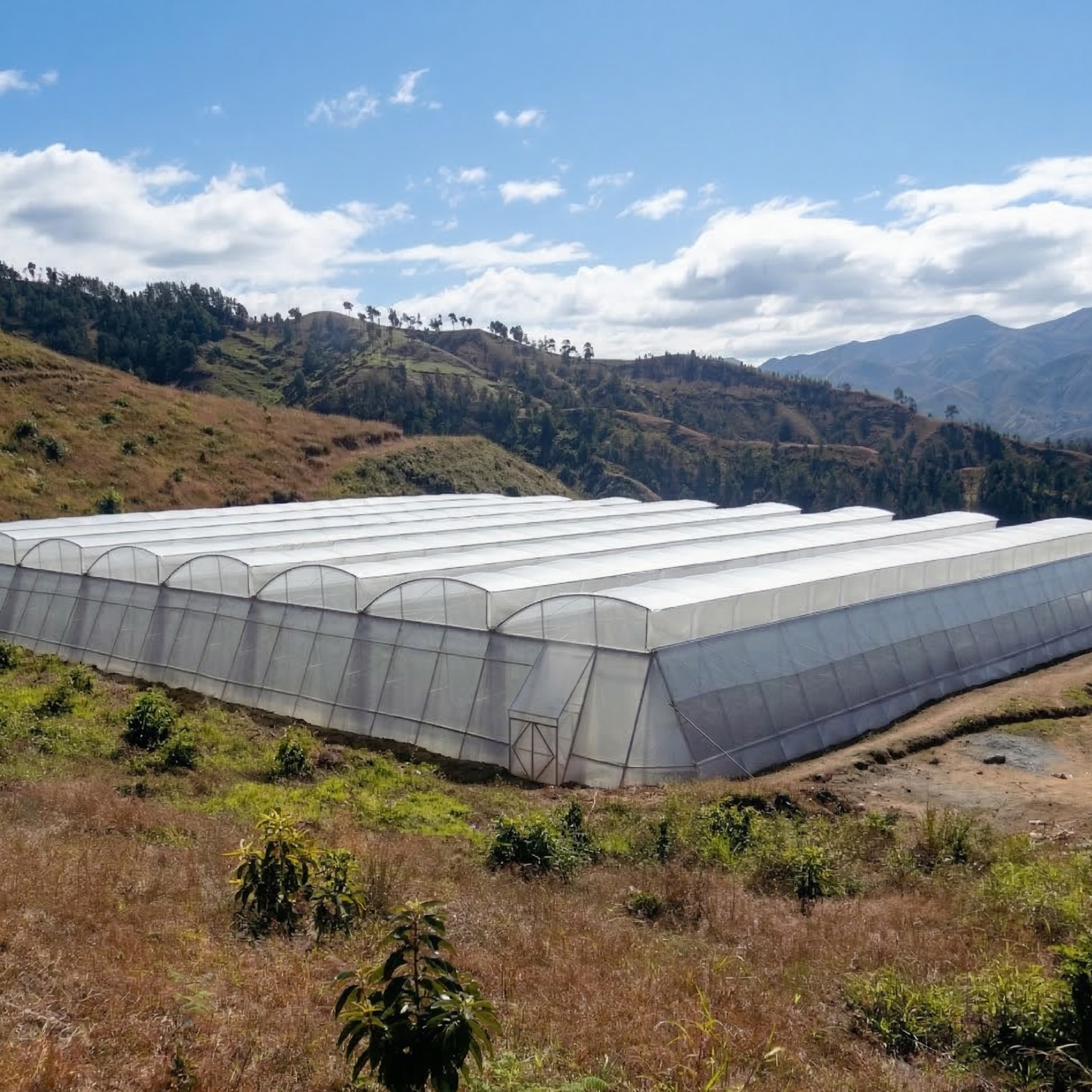
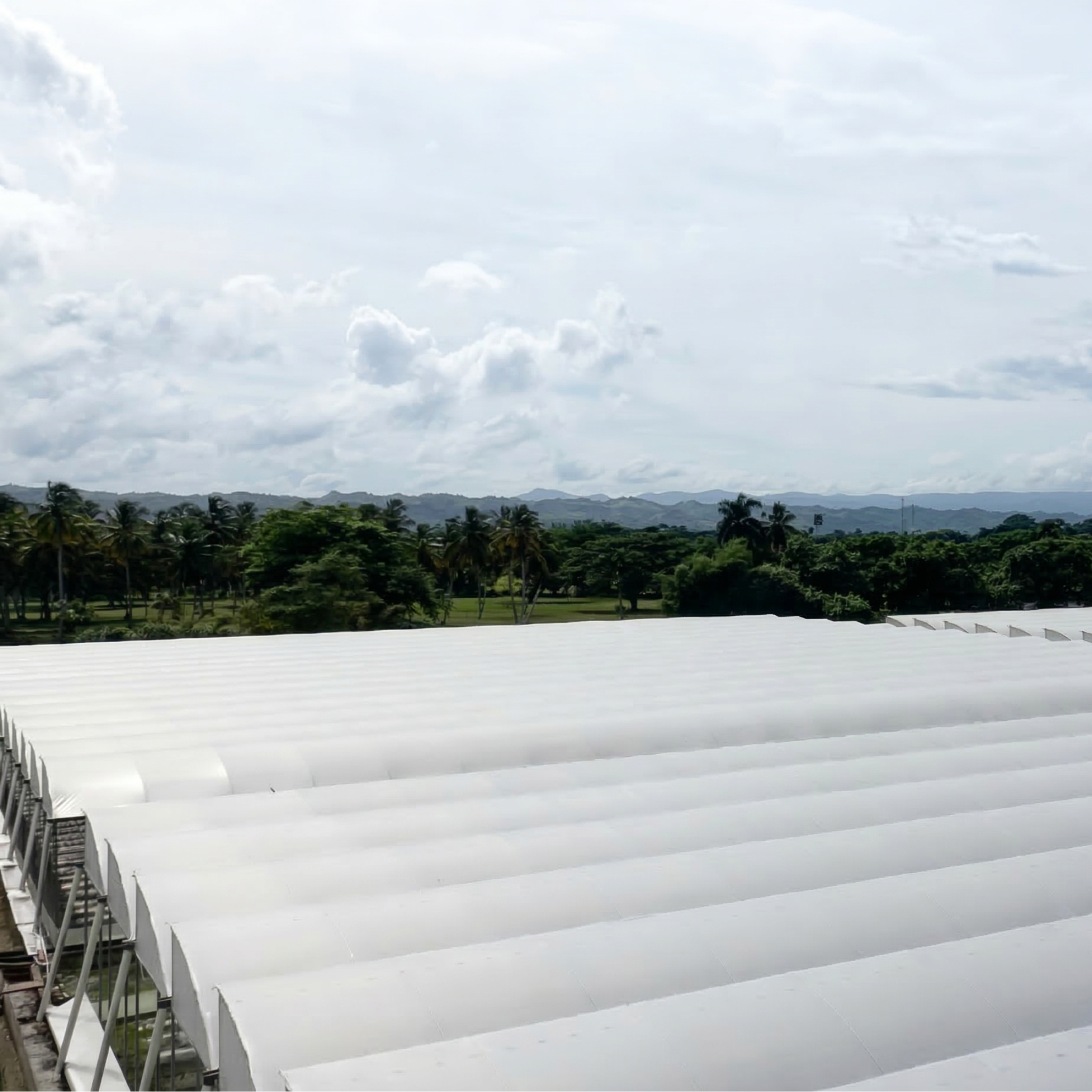


Covering a commercial greenhouse in a Caribbean climate with a plastic that withstands intense UV radiation, seasonal hurricane winds, and at the same time diffuses light for homogeneous photosynthesis without condensation from tropical humidity, requires a coextruded five-layer polyolefin (PO) film with UV-IR-EVA additives and an agronomic-grade diffuser agent. This greenhouse cover plastic —also called agrofilm, PO greenhouse film, or diffuse greenhouse film— is manufactured by Gardese in 5-layer coextruded PO with an EVA middle layer, 200 µm thick (800 gauge), with anti-drip, anti-fog, dust-repellent additives, HALS UV stabilization, thermal preservation through infrared additive, and 70% light diffusion, certified for 700 KLy (≈ 3 years of service life in tropical climate), in four widths (4, 6, 8, and 10 m) and a length of 50 m, designed for professional agricultural production, commercial nurseries, and crop protection in tropical climates.
Why polyolefin (PO) film and not standard polyethylene (PE)
Polyolefin (PO) is a family of high-performance multilayer polymers that replaces standard polyethylene (PE) in intensive-use greenhouses. Compared to PE, PO offers higher transparency (greater light transmission), greater mechanical resistance to tearing and impact, better adhesion of anti-drip additives (which prolongs the anti-drip effect throughout the entire service life), and above all, greater resistance to UV aging in tropical climates like the Caribbean. In practice, a PO cover preserves its optical and mechanical properties to the end of the 3 years, while an economical PE cover becomes brittle and opaque before the first year is over.
What 700 KLy means: the real service-life metric
The lifespan of an agricultural film is not measured in calendar months but in KLy (kilo-Langley), the standard unit of cumulative solar radiation that the plastic receives during use. One Langley equals 1 cal/cm²; 700 KLy is equivalent to the cumulative solar radiation that falls on an exposed surface over approximately 3 years under the sun of the Caribbean tropical climate. Economical films are certified between 100 and 300 KLy (which translates into 6 months to 1 year of real service in DR); this film is certified in the High-Weather-Resistant category at 700 KLy, which guarantees a full service life of 3 continuous seasons under extreme exposure conditions.
Key benefits
- Multilayer PO vs. standard PE: greater transparency, greater mechanical tear resistance, better adhesion of anti-drip additives, and better aging under Caribbean sun than conventional polyethylene, which translates into a longer real service life and better agronomic performance.
- HALS UV stabilization, 3 years guaranteed (700 KLy): the combination of HALS stabilizer (hindered amine), UV absorber, and antioxidant protects the polymer chain against degradation from Caribbean solar radiation, ensuring mechanical integrity through three continuous seasons in full sun.
- Anti-drip, anti-fog, and dust-repellent system: hydrophilic additives on the inner face prevent the formation of drops that create a magnifying-glass effect and burn leaves; they convert condensation into a sheet of water that runs down the greenhouse walls. The smooth finish (no embossing) maximizes the surface life of these additives, in contrast to embossed films that lose the anti-drip effect after a few months.
- 70% light diffusion for homogeneous photosynthesis: a masterbatch with TiO₂, talc, and inorganic fillers disperses direct radiation, converting it into uniform indirect light, eliminating shaded zones and overheating spots where direct rays would concentrate on the crop. 70% haze is the optimum for tropical climate: enough to prevent leaf burns and to spread light down to the lower levels of the canopy, without sacrificing total luminosity.
- 800 gauge (200 µm) and 5 coextruded layers for mechanical resistance: the calibrated thickness and multilayer structure withstand mounting tension, strong winds, and occasional impacts from hail or branches during hurricanes and tropical storms without tearing in a line.
- IR additive for thermal control: the infrared additive retains heat during cool nights (especially in the north of the country and during winter), stabilizing the greenhouse microclimate. The 70% diffusion mitigates daytime overheating.
- Tolerant to conventional sulfur and chlorine: compatible with the usual phytosanitary treatments and chlorinated water from the irrigation system without prematurely affecting the film's service life.
Typical applications and uses
- Top cover for commercial gable, tunnel, and multi-tunnel greenhouses for intensive horticultural production.
- Low tunnels for vegetable, strawberry, and melon crops in open fields with seasonal protection.
- Commercial nurseries for ornamental plants, vigorous fruit-tree stock, and seedling production under permanent roofing.
- Agricultural sheds to protect equipment, materials, or low-profile crops from rain and intense sun.
Quality and durability
An economical greenhouse plastic fails on two fronts: the UV additive dosage is insufficient or of low quality (which causes embrittlement and tearing within months, not years) and the anti-drip additives release or become inactive quickly (which causes leaf burns from the magnifying-glass effect and fungal growth). Gardese works with 5-layer coextruded PO film, HALS stabilizer, IR additive for thermal preservation, 70% diffuser, and 700 KLy certification, which separates a professional production agrofilm from a generic plastic sheet that tears at the first hurricane or loses its anti-drip effect within the first month.
Is this plastic suitable for Caribbean climate with hurricanes and high radiation?
Can it be installed on any greenhouse structure?
How is the cover cleaned to keep optimal light transmission?
Does this material help control pests in protected crops?
Still have questions?
Ask us and we will gladly help you with whatever you need.
| General | |
|---|---|
| Special features | Anti-drip, anti-fog, dust-repellent, anti-UV, anti-aging, thermal preservation (IR), and light diffusion |
| Material and construction | |
| Material | 5-layer coextruded polyolefin (PO) film with EVA middle layer |
| Weight per square meter | Approx. 184 g/m² (5.4 oz/yd²) |
| Dimensions and format | |
| Width | 4 m (13.1 ft) |
| Length | 50 m (164.0 ft) |
| Nominal thickness | 0.2 mm (0.008 in) / 200 µm |
| Coverage area | 200 m² (2152.8 ft²) |
| Thickness limit deviation | ±0.003 mm (±0.0001 in) |
| Average thickness deviation | ±10% |
| Strength and performance | |
| Nominal break elongation (longitudinal/transverse) | ≥500% / ≥450% |
| Haze | 70% (high diffusion) |
| Tensile strength (longitudinal/transverse) | ≥25 MPa / ≥22 MPa |
| Right-angle tear resistance | ≥70 kN/m |
| Light transmittance | ≥88% |
| Durability and protection | |
| UV protection | HALS stabilizer (hindered amine) + UV absorber + antioxidant |
| Performance retention rate after artificial aging | ≥50% |
| Service life | 3 years |
| Physicochemical properties | |
| Density | Approx. 0.92 g/cm³ (57.4 lb/ft³) |
| Presentation and packaging | |
| Presentation | Roll 4 m (13 ft) wide × 50 m (164 ft) long |
| Roll: Width | 23.0 cm (9.06 in) |
|---|---|
| Roll: Height | 23.0 cm (9.06 in) |
| Roll: Depth | 200.0 cm (78.74 in) |
| Roll: Weight | 37.7 kg |
Official GARDESE warranty
What's covered
Confirmed defect: replacement or refund of the amount paid.
What's not covered
Pago & Seguridad

