

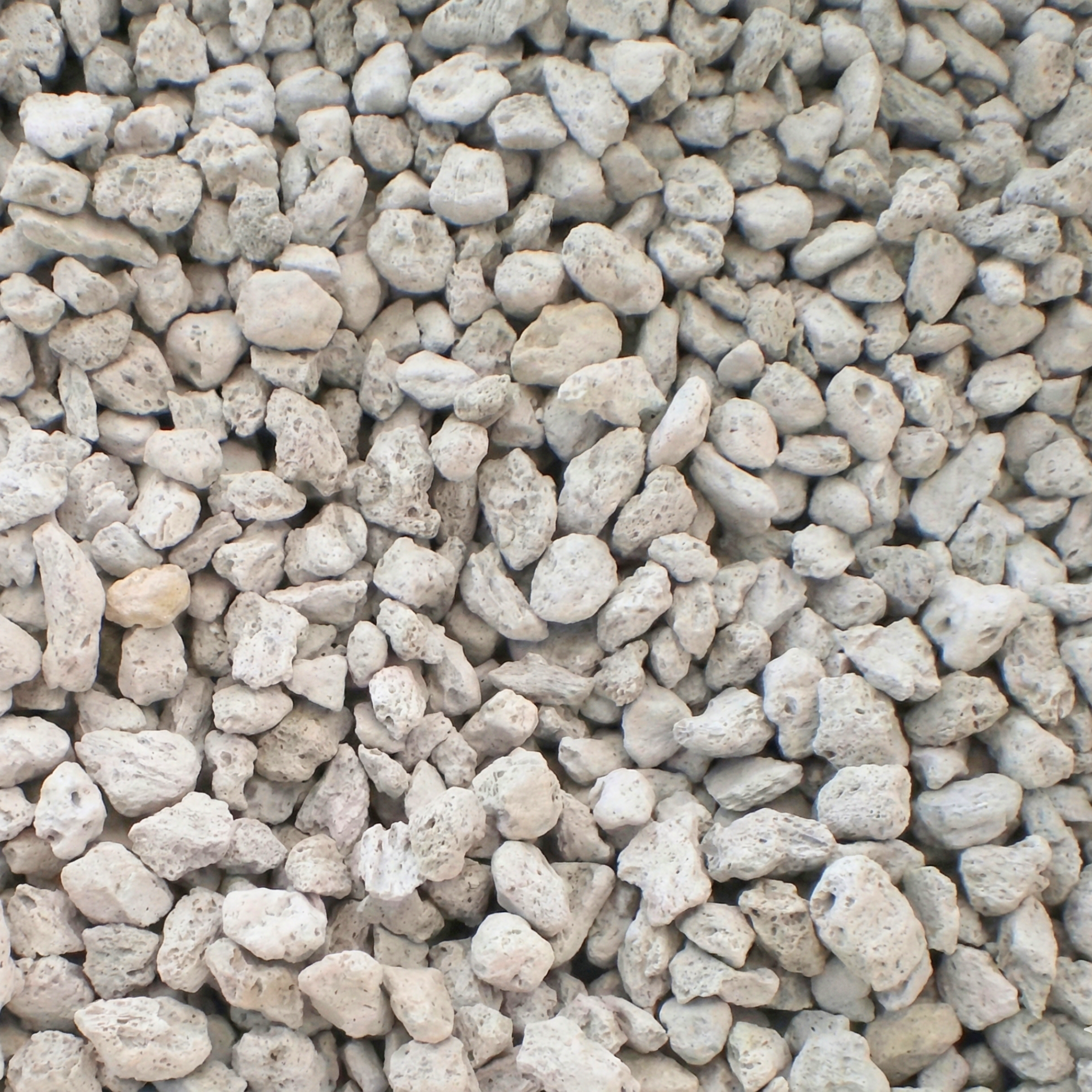


Improving drainage and root aeration in heavy substrates where perlite floats to the surface and is crushed in a few cycles, without adding weight to large pots or altering the pH of the medium, requires pumice stone with calibrated granulometry and stable structural density. This pumice —also called pumice stone, or pumicite— is sold by Gardese in fine (1-3 mm) and medium (3-6 mm) formats in 40 L bags, designed for professional gardening, cultivation of cacti and succulents, hydroponics, improvement of clay soils, and lightweight concrete construction.
Main benefits
- Superior aeration with low compaction: the porous cellular structure ensures continuous oxygenation of roots and prevents root asphyxiation in Caribbean clay soils, a critical condition for cacti, succulents, and sensitive plants.
- Structural density that does not float: unlike ultralight perlite that rises to the surface after several waterings and loses its function, pumice maintains a stable position in the substrate for years, it does not crush or compact.
- Neutral pH, chemically inert: it does not alter the acidity of the substrate or react with fertilizers or chemical additives, a condition compatible with all types of mixtures for gardening and agricultural production.
- Thermal insulation for the root zone: low thermal conductivity protects roots from temperature spikes in pots exposed to the Caribbean sun.
- Dual use in gardening and construction: applicable as an aggregate for lightweight concrete, low-density blocks, and wall insulation, expanding its use beyond horticultural substrate.
Typical applications and uses
- Mix with base substrate (topsoil, coco fiber, peat moss) for pots and planters: 20-40% for horticultural and ornamental plants, up to 50% for cacti and succulents.
- Hydroponic cultivation with pumice as an inert support medium in recirculating systems.
- Recovery of compacted clay soils in lawns, orchards, and professional gardening.
- Drainage layer at the bottom of pots and as an aggregate for lightweight concrete in light construction.
Quality and durability
An economical pumice fails in two ways: the granulometry is irregular with high proportions of fine dust (which reduces useful volume and produces uneven drainage when settled) and the volcanic origin is not controlled (which produces stones with high impurities that affect the pH of the substrate). Gardese works with pumice calibrated in selected fine or medium granulometry, which separates a professional gardening and construction pumice stone from a generic bag that saturates the pot with dust.
What's the real difference between pumice and perlite?
Do I need to wash pumice before using it for cultivation?
Can it be used to lighten concrete in construction?
Does it work for all kinds of plants, or are there specific limitations?
Still have questions?
Ask us and we will gladly help you with whatever you need.
| Dimensions and format | |
|---|---|
| Volume | 40 L (10.6 gal) |
| Physicochemical properties | |
| Electrical conductivity (EC) | Very low (< 0.5 dS/m) |
| Particle size | 1 - 3 mm (0.04 - 0.12 in) |
| pH level | 6.5 - 7.5 |
| Presentation and packaging | |
| Packaging | Bag |
Official GARDESE warranty
What's covered
Confirmed defect: replacement or refund of the amount paid.
What's not covered
Pago & Seguridad

