
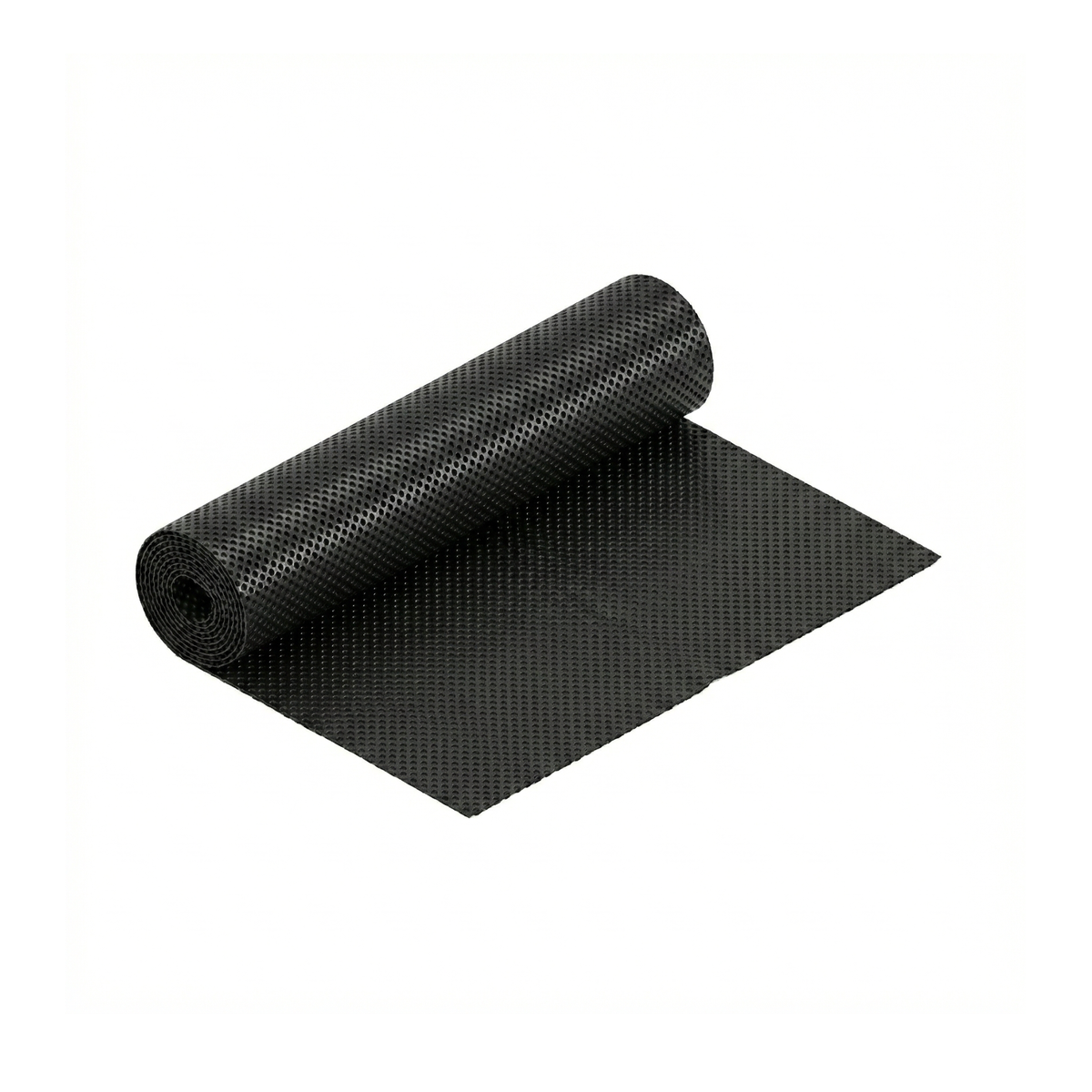
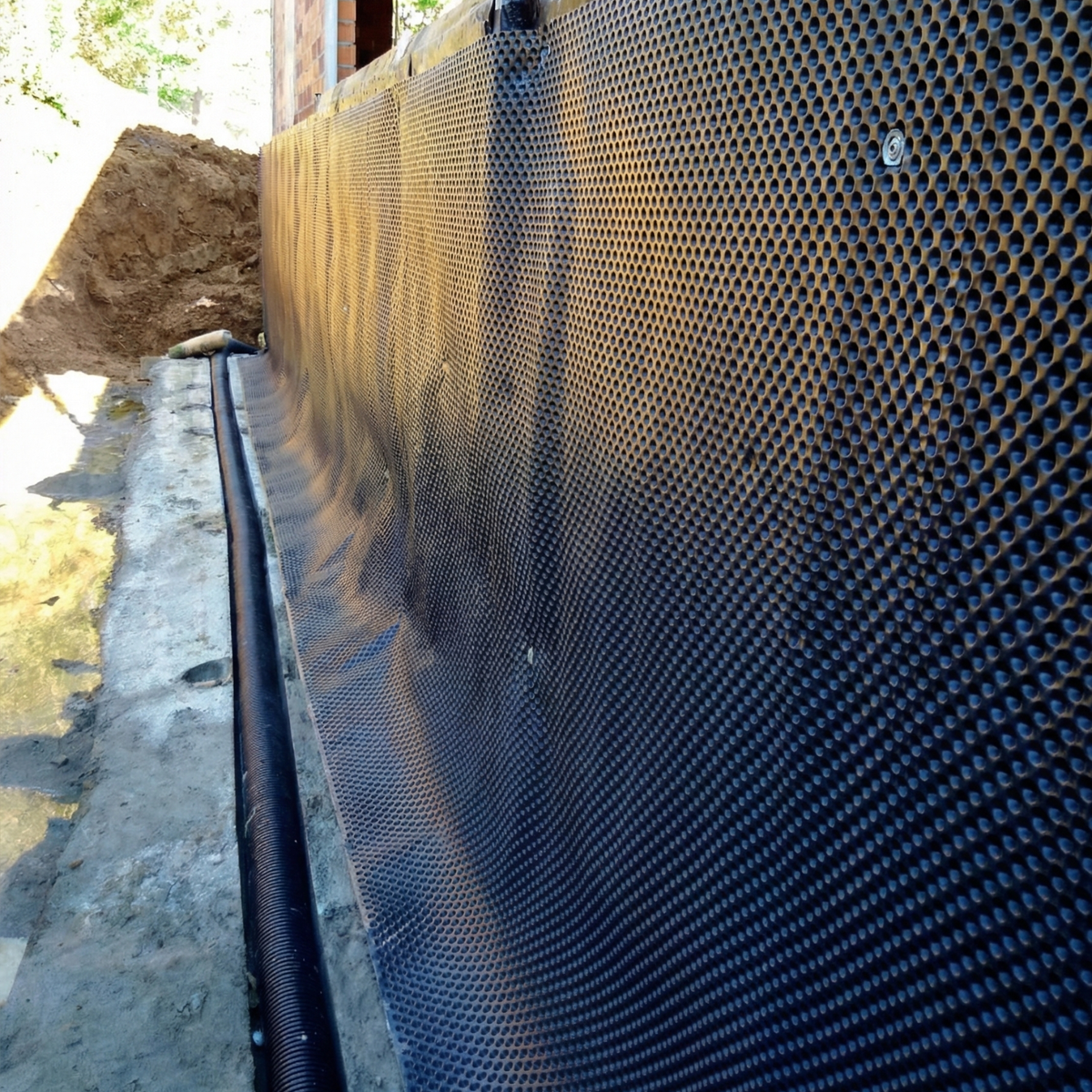
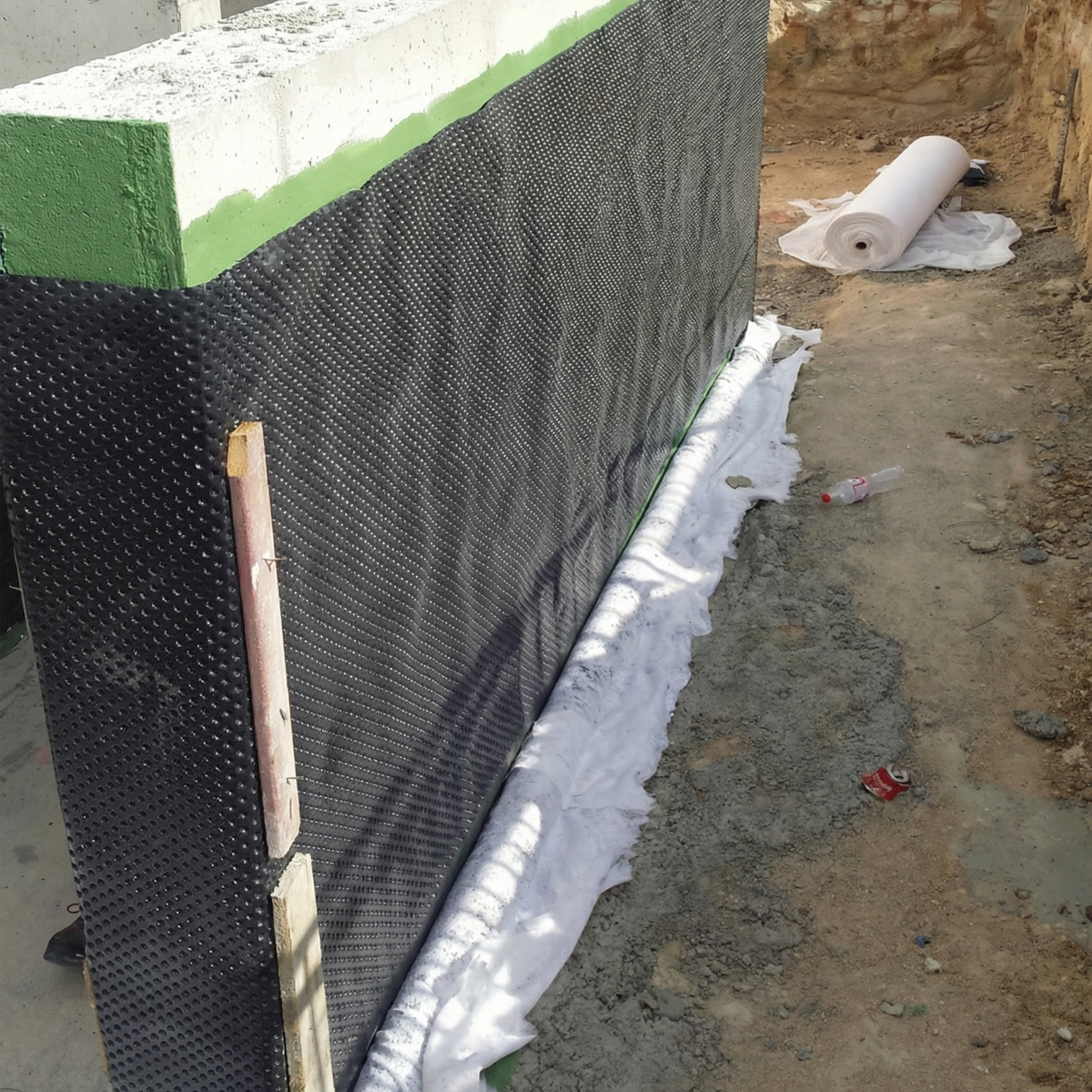


Protecting buried basement walls against permanent moisture without the hydrostatic pressure of the ground water degrading the waterproofing over time, shielding retaining walls against mechanical damage during backfilling with earth and stones, and creating a ventilation chamber for breathable walls, requires a dimpled HDPE drainage membrane with calibrated dimples and compressive strength for buried use. This dimpled drainage membrane —also called a dimple sheet, or studded membrane— is manufactured by MOLTEXO in 700 g/m² HDPE, in 2×20 m rolls, designed for buried walls, foundations, basements, tunnels and civil construction projects with problems of capillary moisture or groundwater.
Key benefits
- Air gap between wall and ground: the dimples create a circulation space between the wall and the backfill, where infiltrated water flows freely to the lower drainage without putting pressure on the structure, eliminating the hydrostatic pressure that ruins traditional walls.
- Mechanical protection of the waterproofing: the smooth outer face absorbs impacts from stones and compaction of the backfill, preventing damage to asphalt paint, bituminous felt or chemical waterproofing, which, with mechanical damage, loses its watertightness and allows permanent moisture to enter.
- Inert and durable HDPE: polyethylene is chemically resistant to moisture, biological attack (fungi, bacteria), soil alkalis and acids, plant roots and rodents, conditions for decades of service life when buried.
- Wall ventilation against capillary moisture: the air gap allows the wall to breathe and eliminate moisture accumulated by rising capillary action, a critical condition for basements in areas with high water tables in the Caribbean where capillary moisture is a chronic problem.
- Water reserve in green roofs and planters: the "cups" formed by the dimples retain small amounts of water available for the upper substrate between waterings, an additional technical advantage when the membrane is used as a combined drainage-retention layer in green roofs.
Typical applications and uses
- Buried basement walls, stair walls and retaining walls with permanent ground moisture.
- Deep foundations, footings and retaining walls in hydraulic works with hydrostatic pressure.
- Tunnels, underground works and service galleries with perimeter drainage.
- Green roofs and planters with a dual drainage-water retention function for the upper substrate.
Quality and durability
An economical drainage membrane fails in two points: the HDPE is low-grade recycled (which produces dimples that flatten under the weight of the backfill and lose the drainage air gap) and the actual grammage is lower than declared (which produces a thin membrane that tears during backfilling with stones). MOLTEXO works with verifiable virgin 700 g/m² HDPE, which separates a professional construction drainage membrane from a decorative membrane that fails after a few years under the buried wall.
Equivalences
Equivalent to these other-brand references:
- 700 g/m² (20.6 oz/yd²) · Roll 2 m (6.6 ft) wide and 20 m (66 ft) long
- Delta-MSEnkadrainGeodrénFondalineTefond
Brands and references mentioned belong to their respective owners; cited only for comparison and compatibility.
Which way should the dimples face when installing the membrane?
Does this membrane replace bituminous paint or wall waterproofing?
Can it be used in planters and green roofs?
What mechanical strength does it offer under the weight of the backfill?
What specific accessories does a proper installation require?
Still have questions?
Ask us and we will gladly help you with whatever you need.
| General | |
|---|---|
| Appearance after 50% compression | No damage |
| Material and construction | |
| Material | High-density polyethylene (HDPE) |
| Weight per area (specification) | 700 g/m² (20.65 oz/yd²) |
| Dimensions and format | |
| Sheet height with embossing (dimple) | 8 mm (0.315 in) |
| Drainage area (cross-section) | ≥30 cm² (≥4.65 in²) |
| Strength and performance | |
| Tear strength | 100 N (≥22.5 lbf) |
| Elongation at break | 25 % |
| Tensile force at 10% elongation | ≥350 N/100mm (≥240 lb/ft) |
| Maximum tensile force | 600 N/100mm (≥411 lb/ft) |
| Compressive strength | 100 kPa (≥14.5 psi) |
| Durability and protection | |
| Thermal aging 80°C, 168 h — elongation at break retention | ≥70 % |
| Thermal aging 80°C, 168 h — compressive strength retention | ≥80 % |
| UV protection | Yes (high) |
| Alkali resistance — elongation at break retention | ≥80 % |
| Alkali resistance — compressive strength retention | ≥80 % |
| Presentation and packaging | |
| Presentation | Roll 2 m (6.6 ft) wide × 20 m (66 ft) long |
| Roll: Width | 27.0 cm (10.63 in) |
|---|---|
| Roll: Height | 42.0 cm (16.54 in) |
| Roll: Depth | 200.0 cm (78.74 in) |
| Roll: Weight | 28.0 kg |
Official MOLTEXO warranty
What's covered
Confirmed defect: replacement or refund of the amount paid.
What's not covered
Pago & Seguridad

