
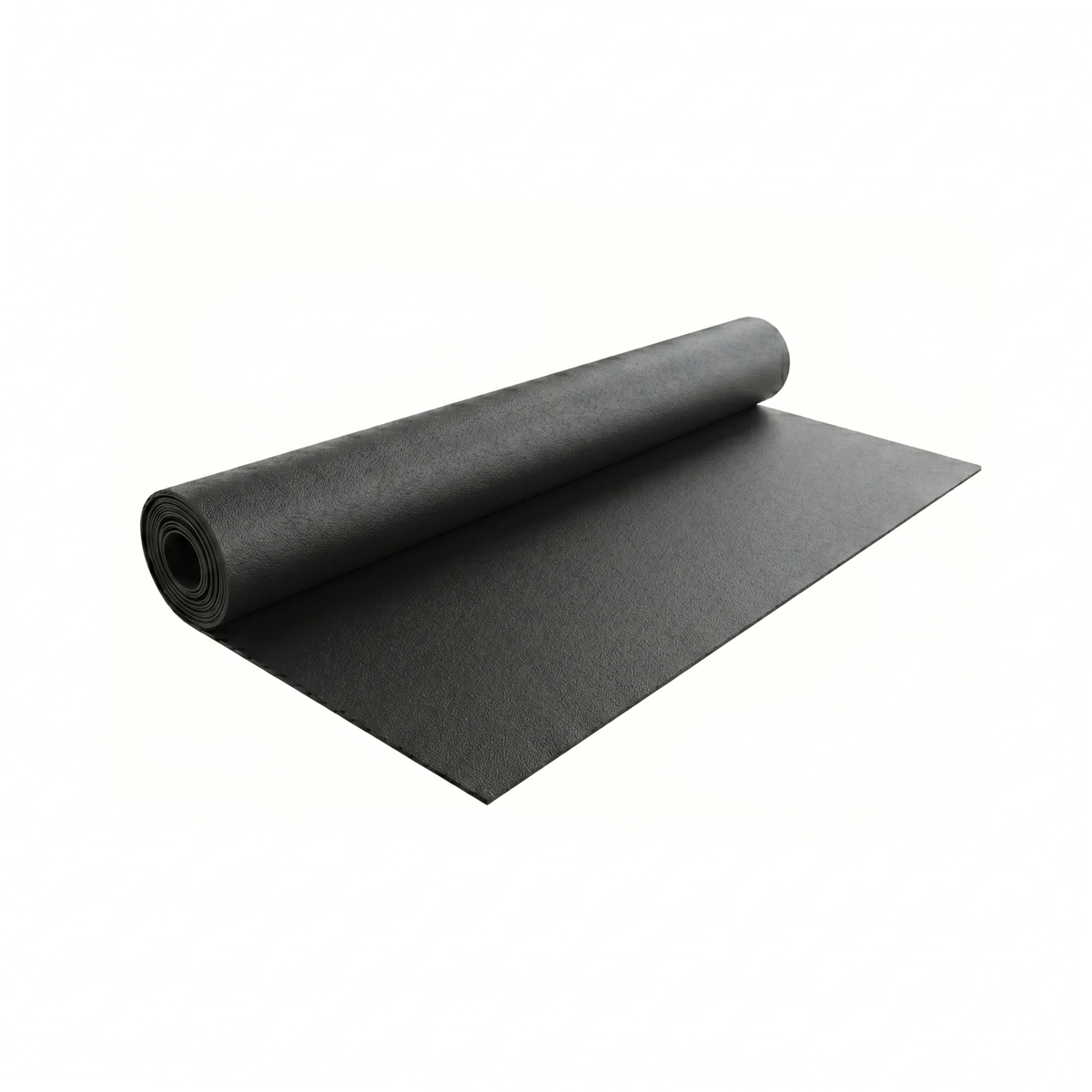
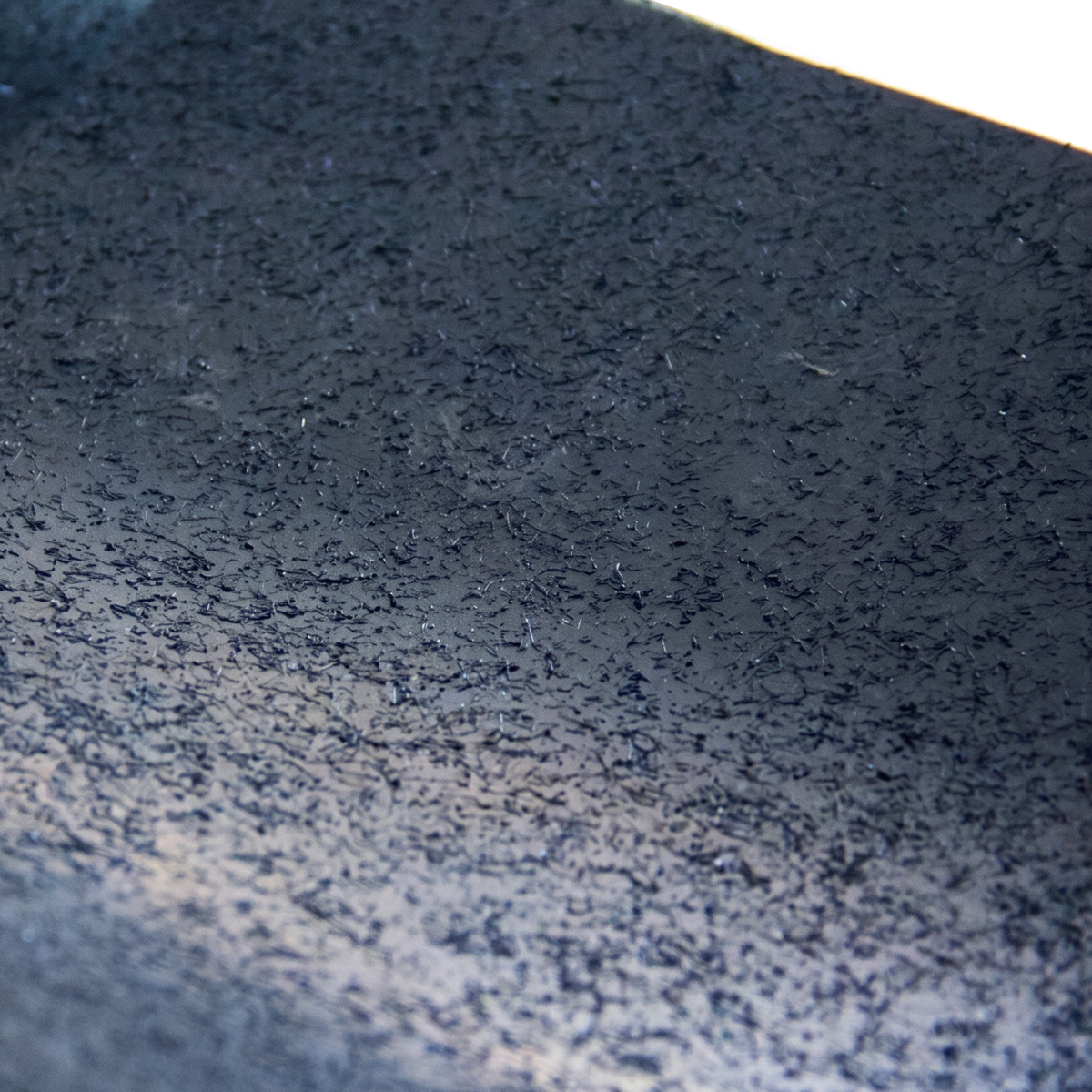
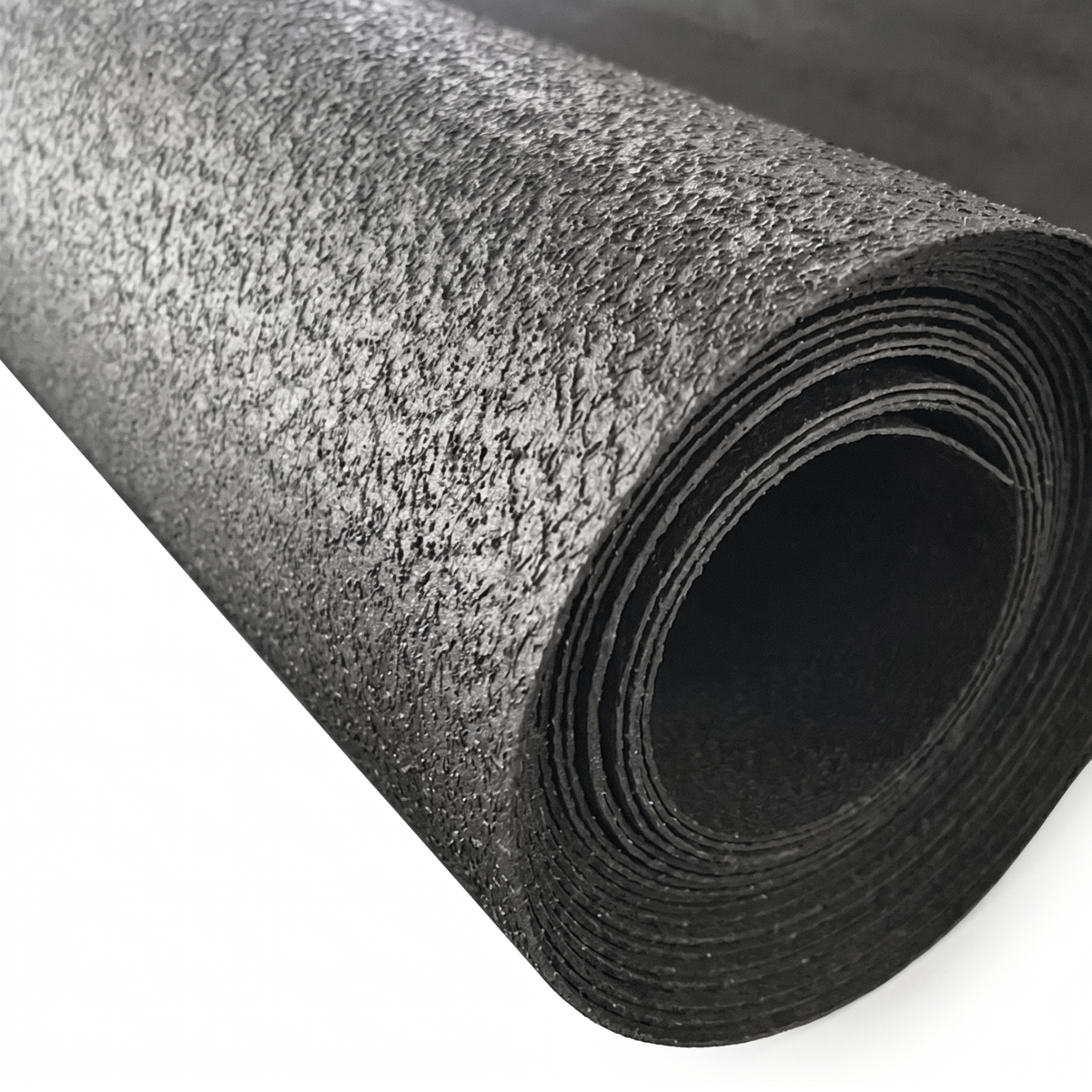
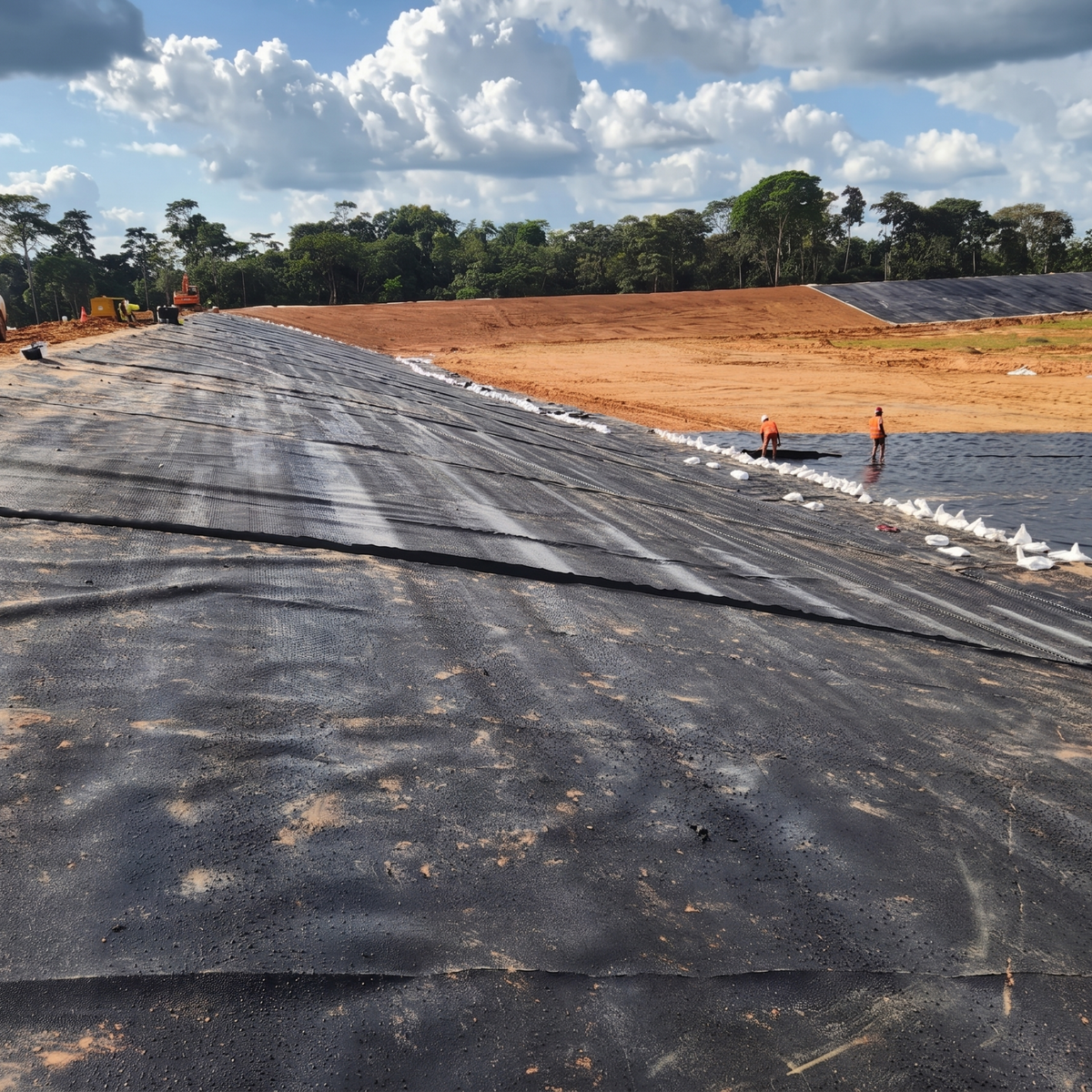


When containment runs over slopes, smooth geomembrane slips: the cover soil, the waste or the water push the sheet down the incline and compromise the stability of the works. This textured HDPE geomembrane —also called textured liner or rough geomembrane— solves that problem with a relief surface on both sides that multiplies interface friction. Manufactured by Moltexo with professional-grade virgin resins in gauges from 4000 to 8000 (1.0 to 2.0 mm), it is designed for landfills, mining and steep-walled reservoirs where slope stability is audited: never as a temporary solution.
Key benefits
- Superior interface friction: texture on both sides with an asperity height ≥ 0.40 mm (ASTM D7466), which increases the friction angle against soil and other geosynthetics and keeps the cover stable on steep slopes.
- Certifiable slope stability: verifiable direct shear behavior per ASTM D5321 / D6243, the data required by the stability calculation in landfill cells and leach pads.
- Same UV and chemical resistance as the smooth version: carbon black content of 2.0 to 3.0 % (ASTM D1603) and OIT retention after UV aging, to withstand years under the direct Caribbean sun without degrading.
- HDPE mechanical durability: resistance to tensile stress, puncture, tear and stress cracking (ESCR) in accordance with the GRI-GM13 family of specifications for textured geomembrane.
- Careful Moltexo manufacturing: professional-grade virgin polymer, individual minimum thickness with controlled tolerance and verified ASTM tests on every gauge.
Applications and typical uses
- Lining of slopes and inclined walls in sanitary landfill cells and secure landfills.
- Leach pads (leach pads) and tailings deposits in mining projects.
- Reservoirs, dams and oxidation ponds with steep slopes.
- Final cover systems (capping) where the topsoil must hold on the sheet without slipping.
Quality and durability
Each variant meets the reference tests for textured HDPE: asperity height per ASTM D7466, tensile properties per ASTM D6693 and stress crack resistance (ESCR) per ASTM D5397, with the same UV protection as the smooth line. The texture is produced integrally during manufacturing —it is not a smooth sheet onto which a surface relief is printed— so the relief is not crushed under load nor lost over time. Moltexo also controls the individual minimum thickness with a −10 % tolerance on each roll, a requirement that simply does not apply to low-cost materials.
Equivalences
Equivalent to these other-brand references:
- 1 mm (Gauge 4000 · 40 mil) · Roll 5.8 m (19 ft) wide and 100 m (328 ft) long
- Pavco Wavin Textured HDPE Geomembrane 40 milATARFIL HD Textured 1.00 mmSolmax GSE HD Textured 40 milTitan 40HD SST-DST (40 mil)AGRU HDPE MicroSpike 40 milNAUE Carbofol HDPE BF/TF 1.0 mmLayfield HDPE 40 texturedMaccaferri MacLine TDH 100
- 1.5 mm (Gauge 6000 · 60 mil) · Roll 5.8 m (19 ft) wide and 100 m (328 ft) long
- Pavco Wavin Textured HDPE Geomembrane 60 milATARFIL HD Textured 1.50 mmSolmax GSE HD Textured 60 milTitan 60HD SST-DST (60 mil)AGRU HDPE MicroSpike 60 milNAUE Carbofol HDPE BF/TF 1.5 mmLayfield HDPE 60 texturedMaccaferri MacLine TDH 150
- 2 mm (Gauge 8000 · 80 mil) · Roll 5.8 m (19 ft) wide and 100 m (328 ft) long
- Pavco Wavin Textured HDPE Geomembrane 80 milATARFIL HD Textured 2.00 mmSolmax GSE HD Textured 80 milTitan 80HD SST-DST (80 mil)AGRU HDPE MicroSpike 80 milNAUE Carbofol HDPE BF/TF 2.0 mmLayfield HDPE 80 texturedMaccaferri MacLine TDH 200
Brands and references mentioned belong to their respective owners; cited only for comparison and compatibility.
What sets it apart from a common construction-grade black plastic?
Does it withstand contact with fuels, agricultural acids, and fertilizers?
Is it the same as a PVC sheet or a waterproofing tarp?
Still have questions?
Ask us and we will gladly help you with whatever you need.
| Material and construction | |
|---|---|
| Material | Virgin high-density polyethylene (HDPE) |
| Surface finish | Textured |
| Mandrel | Rigid plastic |
| Dimensions and format | |
| Nominal thickness | 1 mm (0.040 in) — ASTM D5199 |
| Asperity height | 0.25 mm (0.0098 in) — ASTM D7466 |
| Strength and performance | |
| Tear resistance | 125 N (28.1 lbf) — ASTM D1004 |
| Elongation at break | 100 % — ASTM D6693 Type IV |
| Yield elongation | 12% — ASTM D6693 Type IV |
| Puncture resistance | 267 N (60.0 lbf) — ASTM D4833 |
| Tensile strength at break | 10 N/mm (57.1 lbf/in) — ASTM D6693 Type IV |
| Yield tensile strength | 15 N/mm (85.7 lbf/in) — ASTM D6693 Type IV |
| Durability and protection | |
| Carbon black content (range) | 2.0-3.0% — ASTM D1603 |
| Carbon black dispersion | 9 of 10 readings in categories 1-2 (fewer than 1 in category 3) — ASTM D5596 |
| UV protection | Yes (high) |
| Stress crack resistance (ESCR) | 500 h — ASTM D5397 |
| UV resistance (high-pressure OIT retention 1600 h) | 50% — ASTM D5885 |
| UV resistance (standard OIT retention 1600 h) | 50% — ASTM D3895 |
| High-pressure OIT retention (90 days at 85°C) | 80% — ASTM D5721/D5885 |
| Standard OIT retention (90 days at 85°C) | 55% — ASTM D5721/D3895 |
| Oxidation induction time (OIT), high pressure | 400 min — ASTM D5885 |
| Standard oxidation induction time (OIT) | 100 min — ASTM D3895 |
| Physicochemical properties | |
| Density | 0.940 g/cm³ (58.7 lb/ft³) — ASTM D1505/D792 |
| Presentation and packaging | |
| Presentation | Roll 5.8 m (19 ft) wide × 100 m (328 ft) long |
 ASTM standards
Official MOLTEXO warranty
What's covered
Confirmed defect: replacement or refund of the amount paid.
What's not covered
Payment & Security

