

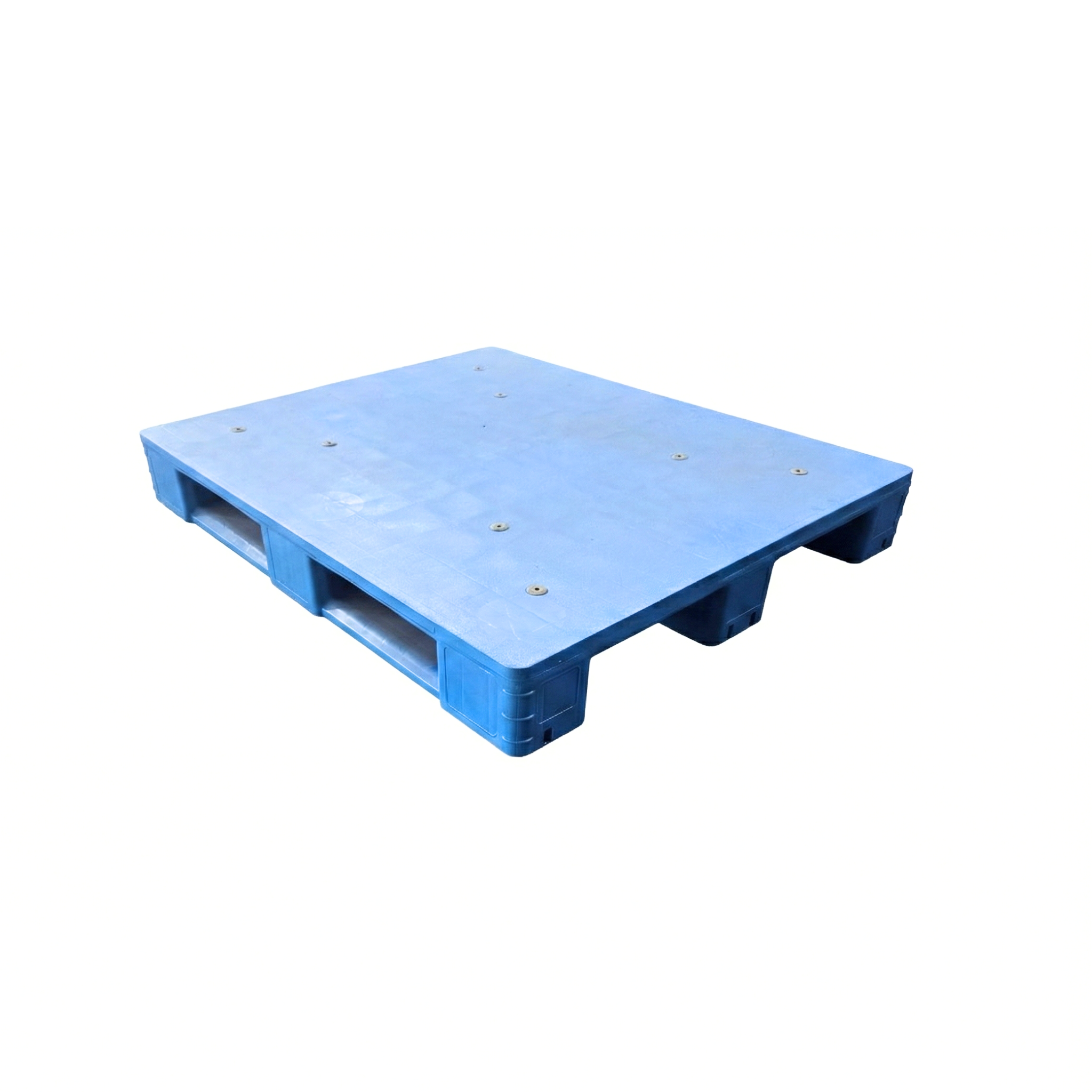
If you process food under HACCP, GMP or ISO 22000 certification, operate a pharmaceutical laboratory with a cleanroom, manage a cold room where wood becomes contaminated by condensation, or export food to the USA and Europe with a buyer's health audit, the hygienic plastic pallet is the only option that performs in continuous auditing without corrective notes. This guide explains how to choose between American (120×100 cm) and European (120×80 cm), how to apply the washing and disinfection protocol between cycles, how to segregate contaminated batches, and how to document pallet traceability in your quality management system.
The hygienic pallet differs from the standard 3-runner plastic pallet on two critical points: the HDPE is certifiable food-grade virgin material (not regenerated, not mixed with recycled materials of unknown origin) and the geometry is designed to minimize organic residue accumulation points and allow complete draining after washing. If your operation does not require active health certification, the standard 3-runner pallet meets the requirement at a lower cost. If you require certification, the additional cost of the hygienic one is justified by the risk of not passing the audit with the standard pallet.
Product specifications
The hygienic plastic pallet is offered in two standard formats corresponding to the most widespread international palletizing standards. Both variants share food-grade virgin HDPE material and easy-wash geometry. The following table sets out the complete technical specifications of the two available variants:
| Specification | American 120×100 cm | European 120×80 cm |
|---|---|---|
| SKU | 096453 | 650567 |
| Material | Food-grade virgin HDPE | Food-grade virgin HDPE |
| Dimensions | 120×100 cm (48×40 in) | 120×80 cm (48×32 in) |
| Color | Blue (standard food-grade color) | Blue (standard food-grade color) |
| Geometry | Closed surface / controlled grid | Closed surface / controlled grid |
| Chemical compatibility | Diluted chlorine, peracetic acid, quaternary ammonium compounds | Diluted chlorine, peracetic acid, quaternary ammonium compounds |
| Pressure washing | Yes, up to 80–90 °C with steam | Yes, up to 80–90 °C with steam |
| ISPM-15 standard | Exempt (does not apply to plastic) | Exempt (does not apply to plastic) |
| Main application | USA/LATAM food processors | European food processors |
| Estimated service life | Hundreds of cycles with standard washing | Hundreds of cycles with standard washing |
The sister guides for the 3-runner plastic pallet, the one-way plastic pallet, the reversible plastic pallet, the folding-box plastic pallet, the box plastic pallet and the spill-containment plastic pallet cover the other six configurations in the family.
Step-by-step usage
The following procedure covers the operating cycle under health regulations: integration into the client's HACCP protocol, palletizing, washing between cycles, segregation and traceability. The instructions apply to both variants and supplement —not replace— the written protocol of your quality management system.
Integration into the HACCP/GMP protocol
Before incorporating the hygienic pallet into the production circuit, integrate the unit into your plant's HACCP manual: identify the pallet as a control point in the goods flow, define the frequency of visual inspection (at least at the start of each shift), establish the washing and disinfection protocol between batches, and link the pallet to an identification number for traceability. Ask Cargobo for the technical data sheet with the food-grade declaration of conformity for the virgin HDPE so you can include it in the audit file.
Visual inspection and palletizing
Before loading, visually inspect the pallet: discard any unit with cracks, broken corners, dried organic residue stuck to the surface, or deformations indicating structural fatigue. Pallets with structural damage are segregated to a downgrade area for repair or controlled disposal, and are NEVER returned to the hygienic circuit. Place the packaged goods (sealed boxes, pallets with product packaged in plastic, closed bags) centered and within the perimeter. For the food industry, avoid direct contact between the product without primary packaging and the pallet —there must always be a barrier (box, plastic, tarp)—.
Washing between cycles
Washing between cycles is what distinguishes the operationally hygienic pallet from the one that merely carries the label. Standard procedure: initial rinse with pressurized water (60–80 bar) to remove visible solid and organic residues, washing with neutral food-grade detergent and a hard-bristle brush for corners and joints, intermediate rinse, disinfection with the protocol solution (chlorine diluted to 200 ppm, peracetic acid at 0.1–0.3% or quaternary ammonium compounds per client specification), final rinse and complete draining. The surface must be left visually clean and dried in the air or by passing through a drying tunnel before the next use.
Segregation by zones and color codes
In professional HACCP operations, pallets are segregated into zones (raw material receiving, production line, finished product warehouse, dispatch) and do NOT migrate between zones to avoid cross-contamination. Identify each zone with a color code (indelible label on the side of the pallet) or control number. If the end client requires allergen segregation (gluten-free plant, nut-free plant, etc.), keep batches of pallets exclusive to that flow, washed in a separate circuit. Discipline in segregation is what passes the audit; a pallet from the raw meat zone used in finished-product packaging is a "critical finding" in HACCP.
The plant with recurring audits that has gone three years without observations typically keeps a "withdrawn pallets log" recording the date, reason (crack, deformation, persistent residue after washing) and destination (repair, controlled disposal). This log gives the auditor objective evidence that the system works and that defective pallets do not return to the circuit. Implementing it costs an Excel sheet and half an hour a week of the plant manager's time, and it is worth more than the supplier's food-grade seal on the day the auditor asks "what do you do with damaged pallets?".
Traceability and recording
For food export to the USA and Europe with a buyer's audit, maintain a per-pallet traceability system: pallet number, product batch it carried, departure date, return date (if applicable), last washing and disinfection date, observations. Modern industrial systems use RFID tags embedded in the pallet for automatic recording as they pass through dock gates; in simpler operations, a number painted on the side face with an indelible seal and manual recording is sufficient. The investment in traceability pays off on the day of a market recall or a health alert, where tracing the pallets that touched the affected batch avoids a complete stock withdrawal.
Do not mix hygienic pallets with standard pallets from the general industrial circuit. The usual mix-up occurs when a standard pallet enters the food production area "because there were no hygienic ones available", contaminates a batch of finished product with its non-certified surface, and ruins the quality traceability of the entire day. Differentiation by color (standard food-grade blue) is deliberate so the supervisor immediately identifies a "foreign" pallet in the hygienic zone. If your rotation demands more hygienic pallets, buy more; never fill in with standard pallets.
Complementary products
To complement the hygienic plastic pallet in operations under continuous health regulations, the following products cover the most common adjacent needs:
The standard 3-runner plastic pallet is the complementary option for general industrial zones without active health certification, keeping the rack-compatible geometry. The reversible plastic pallet is an alternative for cold rooms with bag stacking where the double face distributes wear and the smooth base protects the goods underneath. The transparent manual stretch film is the natural tool for wrapping the load on the pallet without leaving residue on the surface. The box plastic pallet with modular accessories is the option when the product is handled in bulk and needs a structural container —ideal in harvesting and intermediate transport under HACCP—.
Maintenance and care
The hygienic pallet has more demanding maintenance than the standard one due to its health condition. The washing protocol is covered in step 3; what adds to continuous maintenance as good practice is: visual inspection of each pallet at the end of the shift (not only at the start of the next one), immediate removal of pallets with persistent residue that standard washing did not remove, and quarterly review of the structural integrity of the entire fleet to identify fatigued pallets that would be dangerous to use under load at height.
For storing empty stock, stack them in a dry area segregated from the other pallet families, ideally covered with a tarp or plastic to prevent dust accumulation between washes. Pallets that have been unused for a while (more than 1 month) must go through the complete washing cycle before being reincorporated into production. Document the empty-stock storage as part of the HACCP file. If your seasonal rotation involves high peaks followed by months of low activity, consider keeping a minimum fleet active in the circuit and the rest in stabilized stock with periodic validation cycles before reactivation.
Frequently asked questions (FAQ)
What is the difference between food-grade virgin HDPE and standard HDPE?
Food-grade virgin HDPE is manufactured with non-recycled resins, without dyes, plasticizers or additives unauthorized for food contact, with a declaration of conformity per FDA, CE or equivalent. Standard HDPE may contain regenerated resins (of uncontrolled origin) and additives that improve processability but are not suitable for food contact. For a HACCP audit the detail is critical: the auditor requests the manufacturer's technical data sheet and the declaration of conformity. Pallets without that documentation are considered non-certified and produce a "finding" in the audit. Cargobo provides the corresponding documentation for the hygienic pallet upon request.
Can I use it in a cold room?
Yes. HDPE does not become brittle at the usual temperatures of a cold room and industrial freezer room (down to -25 °C of continuous operation). In fact, the cold room is one of the environments where the hygienic plastic pallet makes the most sense compared to wood: wood absorbs moisture from condensation and becomes a focus of fungi and bacteria, contradicting the very purpose of the cold room. Keep the cold-room pallet fleet segregated from the rest and apply the same washing protocol, considering complete drying before returning to the cold room to avoid ice forming on wet pallets.
Do I need a certificate to export food on this pallet?
The hygienic plastic pallet does not need an ISPM-15 phytosanitary certificate (it does not apply to plastic) or special export authorization due to its condition. What you do need for food export is the health documentation of the PRODUCT (export certificate from the Ministry of Agriculture of the country of origin, the buyer's health certificate, laboratory analysis if applicable) and, optionally, the pallet manufacturer's food-grade declaration of conformity in the file. If you export to the USA, the FDA requires the exporter's facility registration; if you export to the EU, it requires a health certificate from the official veterinarian for animal products. Confirm the specific requirements of the destination with your customs agent before shipment.
