

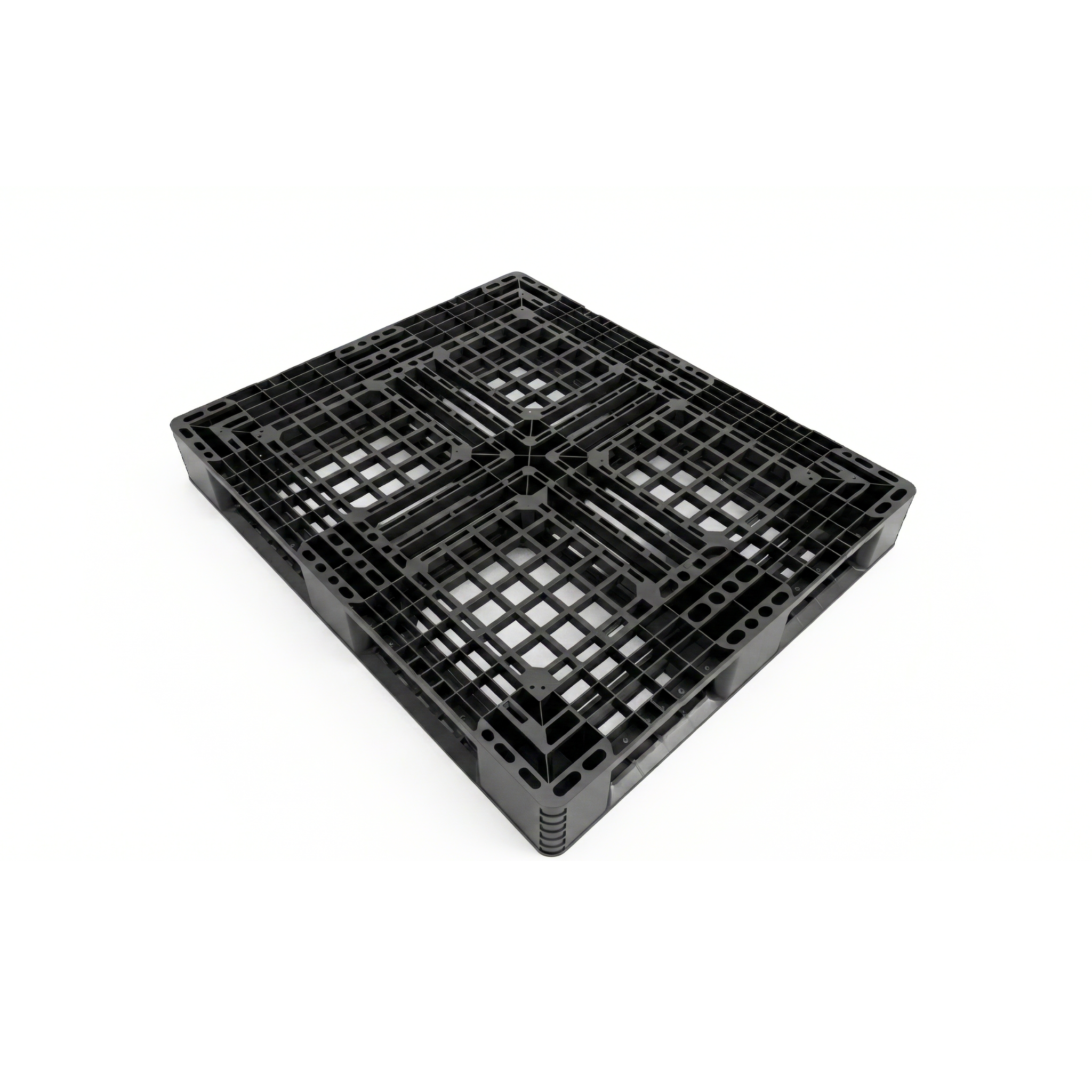
If you export goods to the USA, Europe or the rest of the Caribbean without the possibility of returning the pallet to origin, run high-volume e-commerce with consolidated destinations, ship construction materials that are delivered and stay on site, or manage humanitarian aid where the logistical return is unfeasible, the one-way plastic pallet is the right choice: it takes advantage of plastic's ISPM-15 exemption, maintains basic hygiene compared to wood and reduces the unit cost to the lowest possible level for a single operation. This guide explains how to validate that the scenario justifies one-way, how to palletize for long transit without return and how to document the dispatch with the goods secured to the pallet even though it will not come back.
The one-way pallet is deliberately dimensioned for a single useful cycle with mechanical strength sufficient for transit —not for an intensive returnable circuit—. Confusing it with a continuous-service pallet is a mistake: used in an internal circuit with high rotation it fails within a few weeks and the initial saving is lost. If your scenario is returnable or a professional closed circuit, the right choice is the standard 3-runner plastic pallet or the reversible one depending on the warehouse system.
Product specifications
The one-way plastic pallet is offered in the two standard international export formats, both with weight optimized to reduce air and sea freight cost. The following table sets out the complete technical specifications of the two available variants:
| Specification | American 120×100 cm | European 120×80 cm |
|---|---|---|
| SKU | 381387 | 623123 |
| Material | Optimized injection-molded HDPE | Optimized injection-molded HDPE |
| Dimensions | 120×100 cm (48×40 in) | 120×80 cm (48×32 in) |
| Color | Black | Black |
| Optimized weight | Yes (thickness calibrated for air freight) | Yes (thickness calibrated for air freight) |
| Fork entry | 2-way (1200 mm sides) | 2-way (1200 mm sides) |
| ISPM-15 standard | Exempt (does not apply to plastic) | Exempt (does not apply to plastic) |
| Basic hygiene | Non-porous, non-contaminating surface | Non-porous, non-contaminating surface |
| Main application | Export to USA, Mexico, LATAM, Caribbean | Export to Europe, North Africa |
| Expected service life | 1 export cycle (single trip) | 1 export cycle (single trip) |
The one-way pallet is deliberately calibrated with less material than the standard returnable pallet to reduce weight and cost. The operational consequence is that its load capacity —static, dynamic and especially in racking— is lower. Confirm the format's load limit against the product's technical data sheet and compare it with the weight of the batch to be exported before palletizing. For heavy loads use a standard 3-runner or reversible pallet, not this one.
The sister guides for the 3-runner pallet, the hygienic one, the reversible one, the folding box, the box and the spill-containment one cover the other six configurations in the family and help you confirm whether one-way is the right choice for your scenario.
Step-by-step use
The following procedure covers the single-trip export cycle: scenario validation, format selection, freight-optimized palletizing and final delivery with documentation. The instructions apply to both variants with specific notes depending on destination.
One-way scenario validation
Confirm that the scenario justifies the one-way pallet: the goods do not return to origin, the end customer does not return the pallet, or the cost of the logistical return exceeds the price premium of the returnable pallet. Typical valid scenarios: export to an end buyer who unloads and discards the pallet, shipment to a construction site where the material stays on site, high-volume e-commerce with a terminal destination at the customer's warehouse, international humanitarian aid. Scenarios where one-way is NOT suitable: internal returnable circuit, warehouse with selective racking where the pallet rotates many times, recurring exports to the same customer who returns the pallets.
Selection between American and European
Confirm the format according to the destination and the end customer's logistics system: 120×100 cm American for the USA, Mexico, Central America, much of LATAM and the Caribbean; 120×80 cm European (EUR/EPAL) for Europe and North Africa. In shipments to end e-commerce customers, where the pallet is unloaded and discarded, both formats are functionally compliant; in shipments to the customer's distribution center with racking dimensioned to the local standard, arriving with the “wrong” format forces the recipient to transfer the load, which costs time and generates complaints.
Palletizing dimensioned to the pallet's capacity
Distribute the load centered on the pallet, without overhanging the perimeter and respecting the load limit indicated on the technical data sheet. The maximum recommended height for one-way with medium loads is 1.5 m —lower than the 1.8 m standard of the returnable pallet— to reduce the risk of instability in long transit. For very heavy loads (cement bags, rebar, aggregate), do not use one-way; the initial saving is lost if the pallet gives way on the port dock and the goods are damaged. Stack in an interlocked pattern (each level rotated 90°) to distribute the weight and increase friction between levels.
Strapping and wrapping for a single transit
The strapping and wrapping of the one-way pallet must be GREATER than on returnable pallets —the film + strapping combination is what ensures the goods arrive intact even if the pallet is partially damaged in transit—. Use at least three PP straps passing through the lower slots of the pallet (vertical in the transverse direction) and full wrapping with several turns of manual stretch film from the base to the top of the load, with two extra reinforcement turns in the middle zone. The philosophy is: the pallet is disposable, the goods are not.
The economic calculation of one-way is not just “price of the pallet” but “price of the pallet + price premium of the extra film and strapping”. A poorly wrapped one-way can cost the entire batch if the load shifts in transit and a carton breaks in the ship's hold. The correct calculation to decide whether one-way is worthwhile is: (price of the returnable + cost of the logistical return) versus (price of the one-way + price premium of the robust packaging). On long shipments to the Caribbean or to the USA with load consolidation, the calculation favors one-way because returning an empty pallet from Miami to Santo Domingo costs more than the new pallet.
Dispatch documentation with photo
Photographically document each complete pallet (front, side, top view) BEFORE loading onto the truck or container. This adds evidence of packaging quality at origin and reduces disputes when the end customer reports damage and the insurer asks for proof. The commercial invoice should explicitly declare “goods palletized on a single-trip plastic pallet, exempt from the ISPM-15 standard” and the Harmonized System nomenclature corresponding to the exported product. This speeds up clearance at the destination customs and removes any doubt about the packaging's regime.
Do not use the one-way pallet in an internal returnable or high-rotation circuit. Common temptation: the warehouse operator buys a batch of one-way because the unit price is low and uses them in daily internal operation. The consequence is that the pallet is dimensioned for 1 cycle and fails within a few weeks, wiping out the initial saving. For a returnable warehouse circuit use a 3-runner plastic pallet or reversible one depending on the system; do not make do with one-way because the economic equation does not hold beyond the first month.
Complementary products
To complement the one-way plastic pallet in export and no-return shipments, the following products cover the most common adjacent needs:
The transparent manual stretch film is the critical tool for wrapping the load on the one-way pallet —more turns than on the returnable one because the load must arrive intact even if the pallet is damaged in transit—. The polypropylene strapping reel provides structural fastening through the pallet's lower slots. The standard 3-runner plastic pallet is the returnable alternative for internal circuits and recurring exports with pallet return. The big bags with open top and flat bottom are an alternative to traditional palletizing for bulk loads destined for a single trip.
Maintenance and care
The one-way pallet requires no maintenance as it is designed for a single use cycle. The relevant practice in operations that use one-way on a recurring basis —exporters with weekly shipments— is correct storage of the stock before use: keep the stacked towers in a vertical position in a dry area, with no direct contact with the floor (on pallets), covered against dust and direct sunlight. Prolonged UV exposure degrades HDPE over time, which in pallets already optimized to the lightest weight reduces capacity before their single use.
Visually inspect each pallet before loading: discard units with visible cracks, broken corners or permanent deformation. In one-way operation, the pre-load inspection is more critical than on returnable pallets because there is no longer a second cycle in which to detect the damage; the defective pallet must be rejected in the warehouse and not in the export container about to be closed. For customers who export large volumes, consider segmenting batches with a sample audit of the received stock to validate that the entire batch is compliant before starting palletizing.
Frequently asked questions (FAQ)
Can I use the one-way pallet in my internal warehouse?
Functionally yes, but economically it is not worthwhile. The one-way pallet is dimensioned for 1 use cycle with long transit; in an internal circuit with many rotations per month it fails within a few weeks. If you bought a batch of one-way and had some left over when the export operation closed, that surplus can be used for static storage of stock that does not move much —but NOT for an active returnable circuit—. For a standard warehouse use a returnable 3-runner plastic pallet, which withstands dozens of cycles.
What load capacity does it withstand?
The capacity varies by format and is detailed on the product's technical data sheet. As a practical rule, calculate a capacity lower than the standard returnable pallet (because the one-way is calibrated with less material to reduce weight and cost). For heavy loads (cement bags, rebar, aggregate), use a returnable 3-runner or reversible pallet. For medium and light loads (boxes of finished products, appliances, packaged goods), one-way is sufficient for 1 trip. If you have reasonable doubts about the load limit for a specific batch, ask the Dodom team with the expected weight per pallet.
To which destinations does it export without a phytosanitary certificate?
The plastic pallet (one-way or returnable) is exempt from the international ISPM-15 standard that regulates solid wood packaging to prevent the transport of wood-boring pests. The exemption applies to ALL signatory destinations of the agreement (USA, Europe, Australia, much of the world). This means that goods exported on a plastic pallet do not need methyl bromide fumigation, heat treatment or IPPC marking from an authorized manufacturer. Confirm with your customs agent at the destination that the shipping documentation correctly declares the plastic pallet to avoid doubts in clearance.
