

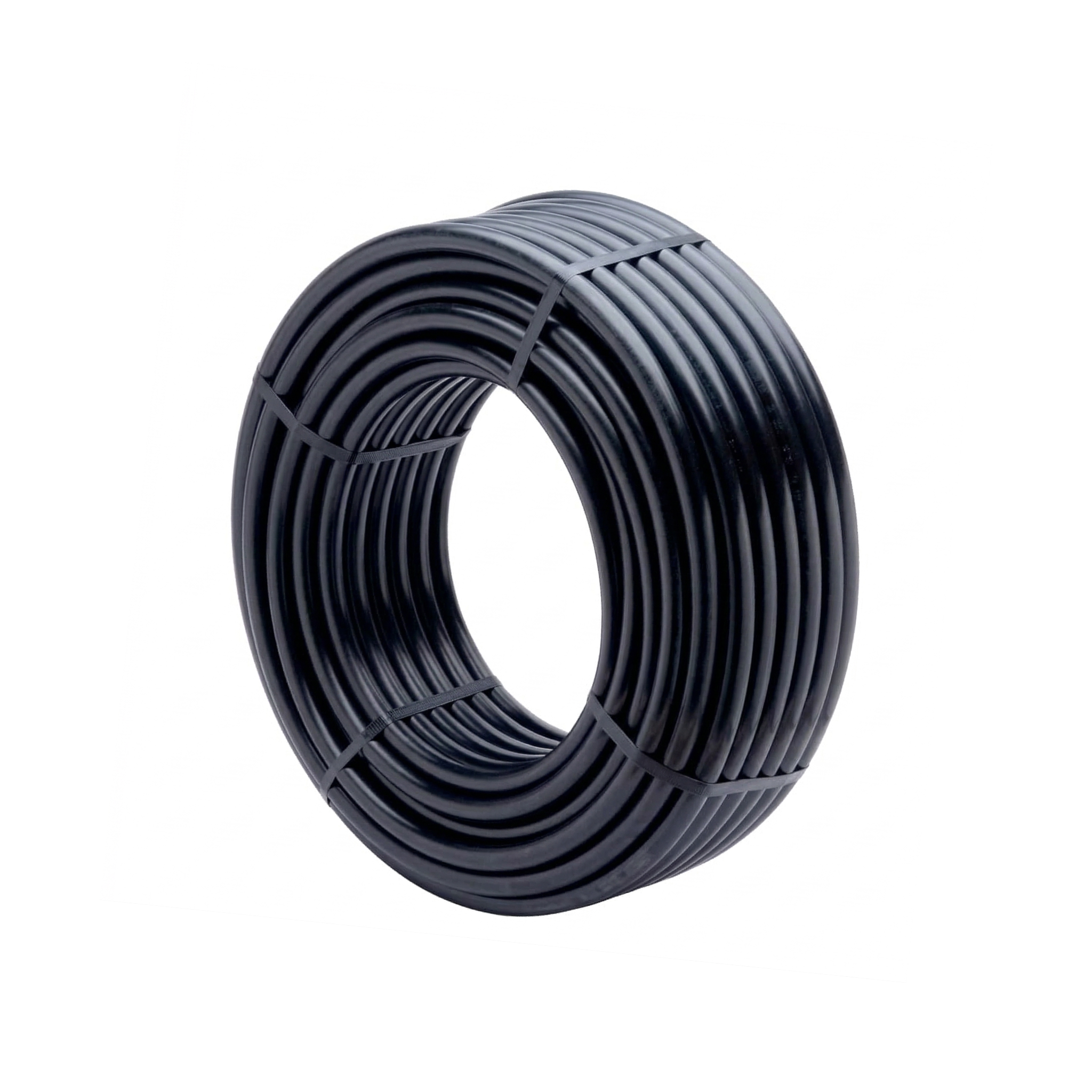
If you manage perennial plantations on steeply sloping terrain (hillside fruit trees, citrus in mountain ranges, mango and avocado on non-level plots), set up buried subsurface SDI irrigation projects in fruit trees or long-lifespan crops, run professional fertigation with short, frequent pulse irrigation, or design professional residential landscaping with planted borders on terrain with elevation changes, the GARDESE heavy wall gauge 4000 pressure-compensating drip hose with silicone diaphragm and integrated anti-drainage (ND) and anti-siphon (AS) mechanisms is the calibrated tool for those scenarios. This guide explains how to take advantage of the PC operating range, how to size the long lines that standard hose cannot handle without losing uniformity, how to bury correctly for SDI, and how to take advantage of pulse irrigation that is only possible with ND systems.
The pressure-compensating hose is the premium choice of the family: it combines a multi-season lifespan (gauge 4000) with integrated pressure compensation. For flat terrain with no relevant slope where the extra cost of PC is not justified, the correct choice is the standard heavy wall hose without compensation. For annual vegetable crops on sloping terrain where gauge 1200 tape is economical but standard does not solve the slope, the choice is the pressure-compensating gauge 240 tape. For vegetable crops on flat terrain with an annual cycle, the flat gauge 1200 tape is the most economical product in the four-product matrix.
Product specifications
The pressure-compensating hose comes in two emitter spacings (30 and 50 cm), both in 16 mm diameter with gauge 4000 thickness, in a 500 m roll. The following table sets out the full technical specifications of the two variants:
| Specification | 30 cm between emitters | 50 cm between emitters |
|---|---|---|
| SKU | 967456 | 945623 |
| Material | Cylindrical LDPE with UV additive | Cylindrical LDPE with UV additive |
| Diameter and thickness | 16 mm × 1 mm (gauge 4000) | 16 mm × 1 mm (gauge 4000) |
| Emitter type | Integrated PC with silicone diaphragm, AS and ND | Integrated PC with silicone diaphragm, AS and ND |
| Flow rate per emitter | 1.6 L/h (0.42 gal/h) | 1.6 L/h (0.42 gal/h) |
| Maximum flow deviation | 7% | 7% |
| Flow rate per meter | ~5.3 L/h | ~3.2 L/h |
| Anti-drainage threshold | 0.14 bar (2.03 psi) | 0.14 bar (2.03 psi) |
| Anti-siphon (AS) | Yes (suitable for buried SDI) | Yes (suitable for buried SDI) |
| PC pressure range | ~0.5-3.5 bar (7-50 psi) | ~0.5-3.5 bar (7-50 psi) |
| Format | 500 m roll | 500 m roll |
| Lifespan | Multi-season (years) | Multi-season (years) |
| Recommended application | Dense hillside fruit trees, landscaping with slope | Wide-spaced hillside fruit trees, buried SDI |
The PC emitter has three integrated technologies that set this product apart from the standard hose. PC (pressure compensation): the silicone diaphragm modulates the flow rate, keeping it practically constant across the entire operating range —the plant at the top of the hillside and the plant at the bottom receive the same flow rate instead of the typical extremes of a system without PC—. ND (non-draining): when the pressure drops below 0.14 bar after the pump is switched off, the emitter closes automatically, keeping the line full between cycles so the next start delivers nominal flow from the very first second —decisive for short-pulse fertigation—. AS (anti-siphon): it prevents soil from being sucked into the emitter when the system is switched off, an essential condition for buried SDI where conventional hose is ruined by the ingress of soil and roots.
Step-by-step guide to using it
The following procedure covers the cycle of the PC hose: sizing taking advantage of the operating range, surface or buried laying, operation with pulse irrigation, and maintenance.
Sizing taking advantage of the PC operating range
The PC emitter's operating range allows significantly longer lines than the standard hose while maintaining uniformity: with 50 cm between emitters, lines up to 300-400 m are viable on flat terrain, and lines up to 200-300 m on plots with accumulated elevation drop of up to 20-25 m. Correct planning requires verifying that the pressure at the MOST UNFAVORABLE emitter (last emitter of the highest or farthest line) stays above 0.5 bar and that the pressure at the MOST FAVORABLE emitter (first emitter of the head unit) does not exceed 3.5 bar. Above that range, the PC stops compensating and dispersed flow returns. For large plots with steep slope, consider sectorizing with pressure-regulating valves per sector. Standard filtration head unit: primary sand/disc filter + secondary 130 mesh screen filter.
Surface or buried SDI laying
For surface laying over hillside fruit trees, deploy the hose lengthwise along the contour line when possible —this reduces the accumulated elevation drop of each line and simplifies sizing—. If the line must run downslope, the PC compensates as long as the accumulated elevation drop stays within the operating range. For SDI (buried subsurface irrigation), the pressure-compensating hose with its AS and ND mechanisms is the correct choice: bury the line beneath the crop's active root zone, typically 15-25 cm deep for fruit trees and 10-15 cm for perennial vegetable crops. The buried hose is protected from UV radiation (decisive for lifespan), from equipment traffic, from rodents and from vandalism. The AS prevents the suction of soil when switching off the pump that ruins buried standard hoses.
Filling, purging and verifying the PC
Before closing the ends, open the head unit at moderate pressure and let the water run for 5-10 minutes through the open ends to purge dirt. Then close the ends with a hose plug. Once in operation, verify the PC's performance by measuring real flow rate in a sampling: take samples at the first emitter of the head unit, at the middle of the line, and at the last emitter of the highest or farthest line. All three should deliver practically equal flow rate (maximum dispersion 7%); if one end delivers significantly less or more, there is over- or under-pressure of the PC's operating range and you must adjust the head unit or sectorize.
For buried SDI in mature fruit trees, the correct burial depth is 15-25 cm beneath the tree's active root zone —neither shallow nor too deep—. Too shallow (less than 10 cm) and the hose is exposed to tractor traffic, large roots that lift it as they grow, and drying of the surroundings when the sun heats the soil. Too deep (more than 30 cm) and the wet bulb does not reach the active root zone where the crop absorbs water. The optimal depth depends on the species, age and soil type: 15-20 cm in sandy soils where water moves quickly downward and needs to come out near the roots; 20-25 cm in clay soils where water moves laterally from the emitter and can reach the root from greater depth. The standard technique is to dig trenches with a tape-trencher or adapted subsoiler, lay the hose and backfill carefully so as not to crush the line while filling the trench.
Operation with pulse irrigation and fertigation
The ND mechanism enables short, frequent pulse irrigation that is inefficient with standard hose: since the line stays full between cycles, each pulse starts with all emitters emitting from the very first second, without wasting water filling the line or delaying supply to the far emitters. The short-pulse technique (15-30 minutes every 2-4 hours) optimizes root absorption by reducing losses from deep percolation in sandy soils. For fertigation, inject the nutrient solution via venturi or dosing pump after the filter and before the laterals. After each fertigation, flush with clean water for 10-15 minutes to prevent salt precipitation in the emitters and prolong the PC's lifespan.
System maintenance and repairs
Inspect the head unit, lines and emitters annually by sampling real flow rate at different points. For buried SDI systems, inspection is done by observing the state of the crop (areas with plants showing water stress = local clogging; areas with waterlogging = leak) and by measuring flow rate on the main line that connects to the buried network. Carry out preventive cleaning with 1-2% nitric acid quarterly or according to water quality. For specific repairs due to breaks, cut out the damaged area and reconnect with a 16 mm straight coupling; for buried systems, mark the route beforehand with stakes to locate the damage without excavating large areas. The initial investment in PC hose is fully justified in multi-season projects with slope where standard would give insufficient uniformity.
Do not operate the PC hose outside the emitter's declared pressure range (~0.5-3.5 bar). Below 0.5 bar the silicone diaphragm does not activate and the flow rate drops with the available pressure —dispersed flow returns as in the standard hose—. Above 3.5 bar the diaphragm is compressed to the maximum and the flow rate rises progressively without effective compensation, in addition to accelerating silicone fatigue, significantly reducing the lifespan of the PC mechanism. If your system's effective range falls outside the PC's operating range (very high or very low pumping pressure, sectors with excessive accumulated elevation drop), sectorize with pressure-regulating valves and use independent head units per sector. Paying for PC hose and operating it outside the operating range is a waste of the investment: you again have the dispersed flow of standard hose but with the extra cost of the premium product.
Complementary products
To complement the pressure-compensating hose in hillside perennial plantations, buried SDI and professional fertigation, the following products cover the most common adjacent needs:
The standard heavy wall hose is the sister choice when the terrain is flat and the extra cost of PC is not justified. The pressure-compensating gauge 240 tape is the choice when the cycle is annual or biannual and the extra cost of the heavy wall PC hose is not amortized by the duration of the crop. The flat gauge 1200 tape is the most economical choice for annual vegetable crops on flat terrain. The IBC Container is a natural complement for irrigation water storage on the farm when the main source is an intermittent well or collected rainwater, especially in fertigation projects where the nutrient solution is prepared in the tank itself.
Maintenance and care
Annual maintenance focuses effort on four fronts: filtration head unit (clean or replace filters according to schedule), PC inspection by measuring flow rate in a sampling (if the dispersion between points rises above the nominal 7% there is diaphragm degradation or pressure out of range), preventive cleaning with 1-2% nitric acid on a quarterly basis or according to water quality, and specific repairs due to breaks. For buried SDI systems, schedule a comprehensive inspection every 3-5 years with a full audit of flow rate and uniformity; well-sized SDI systems offer many years of service before replacement due to emitter wear.
The PC's silicone diaphragm is the component most exposed to degradation: residual chlorine in the irrigation water, concentrated undiluted cleaning acids, and operation outside the pressure range accelerate fatigue. Keeping cleaning concentrations within the recommended range (nitric acid 1-2%, no higher) and verifying that the operating pressure stays within the PC range are the actions with the greatest impact on the system's lifespan. Keep a record of the year of installation per sector to plan gradual replacement before the flow rate dispersion affects crop productivity.
Frequently asked questions (FAQ)
On what slope does the extra cost of PC become justified?
PC starts to become justified when the accumulated elevation drop in the line generates a pressure difference between ends greater than the operating range of the standard hose (1-3 bar). As a practical rule, consider PC when: (1) the accumulated elevation drop in a line exceeds 5-7 meters; (2) the lines are long (>150 m) and the accumulated head loss from length plus slope falls outside the standard range; (3) the system is buried SDI where the AS is indispensable; (4) short-pulse fertigation is part of the agronomic plan. For flat plots with short lines, PC is an extra cost without return and standard hose is the efficient choice. If you are between two options due to reasonable doubts and the project is multi-season with a horizon of 8-15 years, consider PC: the additional investment is amortized through crop uniformity over the life of the system.
At what depth should the hose be buried for SDI?
For mature fruit trees, typical depth 15-25 cm beneath the active root zone: 15-20 cm in sandy soils where water moves quickly vertically and it is best to come out near the roots; 20-25 cm in clay soils where water moves laterally from the emitter and can reach roots from greater depth. For perennial vegetable crops and crops with less root development, go down to 10-15 cm. Too shallow (less than 10 cm) exposes the hose to tractor traffic and drying of the surroundings; too deep (more than 30 cm) leaves the wet bulb far from the active root zone. The final depth must be optimized for the species, the age of the crop and the soil type of the specific plot.
Maintenance between irrigation seasons?
Unlike gauge 1200 tape, which is uninstalled each harvest, the pressure-compensating hose remains installed throughout the crop's entire lifespan. Between active irrigation seasons (if applicable) drain the system by opening the final ends and purge valves, keep the filtration head unit covered and valves closed, and carry out a deep cleaning with 1-2% nitric acid before the period of inactivity to prevent salt precipitation in the emitters during the pause. In a Caribbean climate where irrigation is usually quasi-continuous all year (with seasonal variations), maintenance is scheduled by quarters instead of by season: monthly filters, quarterly acid cleaning, annual flow rate audit and comprehensive review every 3-5 years.
