

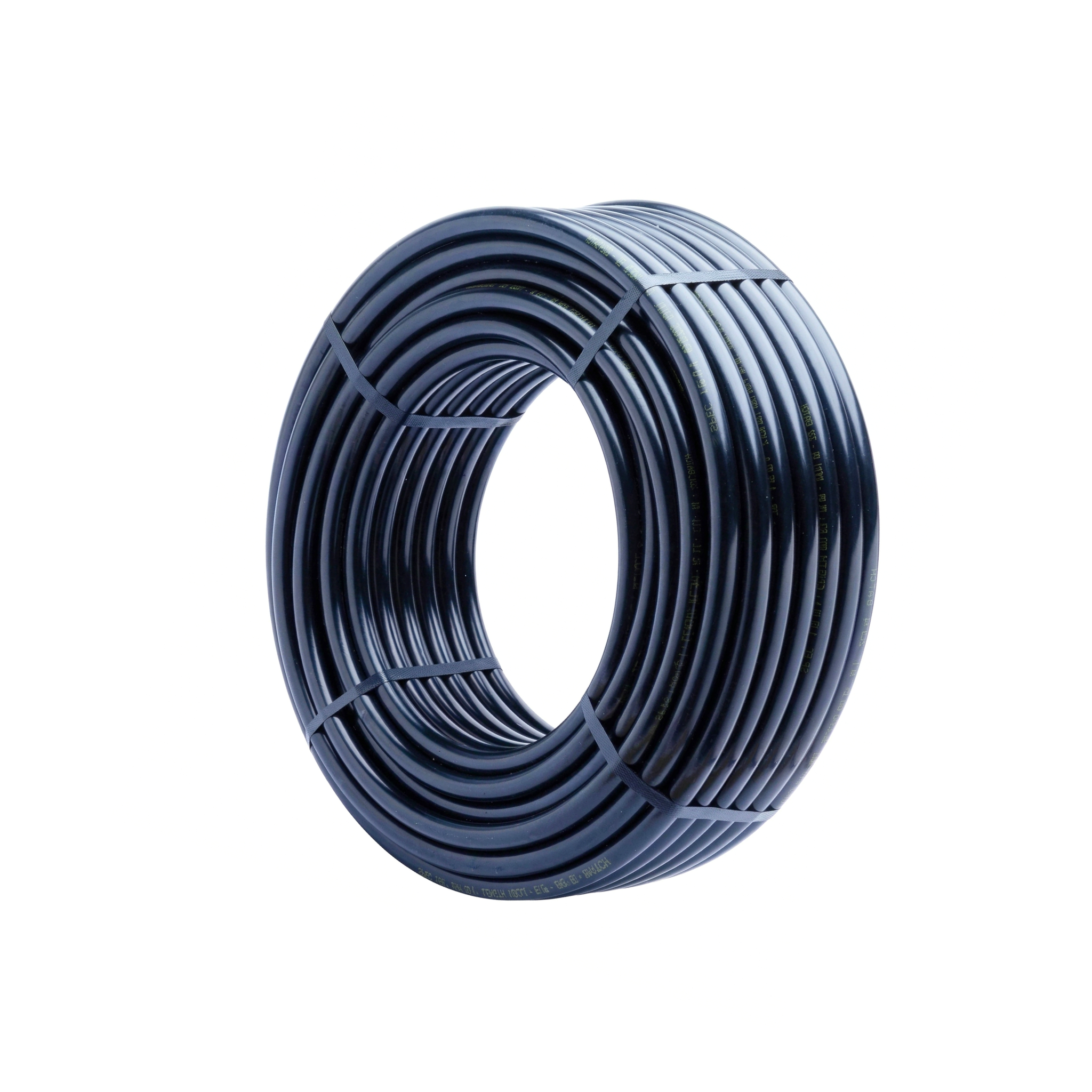
If you manage fruit trees and permanent plantings (citrus, mango, avocado, papaya, palm) that will be irrigated for years, build professional residential landscaping with long-life planted borders, run row crops with a multi-season plan that cannot afford replacing the line every harvest, or work urban gardens and hydroponics with a long-term installed system, the GARDESE heavy wall drip hose gauge 4000 with cylindrical drippers featuring dual inlet and dual outlet is the calibrated tool for those scenarios. This guide explains how to choose between 30 cm and 50 cm dripper spacing depending on the crop, how to size the filtration head and pressure, how to lay the line for several years of service, and how to maintain the system between seasons to protect the investment.
The standard hose is the multi-season choice for relatively flat terrain. For annual vegetables where the system is repositioned every harvest, the correct economical choice is the flat tape gauge 120. For plots with a pronounced slope where a standard hose delivers uneven flow between high and low zones, step up to the pressure-compensating hose with integrated pressure compensation. For terrain with a slope and an annual cycle at the same time, the pressure-compensating tape gauge 240 completes the four-product matrix of the family.
Product specifications
The standard hose is offered in two dripper spacings (30 and 50 cm), both in 16 mm diameter with gauge 4000 wall thickness, in a 500 m roll. The following table sets out the complete technical specifications of the two variants:
| Specification | 30 cm between drippers | 50 cm between drippers |
|---|---|---|
| SKU | 888852 | 443627 |
| Material | Cylindrical LDPE with UV additive | Cylindrical LDPE with UV additive |
| Diameter | 16 mm (5/8 in) | 16 mm (5/8 in) |
| Wall thickness | 1 mm (gauge 4000) | 1 mm (gauge 4000) |
| Dripper type | Integrated cylindrical, dual inlet and dual outlet | Integrated cylindrical, dual inlet and dual outlet |
| Flow per dripper | 1.6 L/h (0.42 gal/h) | 1.6 L/h (0.42 gal/h) |
| Flow per meter | ~5.3 L/h (3.3 drippers/m) | ~3.2 L/h (2 drippers/m) |
| Coefficient of variation Cv | ≤ 5% | ≤ 5% |
| Operating pressure | 1-3 bar (15-43 psi) | 1-3 bar (15-43 psi) |
| Packaging | 500 m roll (1640 ft) | 500 m roll (1640 ft) |
| Service life | Multi-season (years) | Multi-season (years) |
| Recommended application | Row crops with 30-40 cm spacing, dense landscaping | Fruit trees with wide spacing (mango, avocado, citrus), spaced landscaping |
The installation procedure is identical for both spacings. The choice is decided by the crop spacing: 30 cm for perennial vegetables, woody herbs, strawberries in a fixed system and dense landscaping where the plant or cluster is at 25-40 cm; 50 cm for fruit trees with wide spacing where each tree is several meters from the next and a single dripper per plant is insufficient —the standard technique is then to lay a line with several drippers under the canopy projection zone, which at 50 cm gives 4-6 drippers per tree distributed.
Step-by-step use
The following procedure covers the cycle of the standard hose: sizing the head, laying it in the plot, operation and maintenance between seasons for multi-season systems.
Sizing the head with a horizon of years
As in any drip system, install a head with filtration suited to the available water: sand or disc filter as the primary for well or river water, 130 mesh screen filter (120 microns) as the mandatory secondary. The difference with the gauge 120 tape is that here the system will remain installed for years, so the investment in professional filtration pays off quickly and failure from clogging is more expensive to resolve (replacing buried hose sections in mature fruit trees requires careful excavation). Calculate the system flow by summing meters of hose × flow per meter: one hectare of citrus with 5×5 m spacing and two lines per row uses ~800 m of hose, which at 50 cm between drippers demands ~2,560 L/h —significantly less than the dense tape for annual vegetables.
Laying in the plot and connections
Deploy the hose lengthwise along the row or the tree line. The cylindrical hose with dual-outlet drippers requires no orientation: water exits from both sides of the dripper regardless of how the line ends up —a decisive advantage over flat tape in extensive projects where aligning thousands of meters with drippers facing up takes time. For mature fruit trees with wide spacing, the standard technique is to lay a line between the row of trees at the distance of the effective root zone (50 cm to 1 m from the trunk depending on species and age). For large trees (mango, mature avocado), consider TWO parallel lines 30-50 cm on each side of the trunk —see the expert tip below. Connect with fittings specific to 16 mm hose (elbows, tees, end plug), which seal pressure by compression.
Filling, purging and operating at the correct pressure
Before closing the ends, open the head and let water run for 5-10 minutes through the open ends to purge manufacturing dirt and laying residue. Then close the ends with a hose plug (do not improvise). Operate at a pressure between 1 and 3 bar (15-43 psi) at the head end. The heavy wall hose accepts a wider range than flat tape, with margin for systems with a modest slope, long lines or several connected sectors. Use a pressure gauge and a regulating valve if the pumping pressure exceeds 3.5 bar. Head loss along the line is relevant: with 30 cm between drippers, lines up to 150 m maintain reasonable uniformity on flat terrain; with 50 cm, up to 250 m. Beyond those limits or on slopes >2-3%, consider stepping up to the pressure-compensating hose with integrated compensation.
For mature fruit trees with wide spacing (mango, avocado, large citrus), the professional technique is to lay TWO parallel lines instead of one, spaced 30-50 cm from the trunk on each side, instead of a single line per row. This configuration doubles the effective wetted bulb under the active root zone, improves fertigation use and significantly reduces water displacement out of the productive zone through lateral runoff. The additional investment in meters of hose per hectare is marginal compared with the increase in productivity and the better root distribution during the tree's development. For young fruit trees in a new planting, a single line per row is sufficient for the first years; lay the second one in the fourth or fifth year when the canopy starts to expand and the active root zone exceeds the reach of a single dripper's bulb.
Fertigation and line cleaning
Inject the nutrient solution by venturi, hydraulic dosing unit or injector pump after the main filter and before the laterals. The heavy wall hose accepts wider concentrations than flat tape, but the compatibility rules are the same: avoid mixing antagonistic products, use only soluble fertilizers compatible with drip and keep the dosing under the crop's agronomic plan. After each fertigation, flush the line with clean water for 10-15 minutes to prevent salt precipitation in the drippers. Monthly, perform preventive cleaning with nitric acid at 1-2% (where appropriate and under advice) to dissolve accumulated mineral deposits and significantly extend the system's service life.
Maintenance between seasons and spot repairs
Unlike the gauge 120 tape that is uninstalled at the end of the season, the heavy wall hose stays installed all year and between harvests. During the period without active irrigation (if applicable), drain the system by opening the end ends and purge valves, and keep the hose coiled or covered to minimize continuous UV exposure on the same point. For spot repairs from breaks (tractor passing, wildlife damage, accidental impact), cut the damaged area and reconnect with a 16 mm straight pressure coupling; the system goes back into operation without replacing the entire roll. Inspect the assembly annually and gradually replace the areas with visibly degraded drippers, keeping the rest of the system in service.
Do not use a standard hose (not pressure-compensating) on plots with a pronounced slope in the direction of the line (>3-5%). In the high zone of the line the pressure drops due to elevation and the flow decreases; in the low zone the pressure rises and the flow increases. The result is high plants with chronic water deficit and low plants with waterlogging, compromising crop uniformity throughout the entire life of the system. For plots with a slope, the correct choice is the pressure-compensating hose with a silicone diaphragm that keeps the flow practically constant across the entire operating pressure range, equalizing the dose to each plant regardless of position. The extra cost of the PC is fully justified when the accumulated slope along the line exceeds the operating range of the standard hose.
Complementary products
To complement the drip hose in fruit trees, permanent plantings and long-life landscaping, the following products cover the most common adjacent needs:
The heavy wall pressure-compensating hose is the sister choice when the plot has a pronounced slope or the project demands fertigation by short pulses with buried subsurface drip irrigation (SDI). The flat tape gauge 120 is the economical alternative choice for annual vegetables where the system is repositioned every harvest. The pressure-compensating tape gauge 240 combines pressure compensation with an intermediate service life (2-3 seasons) for plots with a slope and an annual or biannual cycle. The expanded perlite is the complementary amendment to improve soil drainage and aeration in landscaping projects and urban gardens where the substrate is a decisive factor in irrigation performance.
Maintenance and care
Annual maintenance focuses effort on four fronts: filtration head (wash or replace filters according to the schedule in the specific filter manual), visual inspection of lines (zones with plants showing water stress = local clogging; zones with waterlogging = leak; drippers with abnormal flow = degradation), preventive cleaning with nitric acid at 1-2% on a monthly or quarterly frequency depending on water quality, and spot repairs from breaks with straight couplings and specific fittings. The initial investment in a heavy wall hose gauge 4000 is amply recovered by avoiding the annual replacement of the complete system and by allowing maintenance work by sections.
For mature fruit trees where the system has several years of service, schedule a comprehensive review every 3-5 years by measuring actual sample flow at different points of the network (bucket + stopwatch). If the dispersion between drippers exceeds 15% of the nominal flow, consider gradual replacement of the oldest sections while keeping the rest in service. Traceability by year of installation by sector allows planning the replacement distributed over time instead of a costly mass replacement at the end of the assembly's service life.
Frequently asked questions (FAQ)
30 or 50 cm between drippers for fruit trees?
For fruit trees with wide spacing (mango, avocado, mature citrus, palm) the standard choice is 50 cm between drippers, laying one or two parallel lines under the canopy projection zone to distribute 4-6 drippers per tree. For denser fruit trees (young citrus at high density, papaya, coffee, cacao) and for professional landscaping with dense planted borders, 30 cm between drippers is preferable —the greater dripper density improves wetted-bulb distribution in zones with smaller spacing. For hydroponics and container crops with regulated substrate, 30 cm is also the natural choice.
Can the tractor pass over the hose?
Occasional tractor passing over the heavy wall hose gauge 4000 is tolerable and does not break it immediately, but the repeated pressure of passing farm equipment deforms it and shortens its service life. The professional practice is: for rows where recurrent tractor passing is expected, install the hose buried 5-10 cm below the surface in passing zones or use protection with a semi-rigid plastic channel at the crossing. For rows where passing is exceptional (maintenance, mechanical harvest), the surface is fine as long as the driver is warned. For SDI systems buried deeply (15-25 cm), tractor passing has no effect because the root zone supports the weight over the hose.
Is it suitable for buried SDI irrigation?
Yes, the standard hose can be installed buried (SDI) in fruit trees and perennial crops with limitations: the cylindrical dripper with dual inlet and dual outlet has no anti-siphon mechanism (AS), so when the system is turned off there may be suction of soil into the dripper due to the natural vacuum that forms in the line —that suction accumulates sediment inside the dripper over the months and produces progressive clogging. For professional SDI with buried subsurface irrigation in systems that will be underground for years, the correct choice is the heavy wall pressure-compensating hose which incorporates a specific AS mechanism to prevent soil suction. For shallow SDI or with occasional pulse irrigation use, the standard one works acceptably with more frequent preventive cleaning.
