

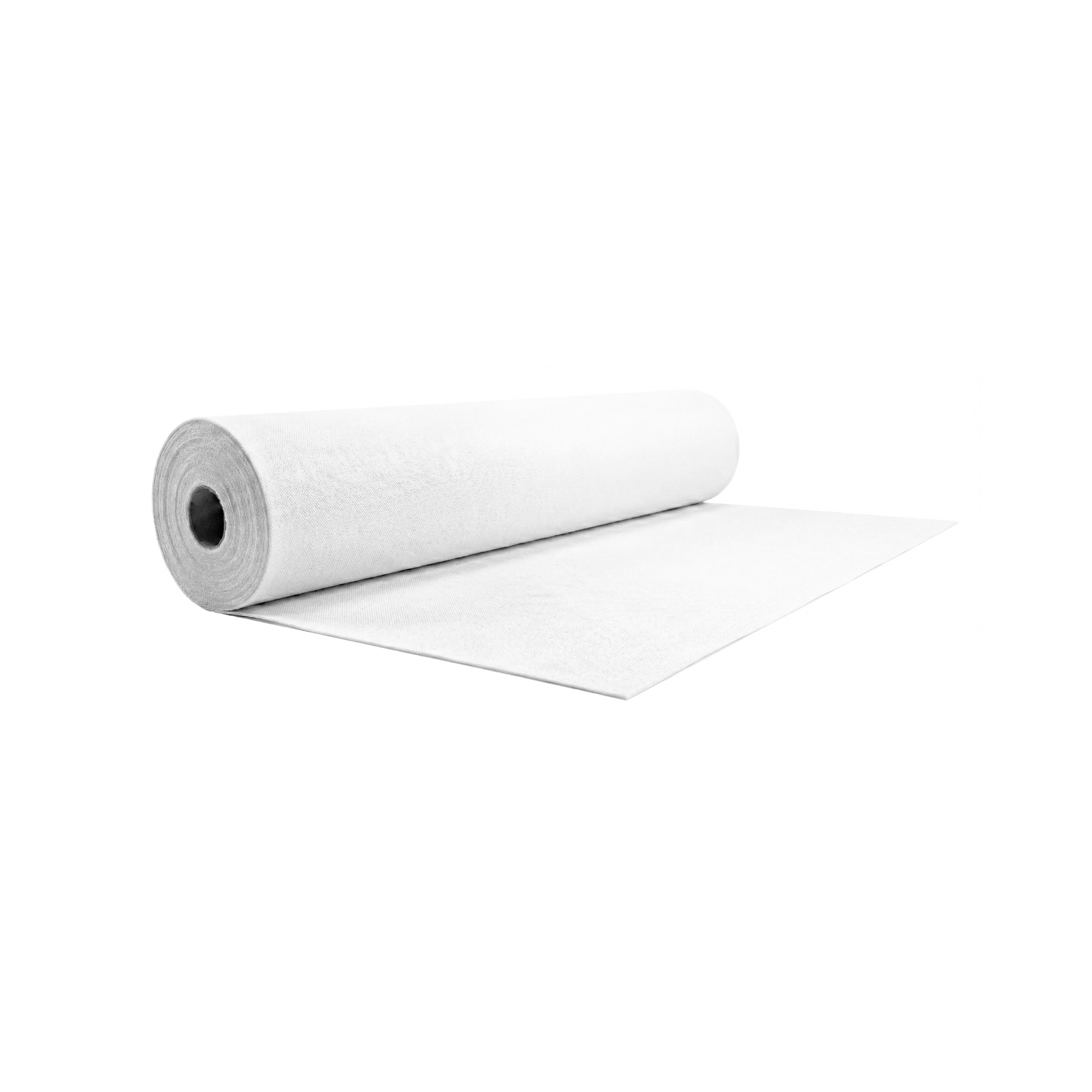
If you are building a road base over soft soil with a structural audit, a mechanically stabilized earth (MSE) wall that must hold back the soil mass for decades without progressive movement, or an industrial platform with continuous heavy loads, woven polyester (PET) geotextile is the highest-performing option among geotextiles for structural reinforcement. This guide explains how to verify the prior engineering design, correctly orient the roll according to the calculated direction of the tensile force, execute overlaps without cutting the strong axis, and complete the layered fill with correct compaction.
Woven PET geotextile is the premium product of the family: high-modulus PET, low creep under continuous load, and tensile strength comparable to structural geogrids. Installation is as strict as that of a uniaxial geogrid: incorrect roll orientation, a poorly executed overlap, or deficient fill compaction can invalidate the designer's calculations. Read it in full before starting work and, if you have doubts, consult the responsible structural engineer.
Product specifications
The woven polyester geotextile is offered in a single standard presentation of 5.2 m wide by 100 m long, with a weight of 320 g/m² in high-modulus PET yarns. The following table gathers the complete technical specifications of the only available variant:
| Specification | Value |
|---|---|
| SKU | 643561 |
| Material | Virgin high-modulus PET |
| Type | Woven (interlaced PET yarns) |
| Weight | 320 g/m² (9.4 oz/yd²) |
| Color | White |
| Roll width | 5.2 m (17 ft) |
| Roll length | 100 m (328 ft) |
| Area per roll | 520 m² |
| Distinguishing feature | Low elongation under load (high elastic modulus) |
| Creep | Low, calibrated for long-duration MSE walls |
| Chemical resistance | Inert to acids and typical soils |
| Main application | Structural reinforcement in MSE walls, slopes, and audited platforms |
The sister guides for nonwoven PET geotextile and woven PP geotextile cover the complementary functions: nonwoven PET for separation and filtration (not reinforcement) and woven PP as a lower-cost structural alternative where the low creep of PET is not a critical factor.
Step-by-step instructions for use
The following procedure covers the operational cycle on site. Supervision by a structural engineer or a qualified resident engineer is mandatory for MSE walls and retaining works; the following instructions are operational and do not replace the engineering design specific to each project.
Verification of the structural design
Before any field work, confirm with the project engineer: the height of the wall or slope, the vertical spacing between geotextile layers, the horizontal length of each layer (which defines the "embedment" in the fill), the type of approved granular or cohesive fill, and the justification for choosing PET over PP. For tall MSE walls with a structural audit, PET is the correct choice because of its low creep; on low walls without a formal audit, PP performs well at lower cost. Without this prior validation, installation is building blind.
Preparation of the foundation and first layer
Excavate down to foundation level according to the design. Compact the bottom to the specified minimum density. Place the first layer of granular fill and compact it. Mark on the fill the line where the visible face of the wall will be placed (concrete blocks, gabions, formed earth bags, whatever the project specifies). The first geotextile roll is spread over this layer.
Laying with correct orientation
Unroll the roll so that the LONGITUDINAL DIRECTION OF THE ROLL IS PERPENDICULAR TO THE FACE OF THE WALL. The strength of the woven geotextile is optimized in the roll direction (strong axis); in the transverse direction the strength is significantly lower. Laying it with the wrong orientation means building the wall with strength lower than that calculated in the project. Visually mark the roll direction on site (with paint or tape) to avoid errors in subsequent layers.
Overlap between rolls
If you need several rolls in the same layer to cover the length of the wall, overlap transversely (parallel to the face) by a minimum of 50 cm. NEVER overlap longitudinally (perpendicular to the face), because that cuts the strong axis of the geotextile and the wall is left with the minimum transverse strength at the joint. If the roll length is not enough to cover the length of the wall, individual cuts are necessary with vertical staggering of the joint between layers (at least 1 meter of offset between adjacent layers to avoid continuous planes of weakness).
In projects where quality traceability is critical (public works with audits, structural walls with a declared service life of several decades), keep the manufacturing sticker of each roll together with the plan layout indicating in which layer and zone of the wall it was installed. This documentation makes it possible, in the event of any future incident with the wall, to identify whether the manufacturer's batch corresponds to a valid quality certificate and to settle liability without doubt. Traceability matters especially when there are third-party claims regarding the wall.
Layered fill and compaction
Place the next layer of granular fill over the spread geotextile. Tip the material from the inside toward the outside of the wall (NEVER from the front toward the back, because it would push the geotextile and compromise its anchorage at the face). Keep at least 15 cm of fill between the tracks or wheels and the geotextile when machinery passes over. Compact each layer to the specified Proctor percentage before spreading the next geotextile layer. The vertical spacing between layers comes from the design (typically between 30 cm and 60 cm depending on the total height).
Do not orient the roll with its length parallel to the face of the wall. The strength of woven PET geotextile is optimized in the roll direction (longitudinal axis); the transverse direction has significantly lower strength. Laying it with the wrong orientation means building a wall with strength lower than that calculated in the project. Visual verification is by the visible direction of the yarns: the strong direction coincides with the "roll" direction as it comes off the core when unrolled.
Complementary products
To complement woven PET geotextile in MSE walls, slopes, and audited structural platforms, the following products cover the most common adjacent needs:
The woven PP geotextile is the more economical version of structural reinforcement, indicated when the low creep of PET is not a critical factor (farm roads, low walls, residential platforms). The uniaxial PP geogrid is a structural alternative in tall MSE walls: a different reinforcement principle (interlock with granular aggregate instead of textile friction) that may be more efficient depending on the type of available fill. The nonwoven PET geotextile is a natural complement to woven PET in walls with drainage behind the face: the nonwoven acts as a hydraulic filtration layer while the woven provides the structural reinforcement. The biaxial PP geogrid is combined in integral projects that have an MSE wall plus a reinforced road base at the crest.
Maintenance and care
Woven PET geotextile buried in MSE walls requires no maintenance during its service life. What does require monitoring is the behavior of the wall: in structural walls (especially those of significant height), it is advisable to establish a program of periodic visual inspection of the external face to detect signs of progressive deformation, localized bulging, cracks in block joints, or differential settlement at the crest. Visual inspection every 6 months during the first 5 years of life is good practice.
For storage prior to installation, keep the rolls in a horizontal position on flat pallets, covered against direct sunlight. Prolonged UV exposure degrades the PET yarns over time, especially at exposed edges. Inspect each roll before lowering it to the site and before spreading it, particularly the first and last meters that may have been exposed during transport. A transverse cut at the edges can start a tear that propagates as you unroll and that is very difficult to detect before covering with fill.
Frequently asked questions (FAQ)
Why woven PET and not woven PP for my MSE wall?
PET has a higher elastic modulus (lower elongation under load) and low long-term creep. In tall MSE walls where the soil mass exerts continuous thrust for decades, PET maintains its dimensions and strength while PP can accumulate small progressive elongations year after year that, in aggregate, translate into visible deformation of the wall. For a serious structural audit with a service life declared in decades, PET. For low walls without a formal audit and small projects, PP performs well at lower cost.
Can I overlap longitudinally to use up a remnant?
No. A longitudinal overlap (perpendicular to the face of the wall) cuts the strong axis of the woven geotextile and leaves the joint with minimum transverse strength instead of the product's nominal values. In practice this means that the reinforcement layer does not perform as calculated in the joint zone, which can compromise the local stability of the wall. If the roll length is not enough to cover the length of the wall, individual cuts are necessary with vertical staggering of the joint between layers (at least 1 meter of offset between adjacent layers).
How does it differ from nonwoven PET geotextile?
The two products are made of the same base material (PET), but the structure is radically different and that defines different functions. The nonwoven is needle-punched PET, without preferential orientation, with low tensile strength; it serves for filtration, separation, and protection. The woven is PET in interlaced yarns with preferential orientation, with high tensile strength and low elongation; it serves for structural reinforcement. They are not interchangeable: using nonwoven instead of woven in an MSE wall compromises structural stability; using woven instead of nonwoven for drainage does not provide adequate filtration.
