

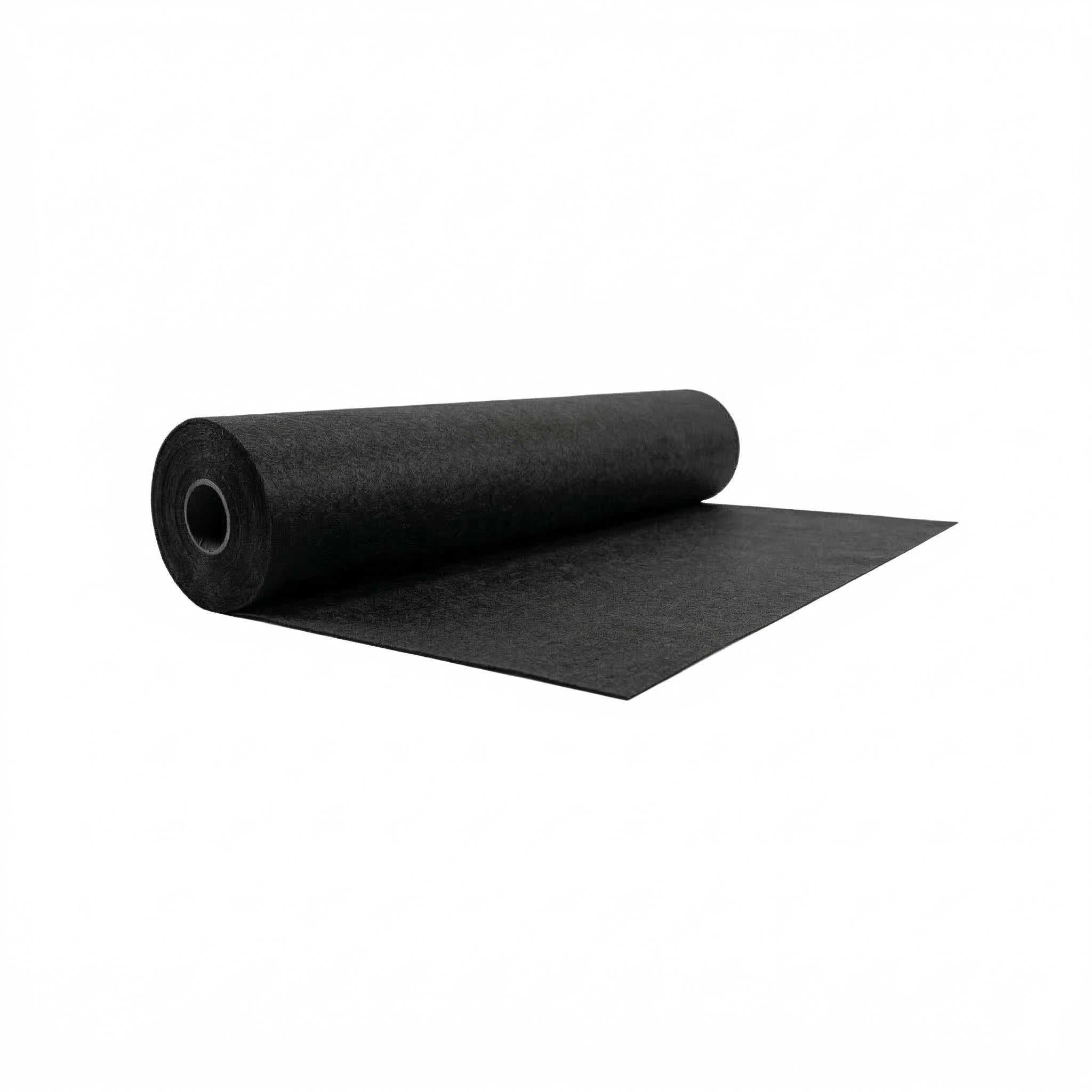
If you are stabilizing a farm road with cart and agricultural machinery traffic, installing an unpaved residential driveway that holds the weight of vehicles without sinking, setting up a structural weed-control system in extensive agriculture, or building a low retaining wall without the audit required for PET, the woven PP geotextile is the family's balanced option: structural tensile reinforcement at an affordable cost, without the premium low creep of PET. This guide explains how to choose between 40 kN/m and 80 kN/m depending on the case, how to orient the roll according to use (road reinforcement vs. weed control), and how to execute overlaps and fastening correctly.
The woven PP geotextile is NOT a premium structural product —for audited MSE walls, industrial platforms with decades-long audits, and paved roadworks with a declared service life, the correct choice is the woven PET geotextile or geogrids—. Woven PP performs well in projects where long-term creep is not a decisive factor and where the extra cost of PET is not justified by the scale or type of work. Read it in full to confirm that the PP choice is consistent with your project.
Product specifications
The woven polypropylene geotextile is offered in two calibrated tensile strengths, both supplied as a roll 5.2 m wide by 100 m long in black. The following table lists the complete technical specifications of the two available variants:
| Specification | 40 kN/m | 80 kN/m |
|---|---|---|
| SKU | 527427 | 654134 |
| Material | Interlaced PP yarns | Interlaced PP yarns |
| Type | Woven | Woven |
| Tensile strength | 40 kN/m (2.7 kip/ft) | 80 kN/m (5.5 kip/ft) |
| Color | Black | Black |
| Roll width | 5.2 m (17 ft) | 5.2 m (17 ft) |
| Roll length | 100 m (328 ft) | 100 m (328 ft) |
| Recommended application | Farm roads, landscaping with loads, non-audited low walls | Standard roadworks, commercial platforms, structural weed control in extensive agriculture |
| Chemical resistance | Inert to acids, alkalis and biological agents | Inert to acids, alkalis and biological agents |
| Estimated service life | Decades when buried | Decades when buried |
The installation procedure is identical for both strengths. The choice is based on the expected structural severity: 40 kN/m covers farm roads, unpaved residential driveways and low walls without formal audit; 80 kN/m is reserved for standard roadworks with medium traffic, commercial platforms with continuous loads and structural weed control in extensive crops where long durability is a critical factor.
The sister guides for the woven PET geotextile, the non-woven PET geotextile and the non-woven PP geotextile cover the complementary functions and help confirm whether the woven PP choice is the right one for your case.
Step by step on how to use it
The following procedure covers the installation cycle on site. It applies to both variants (40 and 80 kN/m), with specific notes according to use (road reinforcement, structural weed control, low wall).
Determine the use and choose the strength
The woven PP geotextile covers three distinct uses with tailored installation techniques: road or driveway reinforcement (with granular fill on top), structural weed control (with anchoring and either uncovered or with light mulching) and low retaining wall (with layered fill as in woven PET but without formal audit). For road reinforcement with light traffic or a low wall up to 1.5 m, 40 kN/m is sufficient; for vehicle traffic with continuous loads, weed control in long-lasting extensive crops, or walls between 1.5 and 3 m, step up to 80 kN/m. Above 3 m of wall the choice is not PP but PET or uniaxial geogrid.
Surface preparation
Clear the surface of roots, vegetation and sharp stones. For road reinforcement, level the subgrade (no potholes larger than 5 cm) and compact lightly. For structural weed control in crops, mow the existing weeds flush (do NOT pull them out, because that leaves pockets of loose soil) and level. For low walls, excavate to the foundation per design and compact the bottom. The quality of the bed preparation directly determines the expected performance of the final system.
Rolling out the sheet with orientation according to use
For road reinforcement, unroll the sheet lengthwise along the road —the strength of the fabric is used along the roll axis, which should be aligned with the direction of traffic—. For structural weed control, orient the roll according to the crop geometry (parallel rows or terrain structure) and maintain continuity without unnecessary cuts. For low walls, orient the roll direction perpendicular to the wall face (strong axis toward where the tensile force acts). In all cases, keep the fabric free of folds and wrinkles.
Overlap and fastening
When joining two rolls, overlap a minimum of 30 cm at longitudinal seams and 50 cm at transverse seams. For low walls do not overlap longitudinally (perpendicular to the face) because that cuts the strong axis of the fabric; use cuts with a vertical offset between layers. Fasten temporarily with metal pins or garden staples every 1-2 meters. For weed control in crops, the anchors are permanent —they will not be covered with fill— and must be more frequent (every 50 cm along edges and every 1 m in the interior) to prevent the wind from lifting the fabric over the years.
In structural weed control over fruit-tree crops, mango, avocado, cocoa or similar, do not extend the geotextile all the way to the trunk. Leave a free circle of 30-50 cm around each tree to allow trunk growth, passage for fertigation directed at the base, and manual management of the critical zone of surface roots. This detail, neglected in piecework jobs, makes the difference between a durable weed-control system and one that strangles trees after a few years as the trunk thickens.
Covering or anchoring according to use
For road reinforcement, cover with granular fill (gravel, aggregate base) in layers of 30 cm maximum, compacting each layer before spreading the next. Keep at least 15 cm of fill between the wheels or tracks and the geotextile when machinery passes. For low walls, dump the fill from the inside outward and compact in layers per design. For structural weed control, do not cover: leave the geotextile exposed with permanent anchors and, optionally, a thin layer of organic mulching (bark, straw) over the fabric to improve aesthetics and reduce UV. Direct exposure to the Caribbean sun degrades PP faster than when buried, so for weed control light mulching is advisable.
Do not use the 40 kN/m woven PP geotextile in tall MSE walls or industrial platforms with continuous loads. The creep of PP under sustained load over years produces progressive elongations that in the wall translate into accumulated deformations, possible cracks in the face and, in severe cases, collapse. For tall MSE walls and audited structural works, the choice is the woven PET geotextile or uniaxial geogrids, products calibrated with low creep for that function. Woven PP performs well in low walls, farm roads and applications where the load is intermittent or moderate.
Complementary products
To complement the woven PP geotextile in farm roads, structural weed control and low walls, the following products cover the most common adjacent needs:
The woven PET geotextile is the premium version for projects where low creep is a critical factor (audited tall MSE walls, industrial platforms with a declared service life). The non-woven PP geotextile is combined as a separation layer under the woven fabric on subgrades with fines present where filtration and reinforcement are needed simultaneously. The biaxial PP geogrid is a structural alternative when the project prioritizes interlock with granular aggregate over textile friction. The metal pins are the natural tool for permanent anchoring in structural weed control over extensive crops and for temporary fastening in roadworks before covering.
Maintenance and care
The woven PP geotextile buried under a fill layer (roads, low walls) requires no maintenance during its service life. In structural weed control, where the geotextile remains partially exposed to the environment, an annual visual inspection is advisable to detect areas lifted by wind (resolve with additional anchors), areas where weeds penetrated through edges or seams (resolve by redistributing the mulching on top) and areas with mechanical damage from wildlife (rodents, large birds that tear it while digging). Spot repairs with patches of the same geotextile and additional anchors are possible and durable.
For storage prior to installation, keep the rolls in a horizontal position on flat pallets, covered against direct sunlight. Prolonged UV exposure degrades the PP yarns, especially at exposed edges. Inspect each roll before lowering it to the site to identify folds, cuts or edge damage. If the roll will remain open between work phases (in large-scale farming with batch installation), store the leftover part rewrapped with opaque plastic or a protective tarp.
Frequently asked questions (FAQ)
40 kN/m or 80 kN/m for my project?
The criterion is the severity of the expected structural load and the declared duration of the system. 40 kN/m covers farm roads with light traffic, unpaved residential driveways, landscaping with loads and non-audited low walls up to 1.5 m in height. 80 kN/m is reserved for standard roadworks with medium traffic, commercial platforms with continuous loads, walls between 1.5 and 3 m and structural weed control in extensive crops where long durability is a critical factor. Above 3 m of wall or extreme loads, move beyond PP and consider PET or uniaxial geogrid.
Woven PP or woven PET for my project?
Woven PP is economical, sufficient for farm roads, low walls, residential driveways and structural weed control. The creep of PP under sustained load is greater than that of PET, which translates into progressive elongations of the fabric over years under continuous load. For projects where progressive elongation is not critical (low walls, roads where the deformation shows up as a minor adjustment), PP is consistent. For tall audited walls, industrial platforms with a service life declared in decades and public works with structural auditing, the extra cost of PET is justified by the lower creep and the required structural traceability.
Is it suitable for weed control in a small residential garden?
It works but is usually oversized. For residential gardens with limited area, the 100 g/m² non-woven PP geotextile fulfills the weed-control function at a significantly lower cost, with the added advantage of better adaptability to curves, irregular beds and organic shapes than the woven fabric. Woven PP makes sense in extensive agriculture, professional nurseries and large-scale landscaping projects with maintenance traffic where the non-woven breaks within a few years.
